PHP2Shell: Cato Reports IPS Signatures Within Minutes of PHP's Fixes
- Dr. Guy Waizel
- 413 views
Cato says its agentic research pipeline produced PHP2Shell IPS signatures within minutes of PHP's 21 October 2026 fixes. Patching PHP runtimes is still the fix.
PHP's 21 October 2026 fixes for CVE-2026-109618 and CVE-2026-109619 matter well beyond a routine patch cycle. The pair, known as PHP2Shell, can allow unauthenticated remote code execution, and the flaws sit in PHP core rather than in one plugin or framework. If you run PHP on anything web-facing, this is a patching job. Cato's contribution is a claim about speed: the company says its agentic research tooling produced a proof of concept and an IPS signature in minutes.
What the flaws actually do
CVE-2026-109618 involves out-of-memory handling. An out-of-memory condition can interrupt initialization and leave invalid request data for cleanup to process. CVE-2026-109619 is a use-after-free style problem: request-owned state is retained after its memory is freed, then accessed again by the same worker. Either failure can lead to code execution, and sensitive process memory may also be exposed.
PHP lists the installations it considers at risk when they serve web requests. That includes PHP-FPM, mod_php, php-cgi, FrankenPHP and LiteSpeed. The highest demonstrated risk is in Apache mod_php, where an unauthenticated request can trigger exploitation before application code runs. Here's the thing: a login page doesn't reliably protect that processing path. Exploitability still depends on runtime integration, configuration and reachable behavior, so your exposure will differ from the next team's.
What the advisories are asking for
The UK NCSC urged immediate action to identify PHP installations and apply updates. NHS England's alert highlights both code execution and sensitive memory exposure. Canada's Cyber Centre goes a step further and calls for assessment of products that bundle PHP. That last point is easy to miss. If a vendor ships PHP inside its appliance or application, the PHP inside that product is your problem too, and you'll need the vendor's update to fix it.
Where the business exposure lands
Public research describes unauthenticated code execution on tested WordPress, Drupal and Joomla deployments, along with separate disclosure of PHP worker memory. Those examples show what runtime exposure looks like in practice, but they don't predict how your stack will behave.
For a business, code execution could expose application data, allow content changes or disrupt customer-facing services, all within the permissions of the PHP process. Memory disclosure is the sneakier risk. It could reveal passwords, tokens and API keys even without code execution, and any usable credentials could extend the problem into connected services. Prioritize systems by exposure, the sensitivity of the data they handle and the business processes they support.
How Cato says it built signatures in minutes
Cato says that once the PHP fixes were available, its team analyzed the changes and found behavior that looked materially different from a publicly circulated alleged exploit. That discrepancy prompted more research before the signatures were finalized. Cato hasn't said whether the circulated material described a different issue or an incomplete attack path, and that question matters for how far the coverage extends.
Cato's self-evolving CVE mitigation agent created a proof of concept and generated an IPS signature in minutes. According to Cato, the new signatures address the alleged scenario and the findings from patch analysis, with coverage bounded by the attack paths the company tested. The workflow combines vulnerability intelligence, patch analysis and controlled lab testing. Validation results, execution traces and researcher corrections feed back into the agent's skills and workflows. Cato says its security researchers review proposed protections before release.
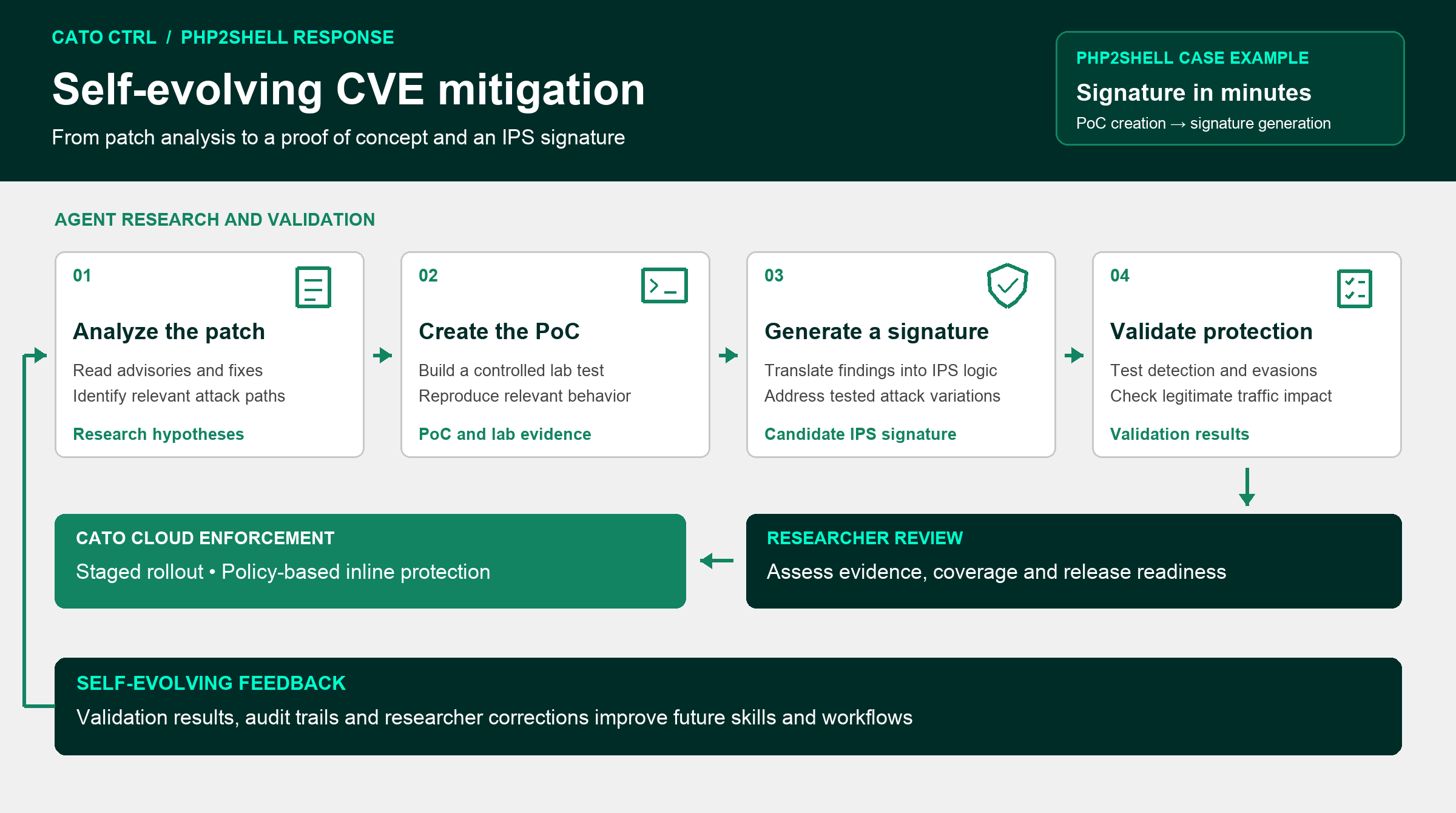
Figure 1. Self-evolving CVE mitigation from patch analysis to PoC, signature and enforcement.
Figure 2 shows a capture from that investigation. The upper pane displays the local PHP2Shell test completion message, and the lower pane shows runtime monitoring and test events. Cato has redacted the detailed outcomes.
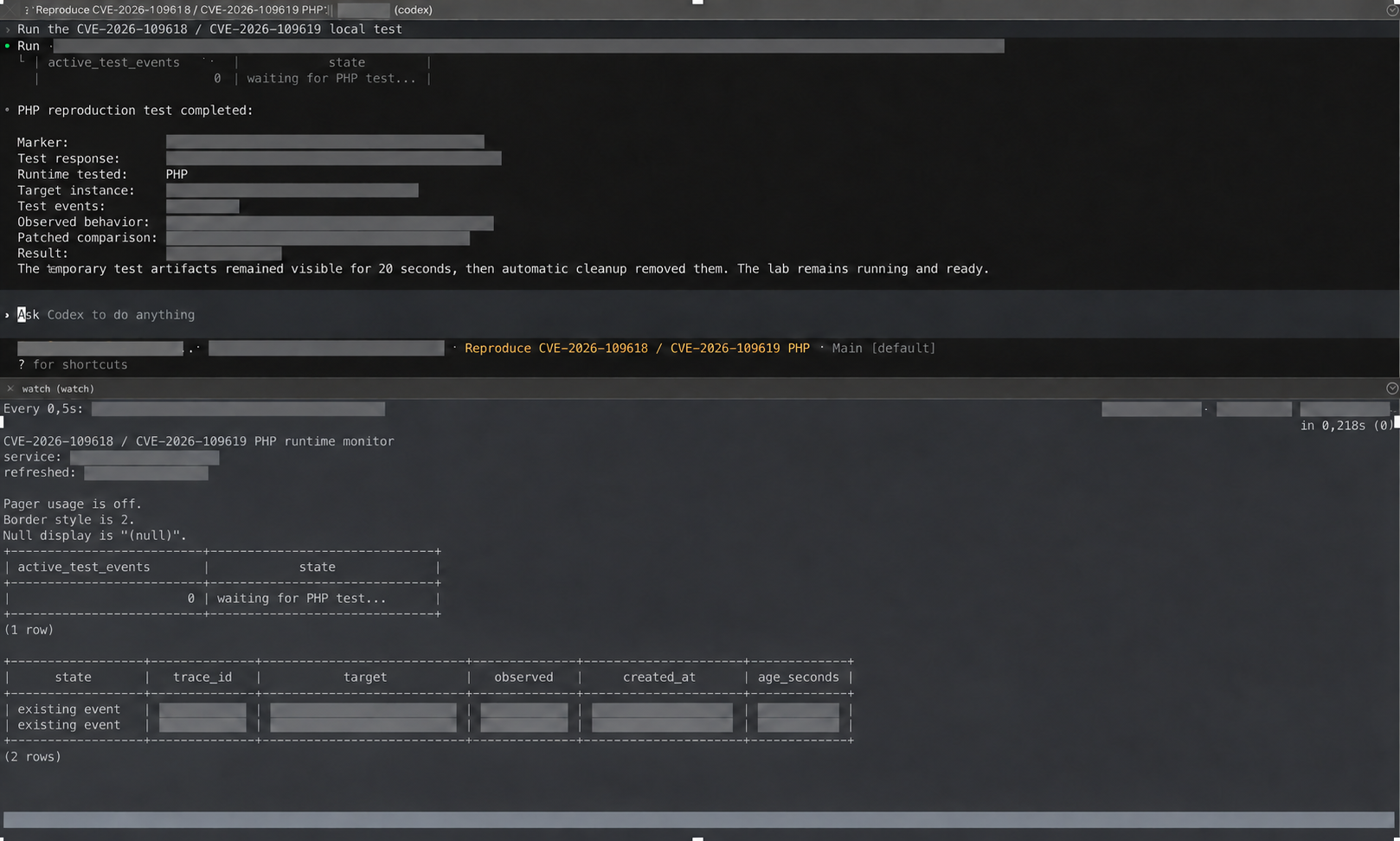
Figure 2. PHP2Shell PoC test and runtime monitoring. Results redacted.
What Cato deployed and what it has seen
Cato reports that its infrastructure assessment found its own production systems are not exposed to PHP2Shell. That finding covers the infrastructure Cato operates, not your estate.
For customers, Cato has added PHP2Shell IPS signatures covering the alleged scenario and the additional behavior found through patch analysis. Per Cato, these signatures block matching exploit requests on traffic inspected by its cloud, provided the applicable signatures are enabled in blocking mode. Customers still need to assess and update affected PHP applications and third-party products. Cato's initial response telemetry showed scanning, with no exploitation attempts identified against customers.
Cato ties this response to its Agentic Threat Prevention (ATP) product. In a separate controlled demonstration against an agentic attacker, Cato says ATP used shared context and inline controls to stop progression to full domain compromise. The PHP2Shell response was narrower: CVE-specific IPS signatures. Cato's framing is that the two examples together show how AI-native SASE can speed up both the creation of protections and adaptive enforcement during an intrusion. That's a vendor claim, and you should test it against your own environment before you rely on it.
Reading the attack path diagram
Figure 3 is an illustrative diagram, not a record of an observed attack. It shows an attacker, Cato's cloud IPS in the middle and a vulnerable PHP service on the right. The red stop mark marks where a matching request would be dropped, but only when payload inspection and the applicable blocking protection are both active. Some exploit paths involve several requests, so a single blocked request doesn't close the path.
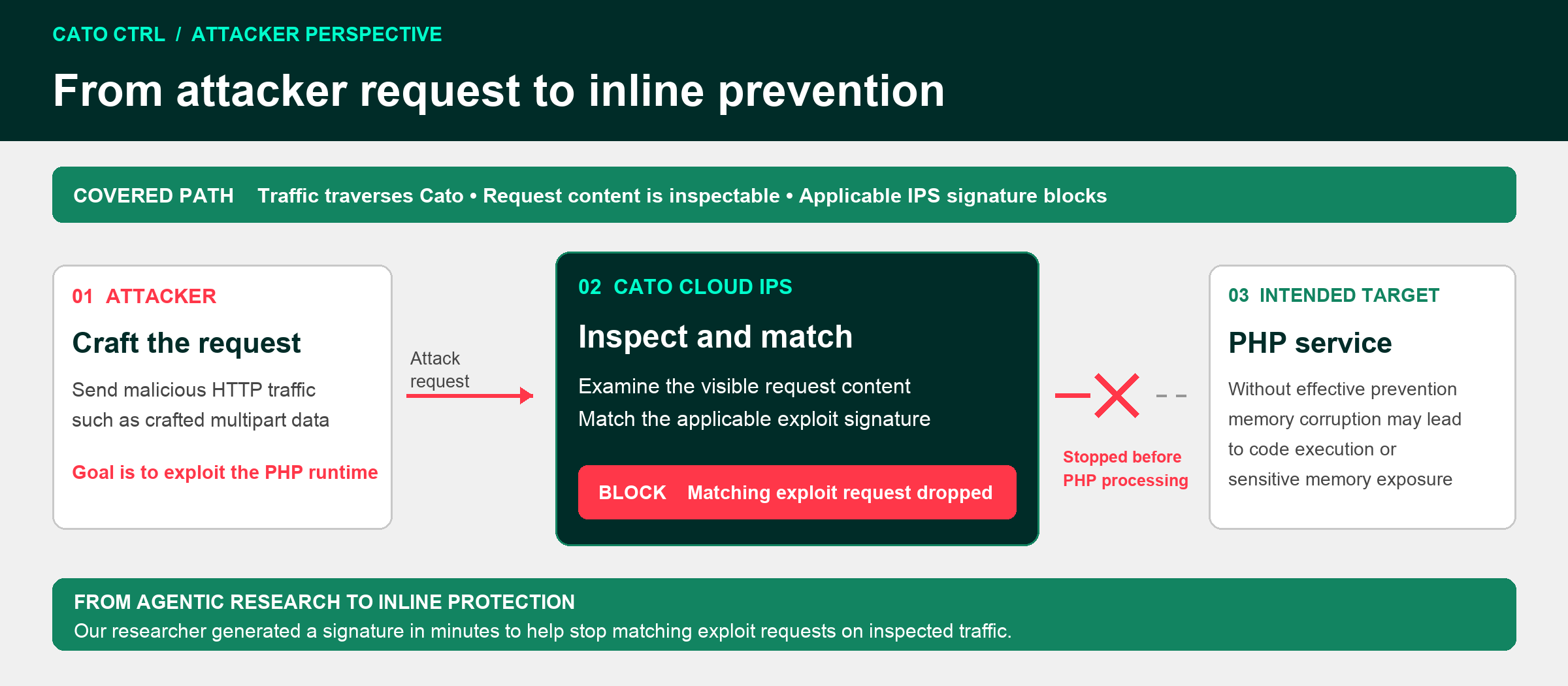
Figure 3. Illustrative PHP2Shell attack path and IPS prevention.
Closing the gaps this week
Start by listing every PHP service that sits outside your inspection coverage. Extend inspection and blocking where your platform supports it. For the gaps you can't cover that way, add an application-layer control such as an inbound WAF configured for PHP2Shell. Then keep updating affected PHP runtimes.
My read is that cloud signatures buy time but don't replace patching. They're bounded by the attack paths Cato tested, and the unresolved discrepancy with the circulated exploit is the detail I'd watch. Expect the PHP runtime updates and any vendor updates for bundled PHP to close the question faster than signatures will.


