PHP2Shell Attempts Started on Patch Day, and Cato IPS Blocked Them
- Dr. Guy Waizel
- 542 views
Cato saw PHP2Shell scanning begin the day PHP shipped fixes for CVE-2026-109618 and CVE-2026-109619, and its cloud IPS blocked the exploit attempts.
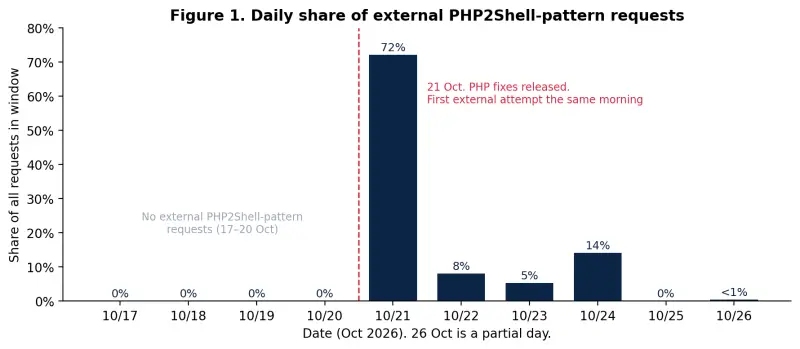
Attackers didn't wait long. Cato's threat research team saw no PHP2Shell-pattern traffic from 17 to 20 October 2026, then scanning and invalid-proof-of-concept attempts appeared on 21 October, the day PHP released fixes for CVE-2026-109618 and CVE-2026-109619. My read is that the patch itself was the trigger, and that anyone still running unpatched PHP was exposed within hours.
Timing: the window closed fast
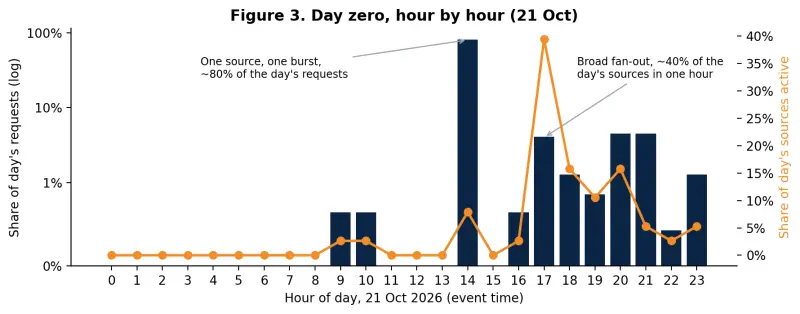
Cato's sample shows roughly 72% of PHP2Shell-pattern requests landing on 21 October. Hour by hour, the day unfolded in two phases. A few early scanning attempts were followed in the afternoon by one source sending a burst that made up about 80% of that day's requests. Later, activity fanned out, with about 40% of the day's sources active within a single hour. That pattern looks like a proof of concept circulating and many operators running it at once.
Cato's first threat brief, Cato AI native SASE delivers PHP2Shell protection at machine speed, described how its self-evolving CVE mitigation agent built a PoC and generated IPS signatures in minutes, with researcher review before release. Those signatures were in place before the attempts in this sample arrived.
Amazon Threat Intelligence reported proof-of-concept exploits circulating on 21 October, and in its own honeypots it recorded a single exploitation attempt on 17 October, four days before public disclosure. Cato saw no comparable pre-disclosure activity in its customer traffic. Amazon's write-up is the reference for that earlier activity.
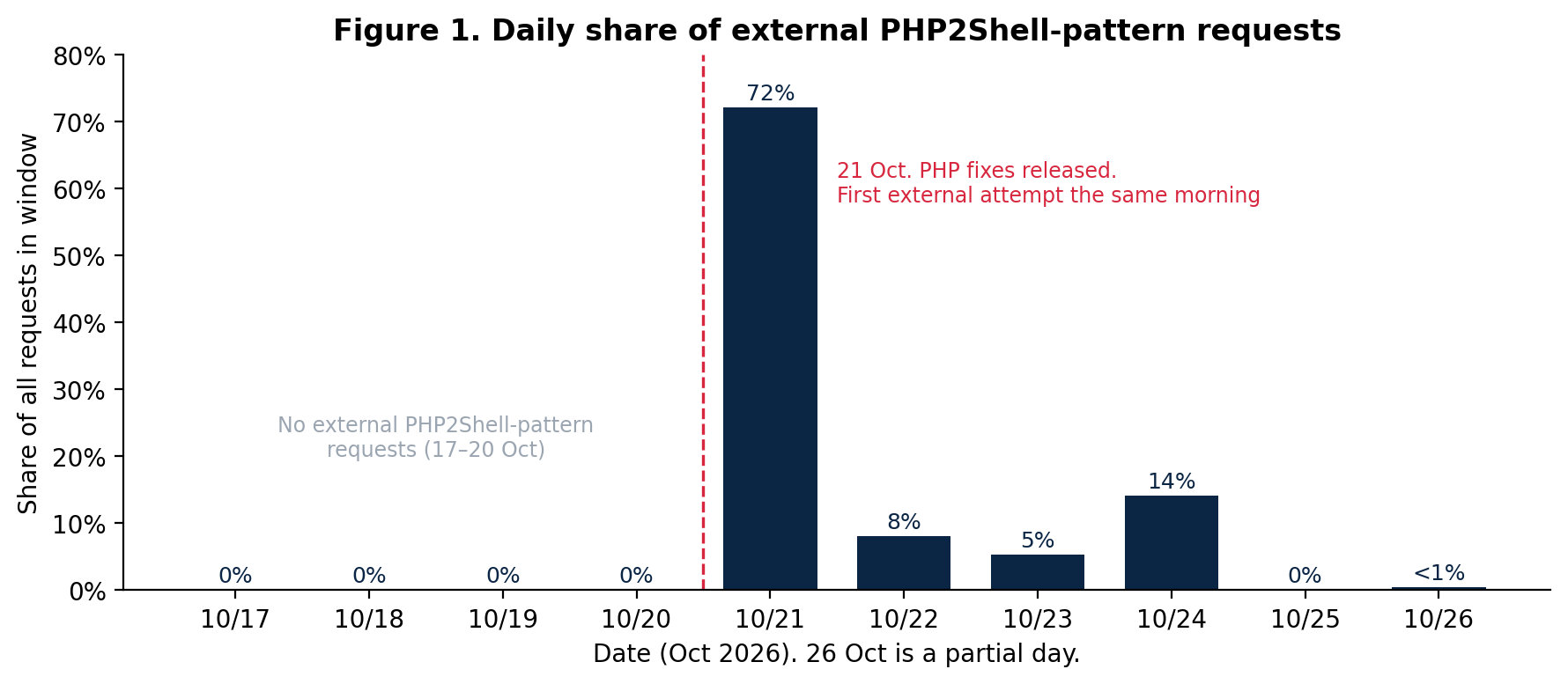
Figure 1. Daily share of external PHP2Shell-pattern requests across the observation window.
Daily totals are spiky because a single noisy scanner can dominate a day. A better gauge of spread is when each source first appeared. About two thirds of all attack sources in the sample first showed up on 21 October, and new sources kept appearing on most days after that.

Figure 2. Attack sources by first-seen date, as a share of all sources observed in the window.
What the attempts looked like
Of the blocked attempts in the sample, about 96% targeted CVE-2026-109618, the out-of-memory flaw, and about 4% targeted CVE-2026-109619. Cato split the blocked traffic into two groups. About 59% were scanning or invalid-PoC attempts, including exploit attempts built on PoCs that wouldn't work against the vulnerable code path. The remaining 41% were exploitation attempts aimed at remote code execution.
Within the exploitation group, command execution was the most common type, followed by deserialization. Cato's researchers also noted that a small number of source IPs generated most of the blocked attempts, repeating PoC-style requests. That's the signature of automated tooling, not hand-run reconnaissance.
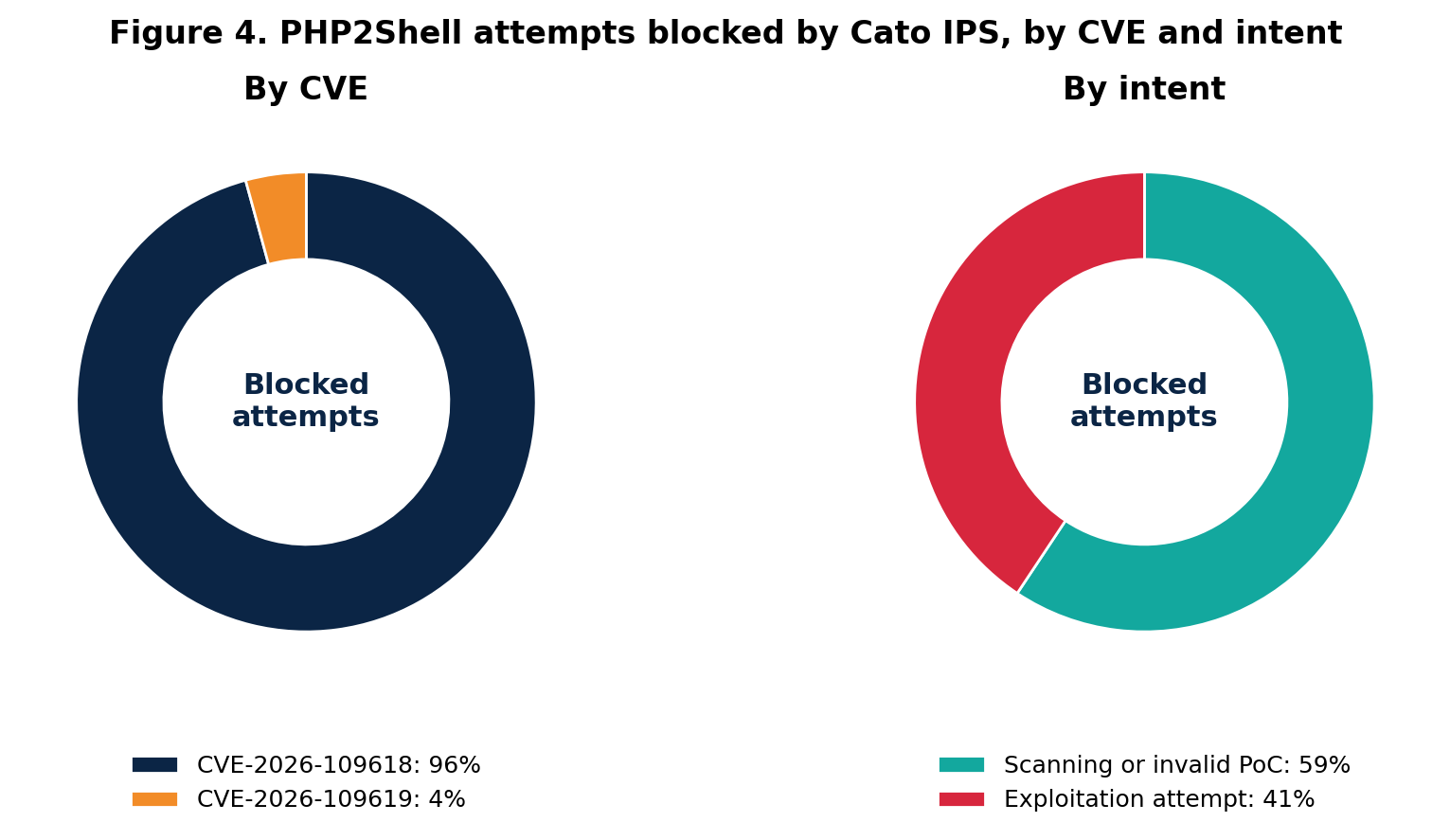
Figure 4. Blocked PHP2Shell attempts by CVE and by intent, based on a sample of Cato telemetry.
Where the traffic came from
By share of source IPs, the United States led at about 36%, with the Netherlands and Germany at about 14% each. By share of blocked attempts, the picture shifts: US-hosted sources accounted for about 54%, the Netherlands about 18%, and Moldova about 16%.
Cato is clear that geography here means where an IP is hosted, not who operates it. Many of these addresses sit with cloud or VPS providers, which makes the country data a description of infrastructure rather than attribution. Cato also cautions that cloud and hosting IPs get reassigned, so an address in its indicator list may not point to the same operator for long.
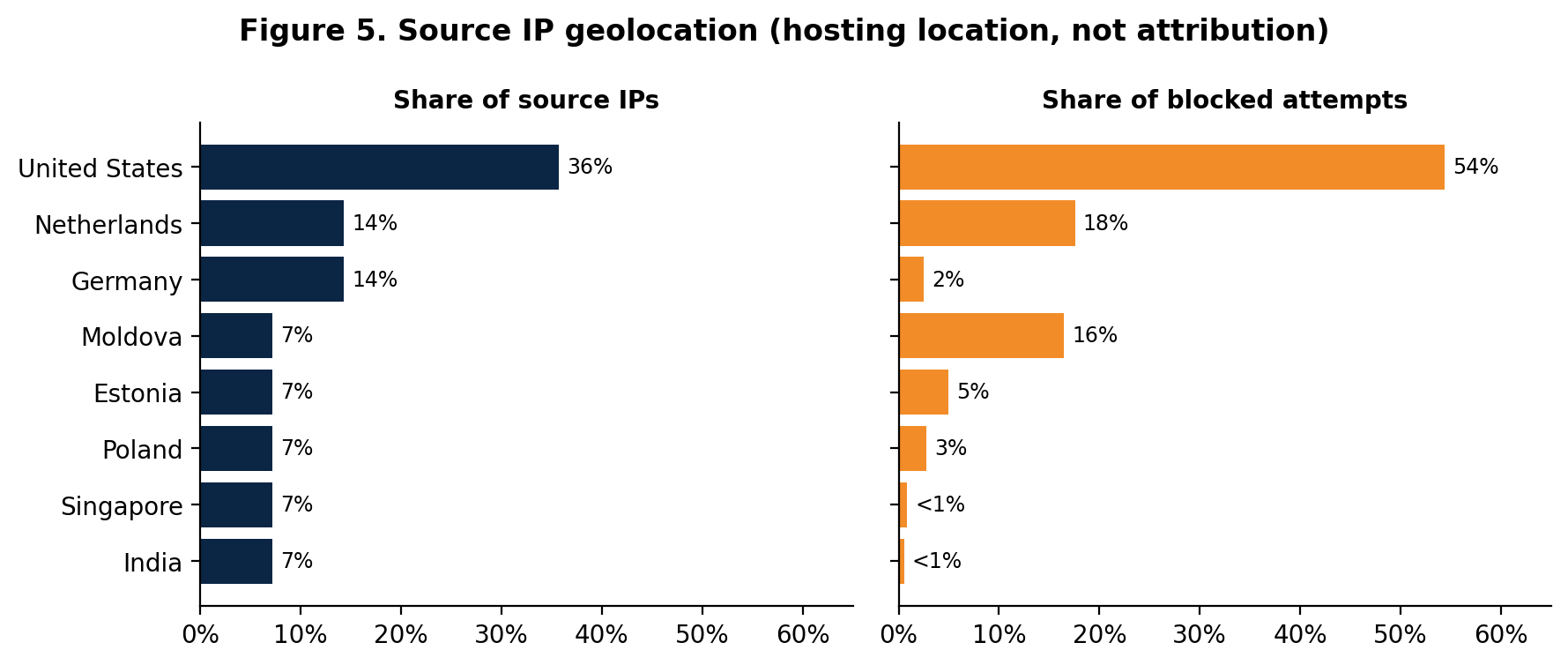
Figure 5. Source IP geolocation by share of sources and share of blocked attempts, based on a sample of sources.
Who was hit, and why healthcare stands out
Healthcare and social care made up about one third of the organizations that received blocked attempts, with technology and security services next. The rest spread across professional services, automotive, education, non-profit and other sectors in several countries.

Figure 6. Industry mix of the organizations that received blocked attempts.
Does that healthcare share mean anyone was singled out? Cato's data says probably not. The same sources hit healthcare organizations and unrelated sectors in different countries, and one source reached healthcare, technology and software organizations on the same day. The sample is small, and the share may partly reflect Cato's customer mix. The more likely explanation is shared technology. PHP-based portals, forms and line-of-business apps are everywhere, healthcare included. If you run PHP, your sector matters less than your exposure.
What to do this week
If you're a Cato customer, you don't need to deploy anything for PHP2Shell protection. Cato says the IPS signatures are delivered and enforced from its cloud. That's virtual patching, and it buys time, but it doesn't close the underlying flaw.
For everyone else, the answer is the same one Cato gives: update every PHP instance to the fixed version the PHP project released. Check Apache mod_php installs first, since Cato identifies that as the highest-risk configuration, where exploitation can happen before any application code runs. Then work through the rest of your PHP estate.
Keep one caveat in mind. This research measures attempts on inspected traffic during the first days after disclosure. It doesn't measure outcomes, so a blocked request tells you the protection worked, not that nothing else got through. A public reporting check is useful too. On AbuseIPDB, independent reporters have tagged one of Cato's sampled addresses, 85.11.167.243, as PHP2Shell activity. None of the sampled sources appear in Amazon's published indicator list, which suggests the two datasets are seeing different slices of the same campaign.
The window between patch and attack has shrunk to a single day in this case. Treat a PHP security release as an emergency change, not something for next month's maintenance window.


