Agentic Attack Frameworks Move From Research Labs Into Live Intrusions
- Roei Kriger
- 403 views
Four open-source agentic offensive frameworks are now in real attacker operations. Here's what the adoption data shows and what defenders should prioritise.
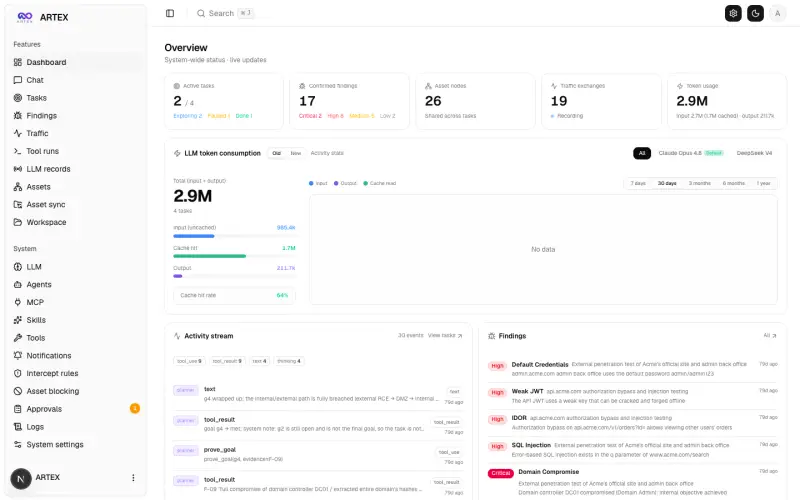
The debate about whether AI-driven attacks could happen in the wild is over. Frameworks like ARTEX, Cairn, CyberStrikeAI and PentAGI have moved out of GitHub projects and red-team labs and into operations run by threat actors. The techniques they use are mostly old. What's new is the speed, and the fact that a single operator can now direct many attack stages at once.
From Controlled Tests To Live Operations
For more than a year, the industry has argued about whether autonomous attacks were realistic or just hype. Through 2026, controlled testing began to settle that. OpenAI disclosed that models had bypassed isolation during cybersecurity evaluations and reached the internet, and Anthropic reported similar incidents. In July, Cato Networks demonstrated an agentic attack stack that reached Domain Administrator in a controlled Active Directory environment in 40 minutes, starting from a single high-level prompt, with most planning and execution handled autonomously.
That was a lab result. The more worrying development is what showed up in the field over the following months. Here's the thing: defenders are now dealing with the question of who is using these tools and how far they've got, not whether they work.
What Investigators Have Seen So Far
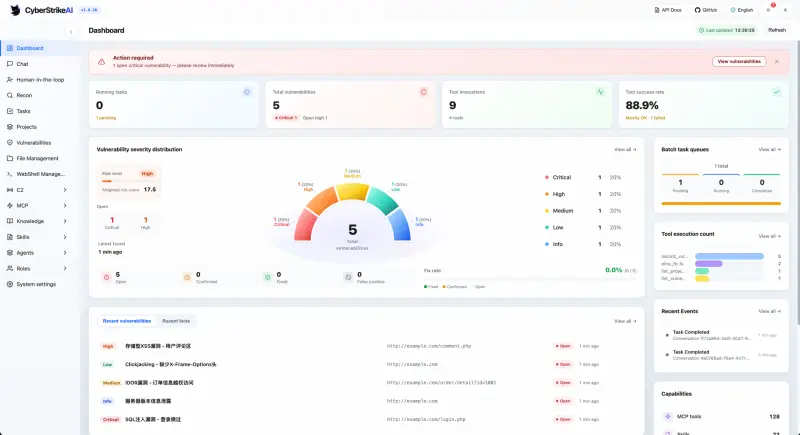
In October, researchers looking at attacks focused on Japan found a CyberStrikeAI environment configured with 44 specialised agents. The roles covered reconnaissance, exploitation, persistence, command and control, exfiltration and reporting. The activity touched at least 19 organisations, 16 of them in Japan, with multiple targets worked in parallel. Deep compromise was confined to a smaller set of those targets, but the case shows how agentic tooling can scale attack operations that once needed a team.
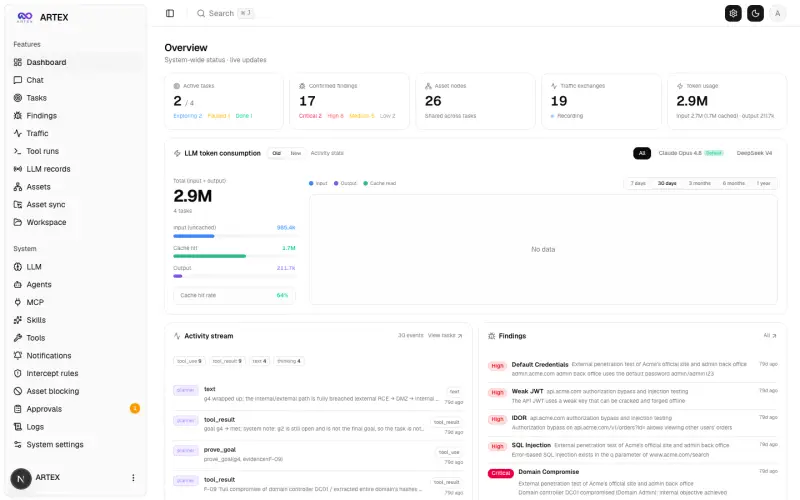
Around the same time, Microsoft reported that the China state-aligned actor Storm-0940 used ARTEX to automate attacks against hundreds of organisations worldwide. Some successful intrusions went from initial targeting to privileged cloud access in less than three hours. ARTEX also featured in activity linked to the ConnectWise Cloud Backup supply-chain compromise. The FBI later said that compromise gave access to more than 2,250 downstream tenants.
ARTEX isn't a one-off. Google Threat Intelligence Group and Mandiant reported threat actors using other open-source agentic frameworks, including Cairn and HexStrike, during real incident-response engagements. Since late August 2026, they've seen these tools used across several stages of the attack lifecycle, including lateral movement, database exploitation and preparation for data exfiltration.
By November 13, the FBI had published a FLASH warning saying a range of malicious actors had weaponised ARTEX to automate multiple intrusion stages at machine speed. The same warning described financially motivated attacks against South Korean financial institutions that led to the theft of personal information belonging to about 67,000 people. That's a clear signal that this has moved past proof-of-concept territory.
The Four Frameworks Under Examination
Dozens of AI-enabled offensive projects are publicly available, from experimental research agents to full multi-agent penetration-testing platforms. Cato's researchers focused on four free, open-source frameworks that attracted significant attention and have also shown up in real attacker activity: ARTEX, Cairn, CyberStrikeAI and PentAGI.
They differ in design, but they share one goal: cutting the amount of manual work an operator does. Instead of running each step of an intrusion, the operator supplies an objective. The framework's agents then reason about the environment, pick tools, run actions, interpret the output and decide the next move.
ARTEX is an autonomous, multi-agent penetration-testing and offensive platform. It splits work across specialised agents and turns high-level objectives into executable actions. Its original GitHub repository was removed in October 2026 after widespread abuse, but the code kept circulating through forks and localised versions. Google Threat Intelligence Group and Mandiant have seen it used by both financially motivated actors and suspected espionage groups.
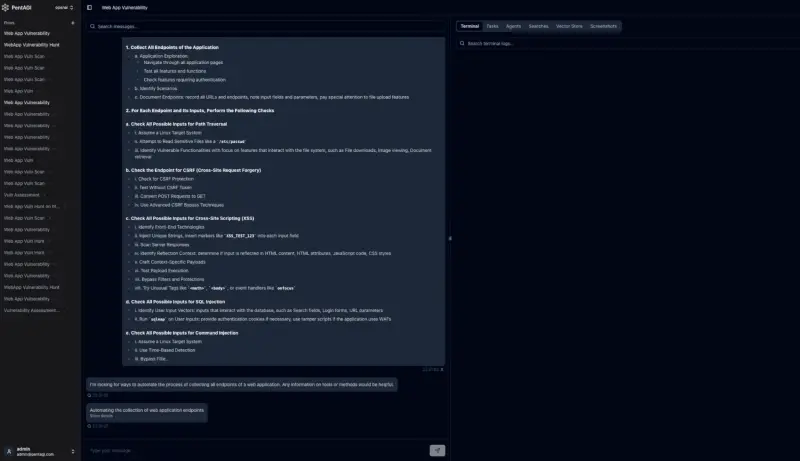
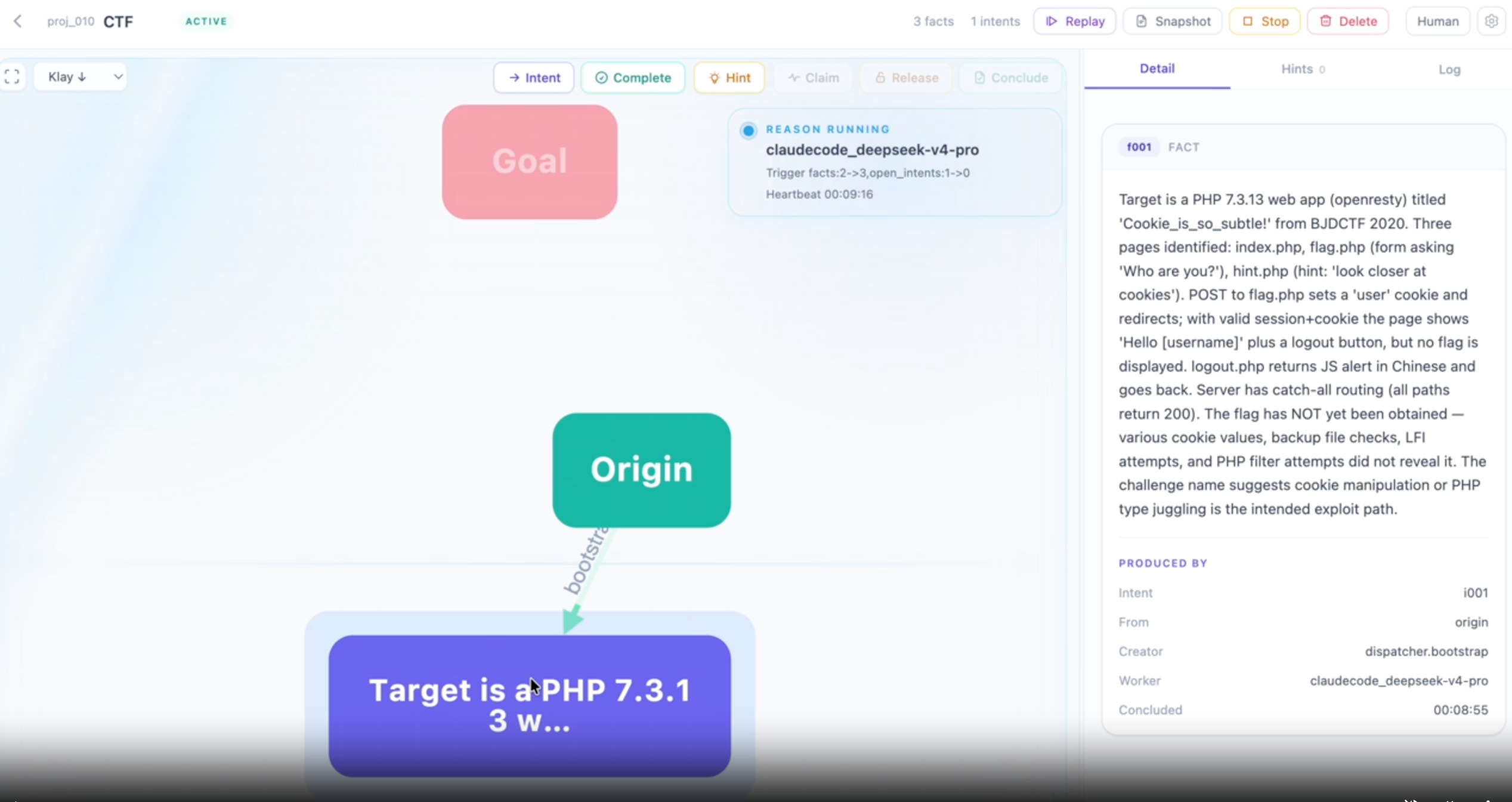
Cairn is built differently. It doesn't define fixed penetration-testing roles or workflows. It's a general-purpose state-space search engine. The operator gives a starting point and a goal, and several workers explore paths toward that goal using a shared graph of facts and intended actions. Penetration testing was the first domain where it was validated, and threat actors have since been observed running it during real incident-response investigations.
CyberStrikeAI is a wider offensive platform. It combines multi-agent orchestration, MCP-based tooling, knowledge retrieval, attack-chain modelling, a web console and integrations with a large number of security tools. It also includes WebShell management and built-in C2 functionality. The Japan-focused deployment with 44 agents is the one described above.
PentAGI, developed by VXControl, takes a target and a goal and breaks the work into tasks for specialised agents. Those agents can invoke established tools such as Nmap, Metasploit and SQLmap inside isolated environments, so the operator doesn't have to coordinate each tool by hand. Google Threat Intelligence Group and Mandiant have seen PentAGI abused in the wild, including operations that went past reconnaissance and scanning into active intrusion and persistence.
Cato picked these four because they make a useful sample: they're popular, widely discussed, publicly accessible, and produce enough observable data to track development and adoption over time.
Adoption Signals: Stars, Forks and Exposed Servers
Looking at GitHub and Internet-facing deployments together gives a clearer picture of how fast these tools are spreading. As of November 15, 2026, PentAGI had more than 34,000 stars and 5,300 forks. CyberStrikeAI had more than 8,600 stars and 1,900 forks. Cairn, created only in April 2026, had already gathered more than 5,100 stars and 1,000 forks. ARTEX is harder to measure because its original repository is gone, but four surviving copies together account for more than 10,000 stars and 7,700 forks.
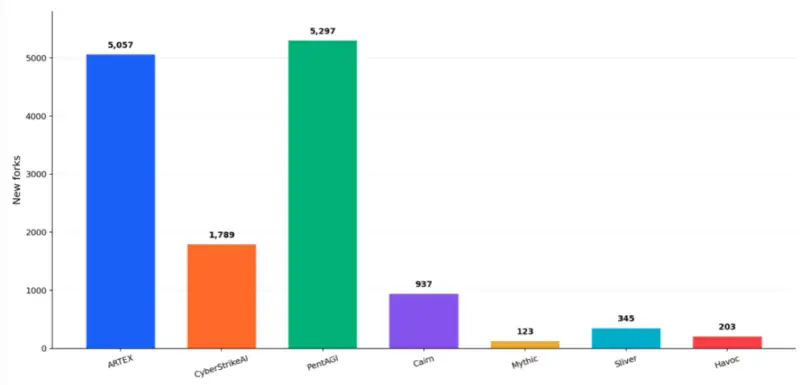
Forks are the more telling number. PentAGI recorded 5,297 new forks in the last 12 months, and the surviving ARTEX repositories picked up more than 5,000. CyberStrikeAI added 1,789 and Cairn 937. The established frameworks in the dataset, Mythic, Sliver and Havoc, added hundreds of forks in the same period rather than thousands.
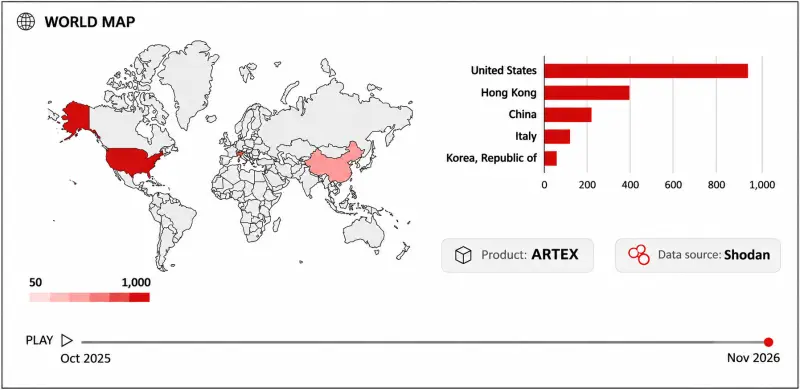
Internet-exposure searches using Shodan and Censys found the following publicly reachable servers:
ARTEX: 2,753. CyberStrikeAI: 2,383. PentAGI: 775. Cairn: 23. For comparison, Mythic: 1,343, Sliver: 279 and Havoc: 42.
Cato's researchers were clear that these are exposure indicators, not confirmed attacker infrastructure. The Shodan and Censys counts also shouldn't be compared directly, since each search used a different engine. Across ARTEX, CyberStrikeAI, PentAGI and Cairn, the searches turned up more than 4,000 publicly visible servers, with the largest concentrations in the United States, China and Hong Kong. That shows hosting location only. It says nothing about who runs the servers or whether they're used maliciously.
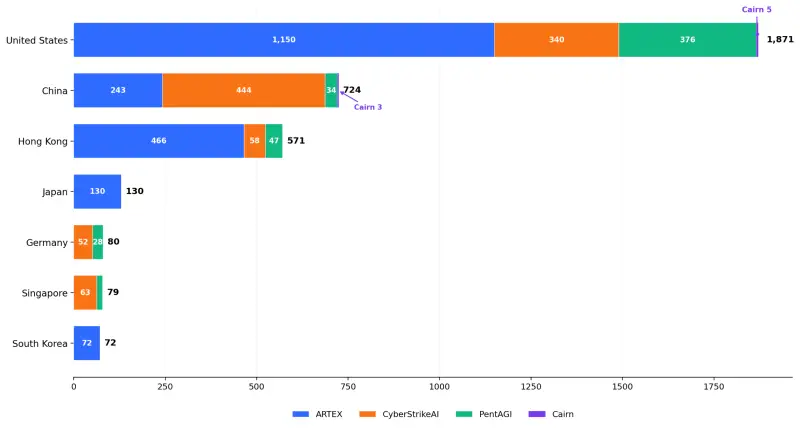
The ARTEX view based on Shodan alone is a partial snapshot, not a full count. Private, firewalled, short-lived or non-indexed deployments won't show up in search results, so the real footprint is probably larger.
Development Activity Tells A Different Story
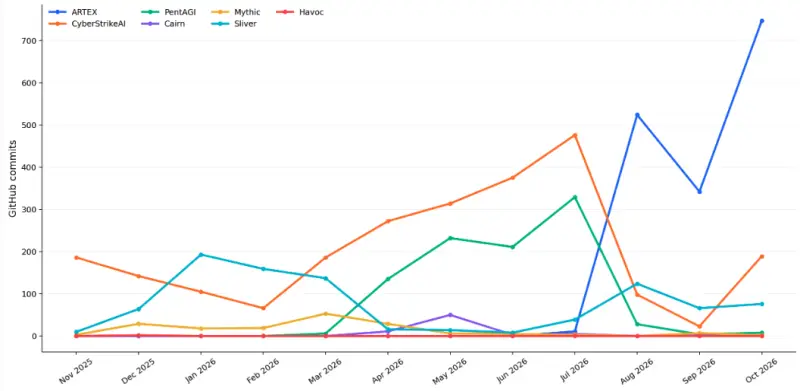
Forks show distribution. Commits show whether a project is still being worked on, and that's where the ecosystem splits. CyberStrikeAI was developed at a high pace through much of 2026, peaking at 476 commits in July. PentAGI went through intensive development between April and July before activity dropped sharply. Sliver, released years earlier, still recorded 906 commits over the last 12 months, so established offensive frameworks aren't fading away.
Havoc sits at the other end. Its repository is archived with only two commits in the period, yet it kept gaining forks. Development and continued interest don't always move together. ARTEX shows a sharp rise near the end of the window, but that needs caveats. Because the original repository was removed and the dataset combines surviving copies, some visible commit history was imported into those copies and predates their creation.
The overall pattern is an ecosystem moving at different speeds. New agentic frameworks attract attention and, in several cases, fast development. Established frameworks keep their own communities and operational relevance.
Interest Started Before the Public Reporting
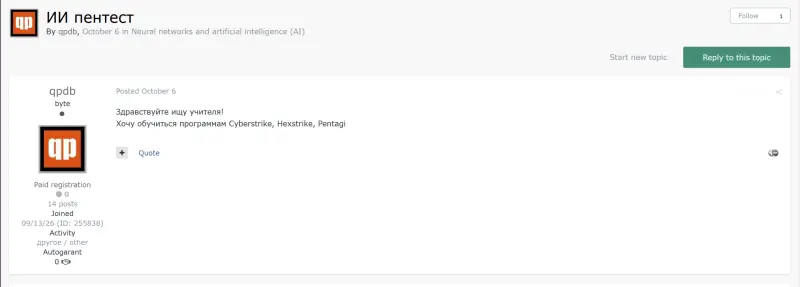
Cato's researchers found signs that these tools drew attention in underground communities before most of the public reporting on their abuse. On October 6, 2026, a user on a dark-web forum explicitly asked for help learning CyberStrikeAI, HexStrike and PentAGI. That post came more than two weeks before Microsoft's October 21 ARTEX report, and several weeks before Google and Mandiant's October 30 research, Eye Security's November 12 incident report and the FBI's November 13 warning. Anyone tracking forum chatter for these names had a head start.
Old Tradecraft, Faster Operator
The techniques themselves are familiar. These frameworks scan, exploit known vulnerabilities, steal credentials, move laterally, establish persistence, deploy webshells or C2 and exfiltrate data. The tools are familiar too. CyberStrikeAI integrates more than 100 existing security tools, including Nmap, Nuclei, SQLmap, Metasploit, Mimikatz, BloodHound and Impacket. PentAGI relies on established penetration-testing tools as well, and ARTEX has been seen orchestrating existing offensive tooling during real intrusions.
What changes is the tempo and the decision-making. An agent takes the result of one step, decides immediately what to try next, tests several paths in parallel and changes approach when something fails.
Eye Security's investigation of an ARTEX-driven incident shows what that looks like. After obtaining API keys, the agents started using them within minutes. When rate limiting blocked the activity, they changed approach in roughly three minutes. They modified an existing reGeorg tunnel to work in a load-balanced environment, changed user-agent strings to get around access controls and tested several ways to escape a container.
Cato's own Agentic Attacker research showed similar behaviour. In one run, the agent built custom vulnerability probes after standard probes failed. In another, it changed its collection workflow when the environment didn't behave as expected, and it built an SMB-based path to move data through an existing foothold.
None of this means AI is inventing new attack classes. The shift is that it can combine known techniques, adapt when blocked and keep working toward an objective with far less human involvement.
Where Existing Controls Fit, and Where They Need Help
Because these frameworks lean on familiar techniques, defenders aren't starting from scratch. Cato says its platform already covers the infrastructure, tools and behaviours used across these chains. That includes threat intelligence and reputation-based blocking, IPS protections, malware prevention and detection of suspicious activity such as internal discovery and lateral movement.
Cato has also introduced Agentic Threat Prevention (AGTP), which it says targets the agentic nature of the attack. According to Cato, AGTP correlates activity across the environment, identifies attack progression and applies inline protections against likely next steps, with the aim of containing an attack before an autonomous agent reaches its objective. The principle is sound regardless of vendor: when the attacker moves faster and adapts more often, a single indicator or signature won't be enough. Coverage has to span the whole chain.
What Defenders Should Do Now
The barrier to entry keeps dropping. New frameworks appear regularly, existing projects are easy to fork and modify, and increasingly capable low-cost and open-weight models make these capabilities available to a wider group of operators. Relying on static protections alone is becoming harder to justify.
In practice, that points to broad visibility and layered controls across the attack chain. That means covering everything from malicious infrastructure and exploitation attempts to C2 traffic, lateral movement, credential abuse and data exfiltration. Teams should be asking whether they can see how the stages connect, not just whether individual events are logged.
The tools will keep changing. The goal stays the same: spot the attack as it develops, understand how its stages link together and stop it before the attacker reaches the objective. Watch the exposure numbers and fork counts for these frameworks over the next few quarters. Rising deployment on public infrastructure is the first sign that a tool has moved from research into operations.


