Java4Shell: Why a Base64 Decoder Bug Belongs in Your Enterprise Risk Register
- Dr. Guy Waizel
- 628 views
Java4Shell (CVE-2026-114938) is a heap-corruption flaw in Java's Base64 decoder. Exposure depends on specific CPUs, enabled code paths and untrusted input.
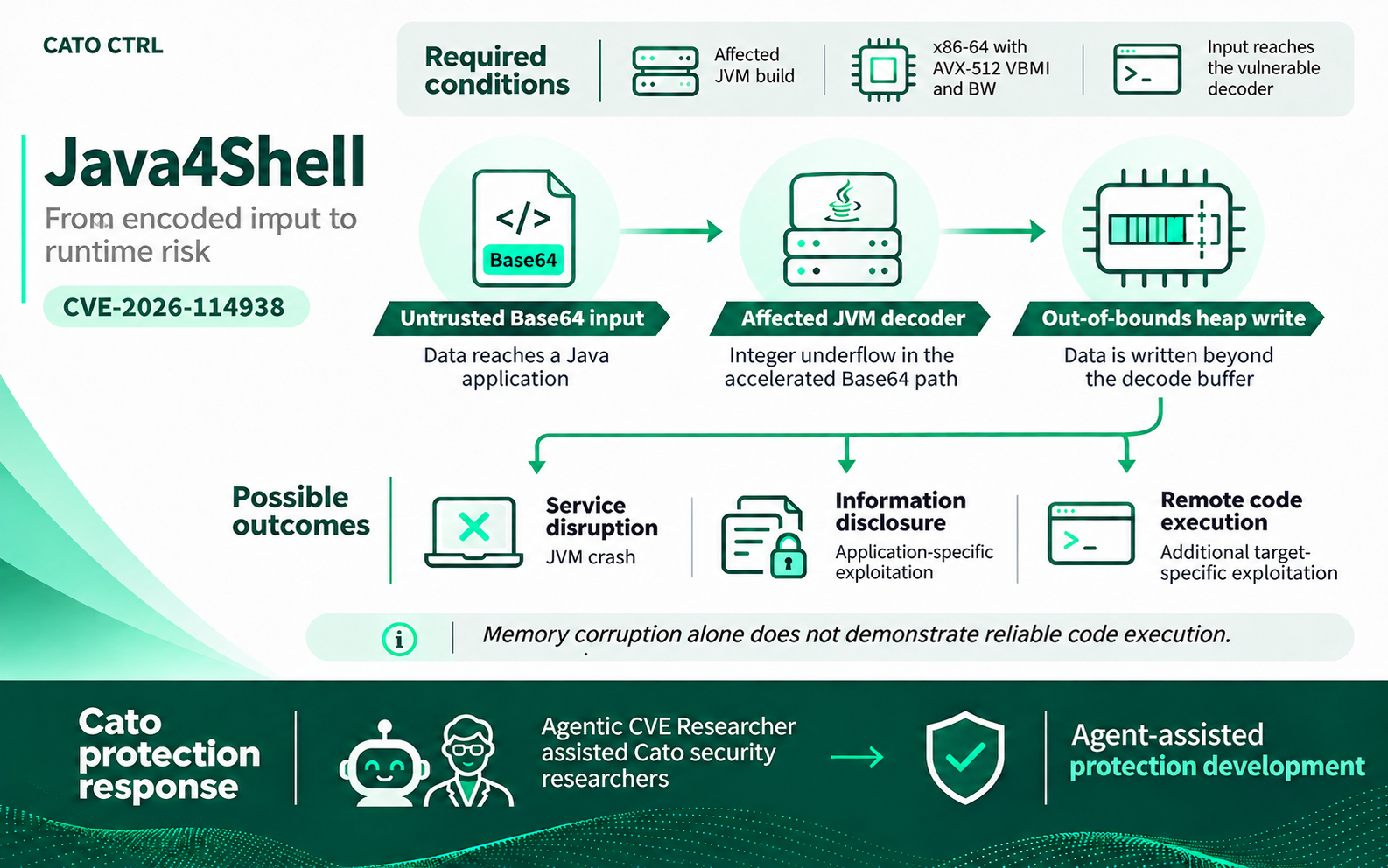
A memory-corruption bug in a decoder usually lands low on the ticket queue. Java4Shell (CVE-2026-114938), disclosed on 17 November 2026, deserves a closer look, because the conditions for exposure are narrow but the consequences depend heavily on what your Java services can reach. My read is that most teams can scope their exposure quickly, but only if they know which JVMs run on which hardware.
What the flaw needs before it matters
The bug sits in Java's accelerated Base64 decoder. When malformed input reaches the affected HotSpot decoder, an integer underflow produces an out-of-bounds heap write. That's the memory-corruption primitive behind the crashes and the more serious research findings.
Exposure isn't universal. The source material requires all of the following:
An affected JVM is in use.
The processor is x86-64 with the relevant AVX-512 features, specifically VBMI and BW.
The vulnerable decoding path (the intrinsic) is enabled.
Untrusted input can reach that path.
ARM systems don't execute this path, according to the research summarised in the advisories. That single condition can take a large share of cloud-native workloads off the list, but it doesn't clear x86-64 fleets, so don't assume architecture alone settles the question.
What researchers have shown so far
The published work separates crashes from code execution. VulnCheck reproduced crashes, but reliable code execution needed additional target-specific exploitation. That distinction matters for triage: a crash is a availability problem today, while code execution is a different severity class.
Calif went further and demonstrated exploitation against Keycloak, Jenkins, Jira and Artifactory in specific environments. It also described a client-side route in which a Java client connects to a malicious TLS server. These results show what's possible under particular configurations. They don't establish that every deployment of those products is vulnerable.
On the threat side, Talos had not observed exploitation in the wild as of its 17 November advisory. The reported research demonstrates potential impact, not evidence of widespread compromise. Treat that as a snapshot, and keep watching for updates from the vendors and researchers involved.
How the business impact breaks down
The consequences depend on what the affected application is allowed to do and what it's connected to. Here's the thing: the same bug can be a nuisance on a internal reporting tool and a serious incident on an identity provider.
Crashes can interrupt sign-ins or transactions. Memory disclosure could expose tokens and keys held by the process. Code execution may open a path to connected systems, which is why the service's network reach and credential scope matter as much as the patch level. A Java service with broad outbound access and long-lived secrets sits at the top of the list.
Cato's protection approach
Cato says its Agentic CVE Researcher helped accelerate protection development for Java4Shell, working alongside Cato security researchers. According to Cato, the workflow combines agent-assisted vulnerability analysis and protection generation with validation and human researcher review. Those claims come from the vendor, and the useful question for your team is whether the protection shortens your own exposure window on the traffic you actually inspect.
On Cato's description, Cato IPS can block exploitation attempts that match the deployed protection when requests target a vulnerable Java service. Inspecting malicious content inside HTTPS requests requires TLS decryption, so teams that don't decrypt traffic should expect gaps in coverage for encrypted payloads.
The infographic walks through the flaw and its possible outcomes, then shows how agent-assisted research added protection. More detail on the research process is in Cato's Agentic CVE Researcher post.
Network controls that reduce exposure
For private Java services, Cato says its firewall policies and ZTNA can restrict which users and systems reach the application. LAN firewall segmentation can limit access from other local devices. None of these controls patches the bug, but they cut down the number of users and machines that can deliver malicious input to the service in the first place.
The client-side route calls for a different control. Restricting unnecessary outbound connections reduces the chance that a Java client reaches a malicious TLS server. That's a sensible default for any service account, whatever the outcome of the Java4Shell assessment.
A practical sequence for the change window
Start with inventory. Identify which JVMs are running, which hosts use x86-64 processors with the relevant AVX-512 features, and which services accept data from untrusted sources. Then rank those services by privilege and connectivity, since a crash-only exposure and a code-execution exposure call for different urgency.
Next, coordinate runtime updates with application owners. Cato's guidance, as described in its materials, is to focus first on business-critical Java services and to schedule vendor-recommended runtime updates with the people who own those applications. Interim network restrictions can buy time on services that can't be patched immediately.
Finally, watch for symptoms. Repeated JVM crashes or relevant security alerts should be correlated with application and network logs to decide whether deeper investigation is needed. A crash in isolation may be a stability issue; the same crash alongside unexpected outbound connections is a different conversation.
Where central protection fits
Java4Shell remediation involves application owners, runtime suppliers and whoever runs the deployment environment. Cato describes its centralised architecture as a way to distribute protections and enforce access policies across covered users, sites and cloud resources while application owners plan and test runtime updates. The benefit, on that description, is a shorter and more consistent protection window across inspected traffic.
Central protection doesn't replace the runtime update. It buys time and narrows the blast radius while the update works its way through change control. Confirming coverage on the traffic you inspect, and closing the loop on the JVM patches themselves, is what finishes the job. Expect more published research as teams test the Java4Shell conditions in their own environments, and plan to revisit your exposure list when it arrives.


