Malicious Google Ads Push Fake Claude Code, Codex and Homebrew Installers to Developers
- Dr. Guy Waizel
- 329 views
Malicious Google ads impersonating Claude Code, Codex and Homebrew share backend domains, Cato Networks finds, tying some lures to AMOS-associated delivery.
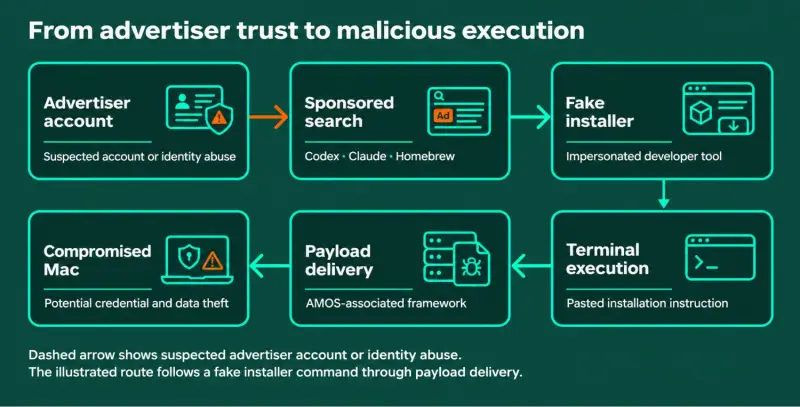
Developers are an attractive target for this kind of lure because they expect to paste install commands. A search for a popular CLI tool, a sponsored result that looks right, and a one-line terminal instruction is a normal workflow for them. Cato Networks researchers have now tracked a set of paid search ads impersonating Claude Code, OpenAI's Codex and Homebrew, and the most useful finding is not any single fake site. It's that several of these lures point to the same downstream domains, which links parts of the activity together.
My read is that this is less about one clever ad and more about a repeatable pattern: a familiar brand, a short command, and a delivery chain that hides what runs on the Mac. Here's the thing: the ads themselves rode on advertiser identities that had nothing to do with developer tools. That detail matters for anyone who runs a developer fleet and assumes sponsored results are a safe place to start an install.
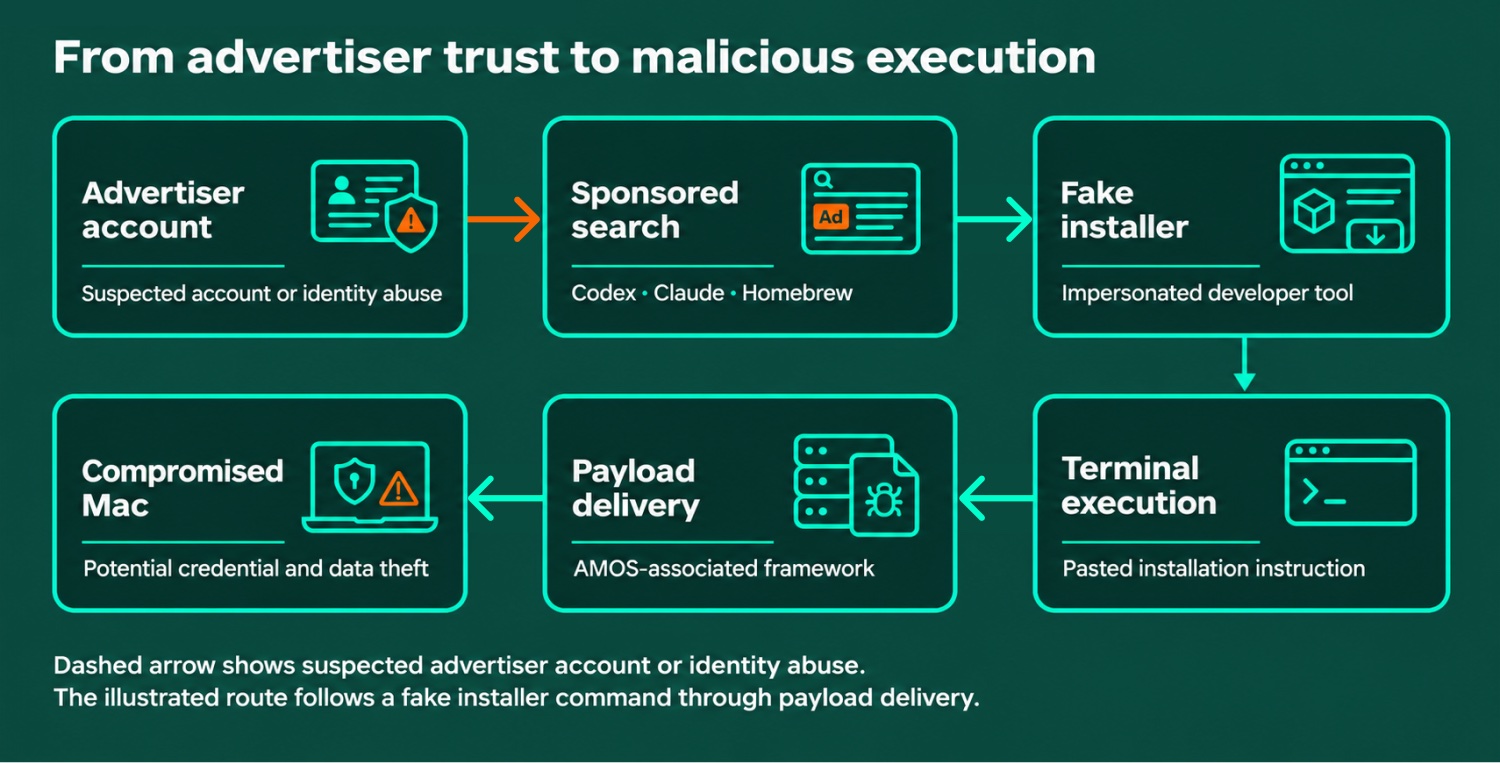
Figure 1. Illustrated command-based route from a sponsored search result through a fake developer-tool installer to payload delivery.
Developer tool ads under unrelated business identities
The first thing that stood out was a mismatch. Ads for developer tools were running under advertiser identities tied to real businesses that sell unrelated products. Cato checked those businesses through company websites and independent reviews, so the businesses are real. In one example, a health and nutrition advertiser's profile showed its own product promotions alongside a malicious Codex ad, and the Codex ad still carried fragments of health-product wording.
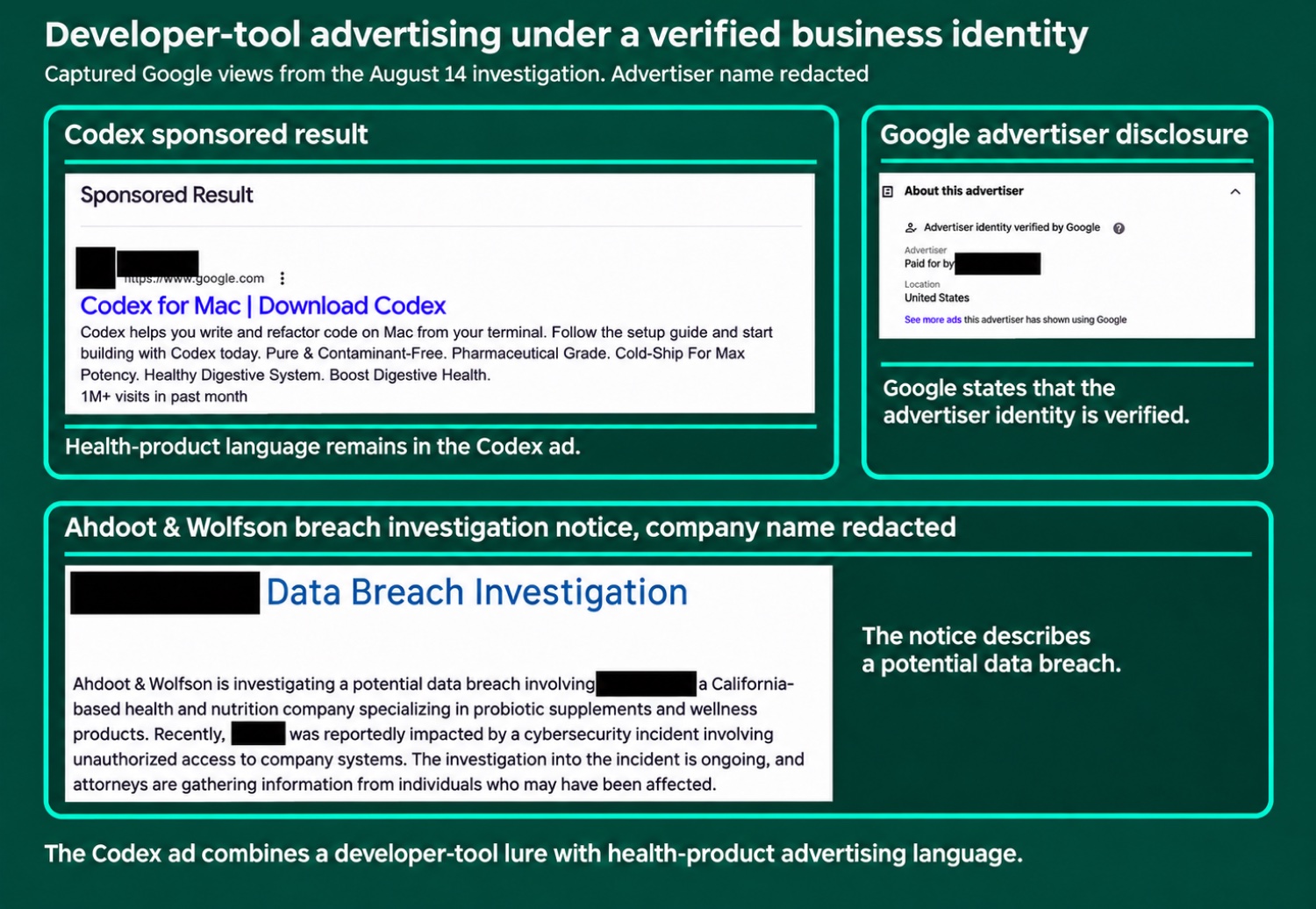
Figure 2. Captured Codex ad and Google advertiser disclosure showing a developer-tool promotion under a health-and-nutrition business identity. The lower panel reproduces a separate potential-breach investigation notice. Names are redacted.
That mismatch supports a suspicion of account or advertiser-identity abuse, but it doesn't prove it. Cato is clear that a separate notice on the advertiser's page doesn't establish that the Google Ads account was compromised or that the notice relates to the malicious ad. Google's advertiser identity verification doesn't confirm compromise either. The advertiser may well be a victim. Malwarebytes has documented attackers phishing advertiser accounts and using them to run malicious ads, which is a plausible mechanism for what Cato saw. It still doesn't tell us who placed these particular ads.
Selective delivery through redirects
Following a sponsored result for "claude code mac download" led through a Google redirect to parentpreneurx[.]com. The landing page presented Claude's installation as a single command. That's the core of ClickFix-style social engineering: the page doesn't install anything itself. It persuades the user to copy a command and run it, which turns the user into the execution step.
The same chain behaved differently depending on the visitor. Under some access conditions it served the installation lure, and under others it returned benign content. That fits traffic cloaking, where different visitors see different pages. It makes investigation harder, and Cato's observations don't isolate which visitor trait triggered the difference.
The Homebrew cases showed similar Google /url redirects to homebrexwin[.]com and storageprofiler[.]com. Two of the captured requests included a source=gmail parameter, and one omitted it. The Claude request used the q parameter for its destination and carried Google Ads tracking parameters. Cato is careful here: source=gmail doesn't mean the visitor came from Gmail, and it doesn't show that a Gmail account or Google's redirect service was compromised. The redirect similarities justified further digging, but they weren't the strongest evidence. That came later.
Shared infrastructure ties Claude and Codex lures together
The central finding is that several sites impersonating different developer tools referenced the same downstream domains. Infrastructure records link Codex and Claude lures through basequill9[.]com and stride25[.]com, and a separate pair of Codex sites shares plume-compass[.]com. These add to a connection Cato had already reported between the Codex lures and grove-satin[.]com.
Domain reuse is the strongest signal in this set. Shared CDN addresses and similar page designs are much weaker, because thousands of unrelated sites can sit behind the same edge network. Cloudflare, for instance, can sit between a visitor and a website, so a shared address tells you about hosting, not ownership. Cato's table lists 188.114.96[.]9 and 188.114.97[.]9 as shared Cloudflare addresses, and it treats them as hosting context only.
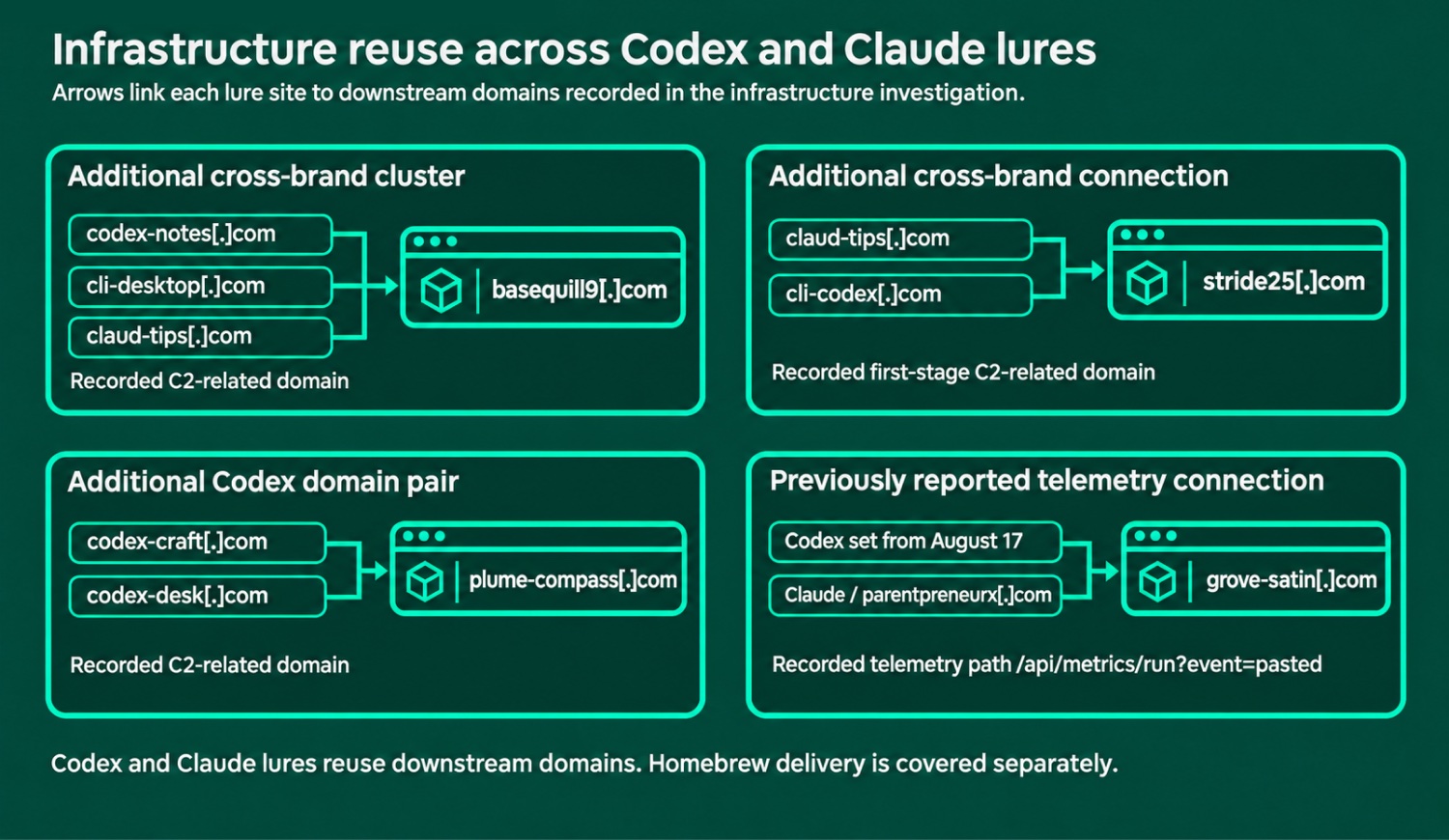
Figure 3. Mapping of Codex and Claude lure sites to reused downstream domains, showing the additional cross-brand connections alongside the previously reported telemetry link.
| Observed sites | Shared infrastructure | What the connection supports |
| codex-notes, cli-desktop, claud-tips | basequill9[.]com, recorded as C2-related | Links Codex and Claude lures. Exact traffic role needs validation. |
| claud-tips and cli-codex | stride25[.]com, recorded as first-stage C2-related | Another connection across Claude and Codex lures. |
| codex-craft and codex-desk | plume-compass[.]com | Links this pair of Codex sites. |
| Previously reported Claude and Codex connection | grove-satin[.]com, /api/metrics/run?event=pasted, similar staged-loader behavior | The earlier reference connection. |
| Several Codex and Claude hosts | Shared Cloudflare addresses, including 188.114.96[.]9 and 188.114.97[.]9 | Hosting context only. Shared addresses are weak attribution evidence. |
| Homebrew redirect cases | Google /url redirects and ad-tracking parameters | Similar distribution method, no demonstrated shared C2. |
| claude-tools | kmtxyn[.]com/agent, native-payload download | Separate JXA chain, no shared domain linking it to the Claude and Codex cluster. |
| nomeibrew and pirloz | Settings API and a separately documented application-based delivery chain | Additional delivery evidence. Connection to the Claude and Codex cluster unconfirmed. |
These overlaps suggest portions of the Claude and Codex activity are related. They could come from one operator, shared tooling, or a common distribution service. The shared domains can't tell those apart, and that's the honest limit of the evidence.
The Claude loader, step by step
The Claude case shows how the infrastructure link works in practice. The fake installation page asked visitors to run one command, which looks routine to anyone who installs developer tools. Behind it, the chain reused grove-satin[.]com, which also appears in Codex infrastructure records from August 17.
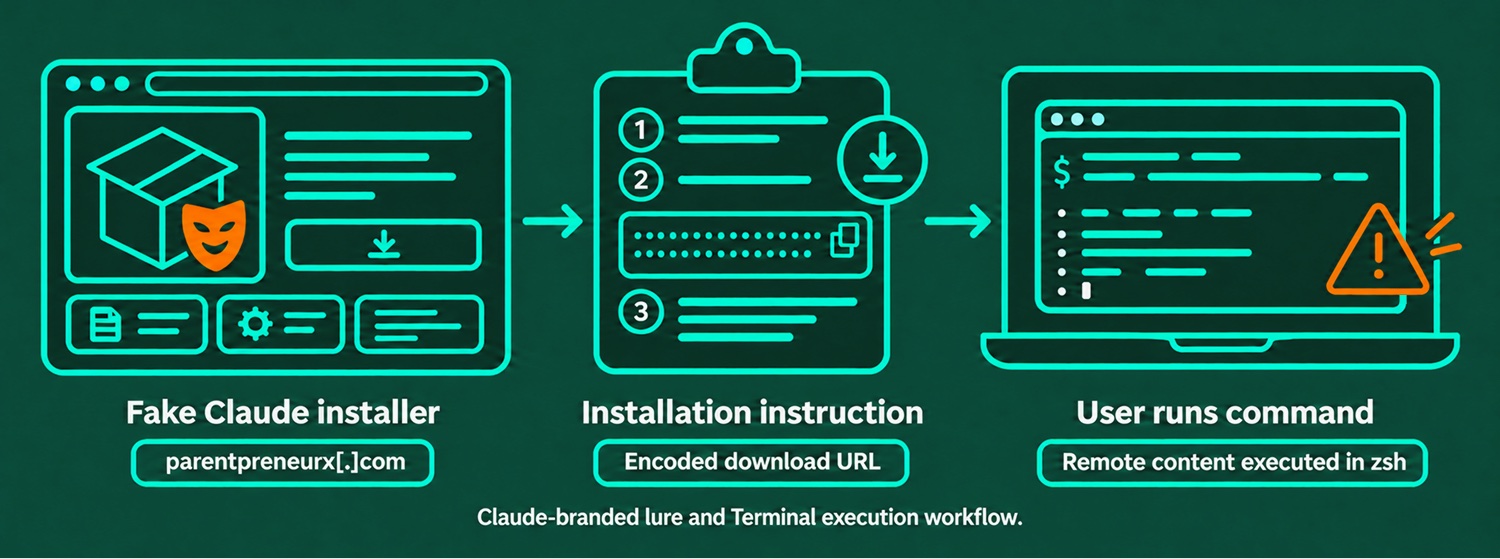
Figure 4. Illustration of the Claude-branded installation lure at parentpreneurx[.]com and the instruction to retrieve remote content for execution in Terminal.
The command first displays an Apple App Store URL, which is a nice touch for credibility. It then decodes a second URL hidden with Base64 and fetches a script from vine-96[.]com to run under zsh. Showing a legitimate-looking Apple address doesn't authenticate the script that comes next.
The loader disguises its active code as update and cache-maintenance work. It rebuilds command names from variables, derives an AES key from a calculated value, decrypts an AES-128-CTR container, decompresses it, and evaluates the recovered shell code. Cato says this resembles the encrypted-loader design it saw in the Codex investigation. Layering like this is designed to keep a static read of the command from revealing much.
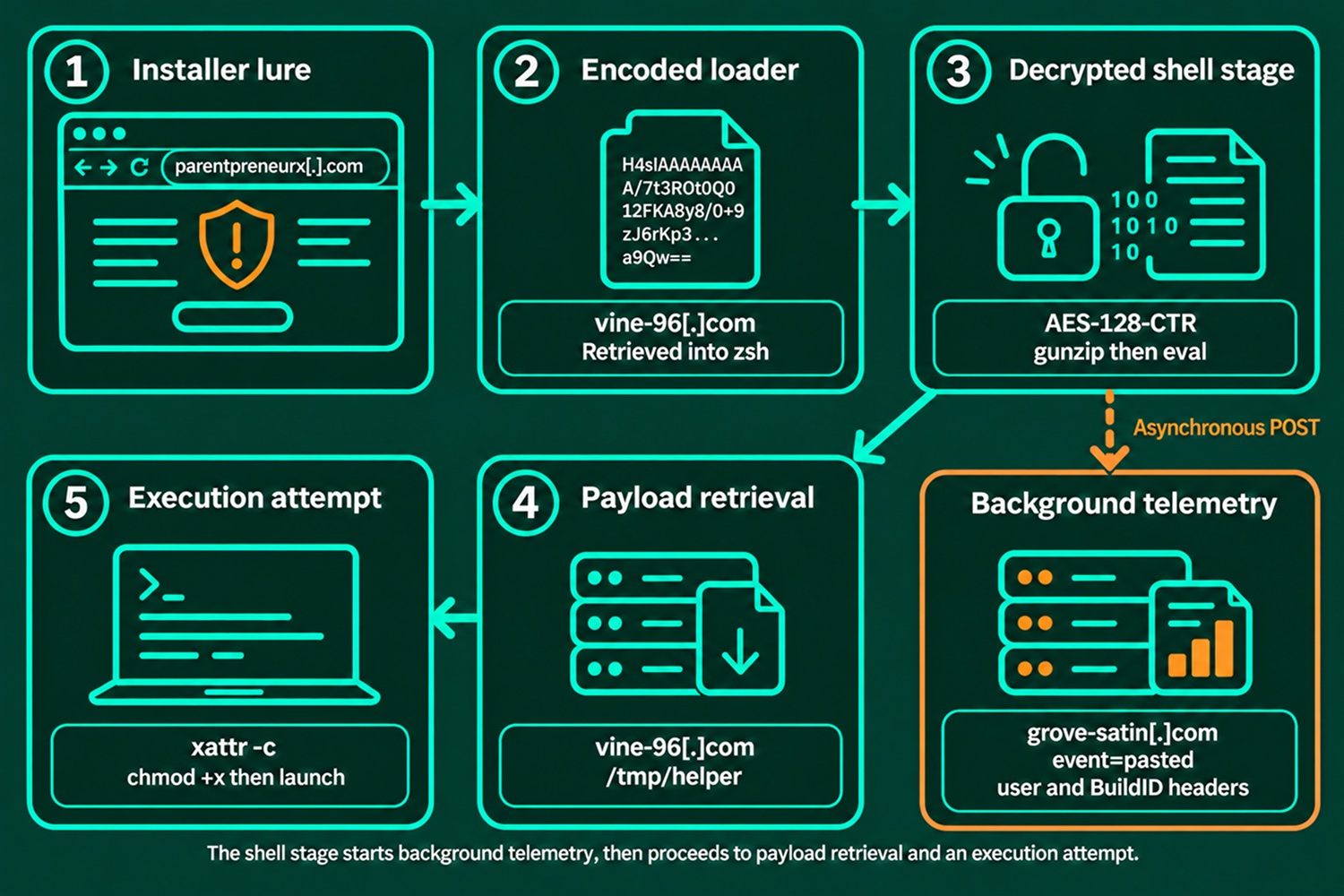
Figure 5. Claude shell-loader sequence. Background telemetry to grove-satin[.]com runs independently of payload retrieval from vine-96[.]com and the subsequent execution attempt.
The decoded stage sends a background HTTP POST to grove-satin[.]com/api/metrics/run?event=pasted, carrying user and BuildID headers. It doesn't wait for that request to finish. It then tries to fetch the payload from vine-96[.]com, write it to /tmp/helper, strip extended attributes, mark it executable, and launch it. The telemetry and the payload run as separate threads of activity, which is why the telemetry alone shouldn't be read as the final command-and-control path. Cato notes the POST is loader-stage telemetry and doesn't establish where the final payload sends its data.
The loader and telemetry behavior match an AMOS-associated delivery pattern. SANS has documented an AMOS infection chain with a Base64-decoded loader URL, an event=pasted telemetry request, and a separate update-themed payload URL. Those similarities support the delivery assessment. They don't identify the operator, and they don't prove every payload in this set is AMOS.
Codex decoy and a shifting downstream domain
An earlier Codex investigation described malicious installer and benign decoy presentations on swiftsaverfin[.]com. The August 14 notes identify the decoy as a fake TALLY application. The new finding here is a change in the downstream domain tied to that lure.
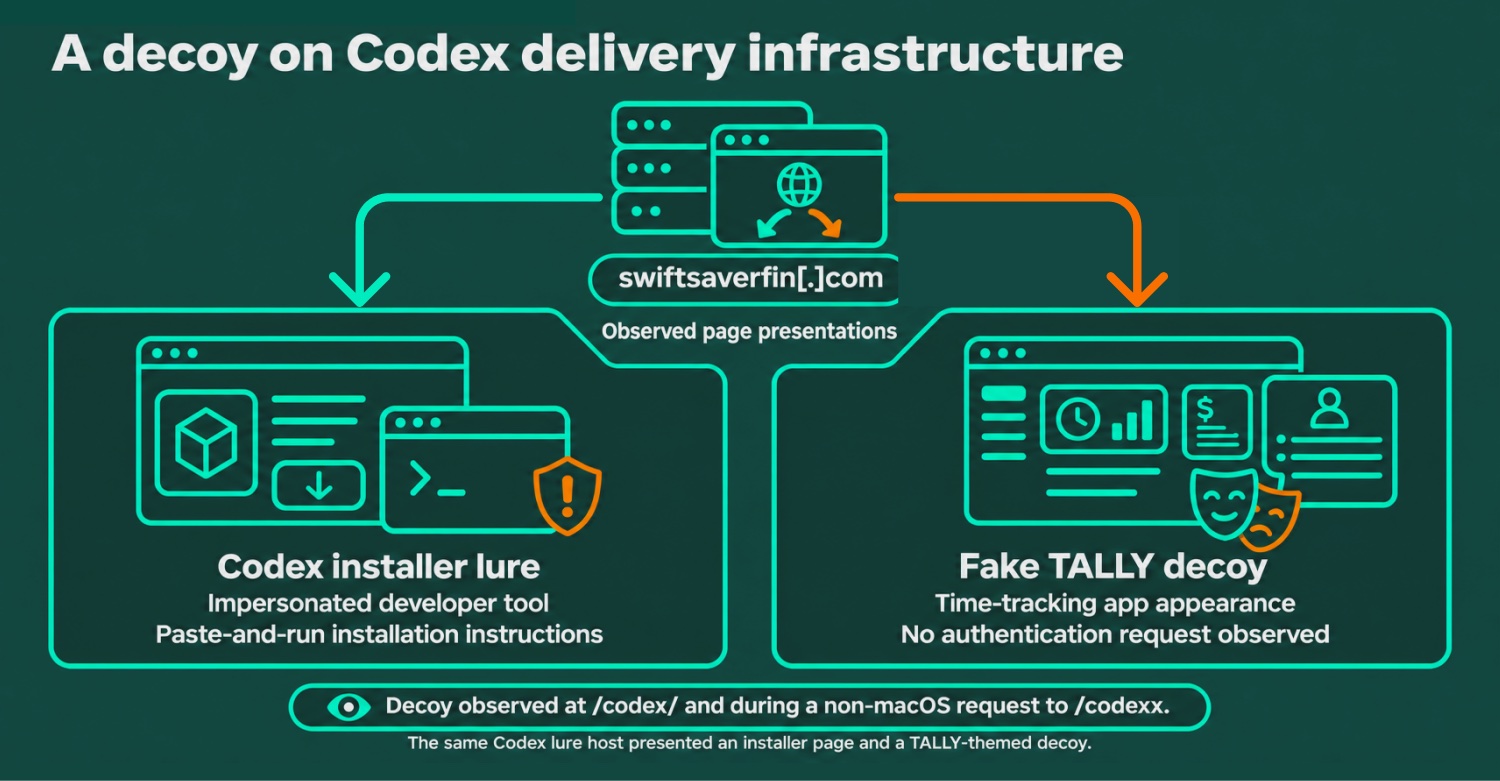
Figure 6. Illustration of the Codex installer lure and TALLY-themed decoy recorded on the same host, swiftsaverfin[.]com.
Later records associate swiftsaverfin[.]com with mossmesh17[.]com, which Cato describes as a downloader or C2-related domain. When Cato checked, mossmesh17[.]com returned NXDOMAIN. That's a reminder that infrastructure in this space rotates quickly, and a dead domain tells you the operator moved on, not that the threat ended.
Additional delivery chains
Cato's notes also recorded claude-tools[.]com offering a DMG download. Analysis dated September 14 documented a separate ClickFix chain that fetched JavaScript for Automation (JXA) from the same domain. The JXA profiled the host and used those results to derive a key that unlocked an embedded downloader. That downloader requested a macOS executable from kmtxyn[.]com/agent, built a counterfeit Finder.app in the user's Application Support directory, and launched it behind a false installation error.
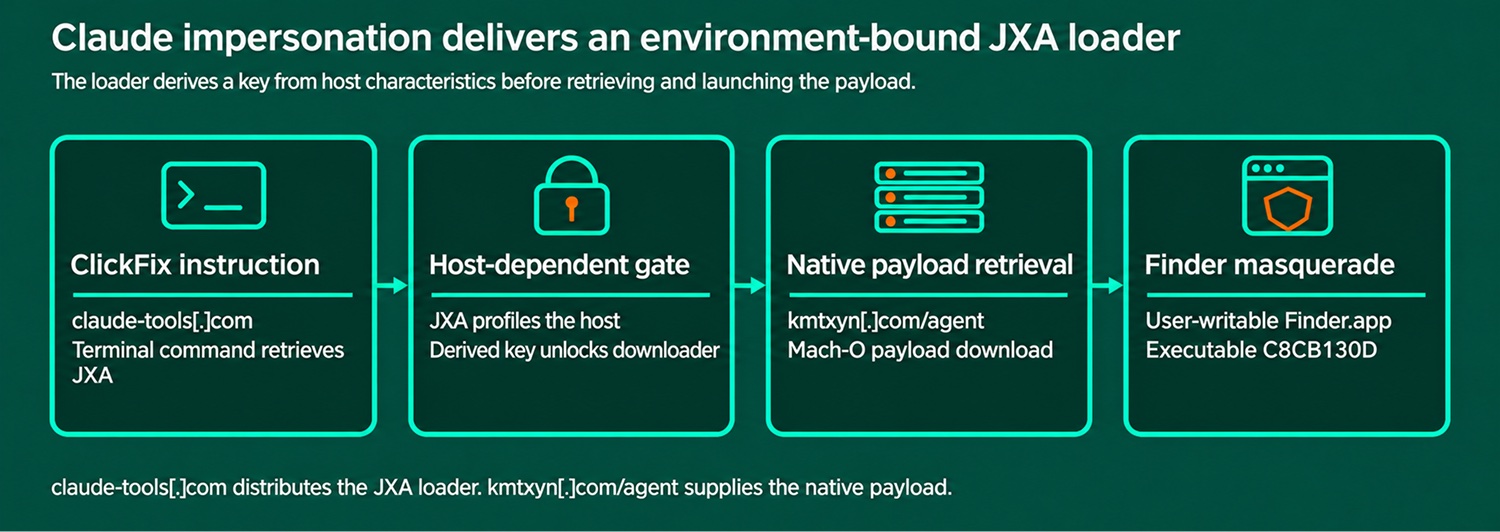
Figure 7. The JXA loader from claude-tools[.]com derives a decryption key from host characteristics, retrieves a native payload from kmtxyn[.]com/agent and launches it in a Finder-masquerading application.
The analysis describes later use of disk-image helper components to choose command-and-control servers, but it doesn't give those addresses or name a malware family. Cato classifies kmtxyn[.]com as a payload host and doesn't link this chain to the Claude and Codex cluster on current evidence. I think that's the right call. Fake Finder bundles are a common disguise, and sharing a technique isn't the same as sharing an operator.
Homebrew lookalikes and the installation settings trick
The August Homebrew cases followed the same search-to-installer pattern, but the records include no recovered payload and no confirmed C2 for homebrexwin[.]com or storageprofiler[.]com. Cato keeps them separate from the linked Claude and Codex activity.
A different lookalike, nomeibrew[.]com, returned installation settings from a tracking-style endpoint. The response supplied a genuine brew.sh redirect and a custom command that placed a Base64-encoded download from pirloz[.]com ahead of the real Homebrew installation command. Mixing an unrelated download with legitimate installer references makes the whole instruction look familiar, and that familiarity is the point.
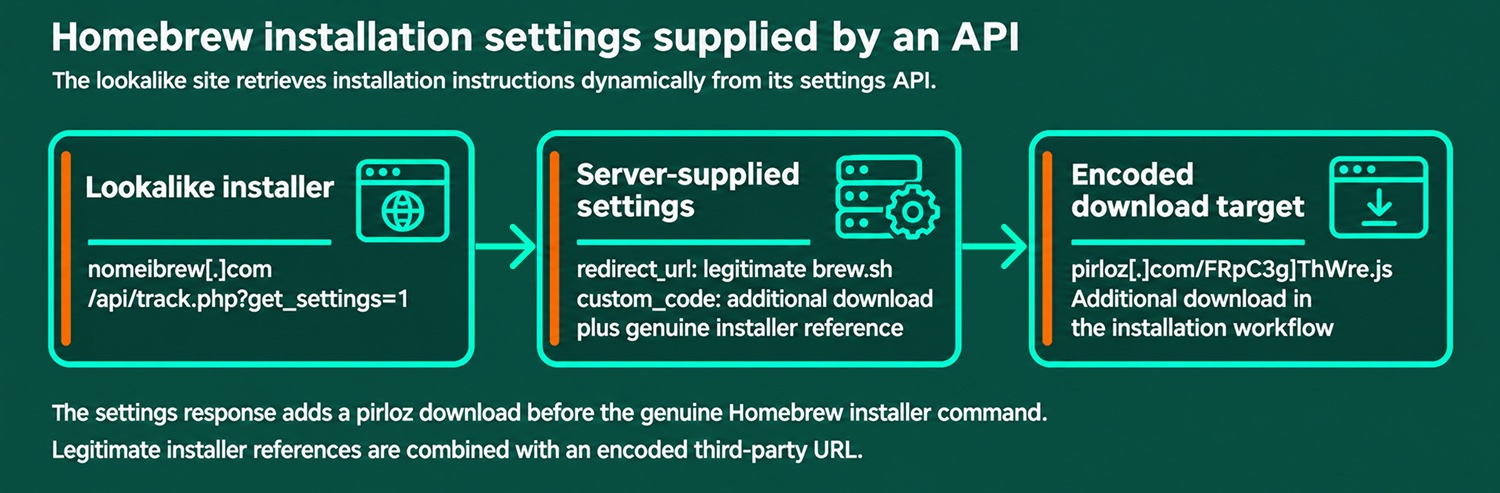
Figure 8. The nomeibrew[.]com settings API returns genuine Homebrew installer references alongside a Base64-encoded pirloz[.]com download URL.
The evidence has a hard limit. The command uses curl with the -k option, which turns off TLS certificate verification for the pirloz request, and the genuine Homebrew installer runs only if that download succeeds. The captured snippet doesn't explicitly execute the downloaded content. So it doesn't establish AMOS installation, and it doesn't prove the move to the application-based chain described next. Anyone who sees that flag in a copied command should treat it as a red flag by itself.
A malicious macOS app delivered through Homebrew lookalikes
Analysis dated September 11 documented a separate disk-image delivery chain tied to nomeibrew[.]com and pirloz[.]com. The disk image held a malicious arm64 macOS application named DayNote. That name refers only to the analyzed sample. Cato found no link to legitimate applications with the same name. When launched, the app ran a helper script that pulled update instructions from the daynotest GitHub account through jsDelivr. Because the URL pointed at the repository's main branch, the content could change after the app was already in users' hands.
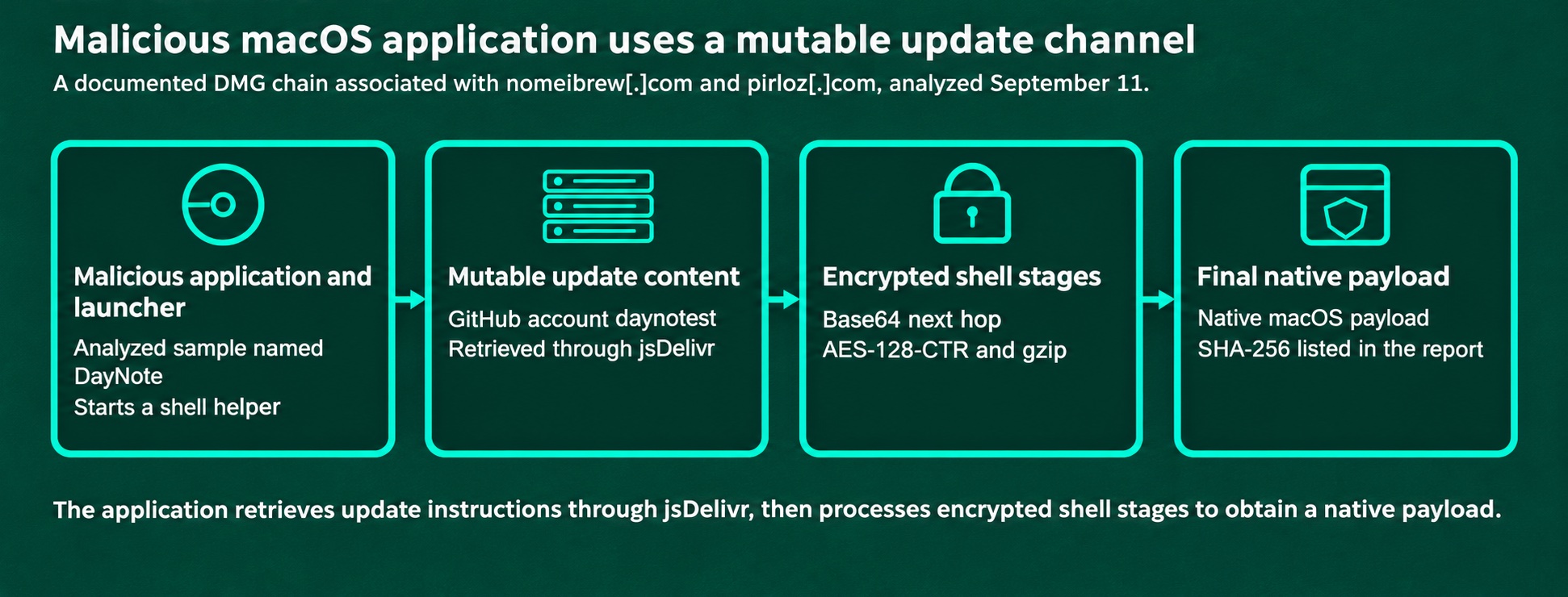
Figure 9. Delivery sequence of the malicious macOS application named DayNote, from its native launcher through GitHub-hosted update instructions, jsDelivr retrieval and encrypted shell stages to the tracked native payload.
The update instructions hid another URL behind Base64. A later shell stage decrypted content with AES-128-CTR, decompressed it with gzip, and recovered instructions for fetching the final macOS payload. Those are the same techniques seen in the Codex and Claude loaders, so they're a useful comparison point. They still don't establish a shared operator or shared infrastructure with the Claude and Codex cluster. The captured settings command doesn't show how users reached the disk image, and the final payload's malware family is still unidentified.
Where this sits among earlier research
Other ClickFix research shows similar methods without a confirmed infrastructure link. Huntress's Custom GPT investigation describes paid search leading users to attacker-created Custom GPTs, then a Google Sites ClickFix page and a Windows installer delivering remote-access malware. It shares the abuse of paid search and familiar platforms, but the operating system, sequence and payload all differ, and its delivery addresses don't appear in Cato's infrastructure summary.
A separate CERT-UA report on UAC-0277, dated September 30, 2026, describes compromised websites showing fake Cloudflare verification pages, with ClickFix instructions delivering MSI packages tied to LUNEXSTEALER. Impersonating a Cloudflare check is a different thing from using Cloudflare's services to serve traffic, and Cato hasn't connected those cases to this activity.
Homebrew impersonation predates this work. SecurityWeek reported in January 2025 that Google ads led users to a fake Homebrew domain and an AMOS installation command, and Field Effect described a lookalike domain distributing AmosStealer. In October 2025, Hunt.io mapped at least 85 phishing domains tied to AMOS and Odyssey delivery. Iru documented fake Homebrew pages whose Copy buttons put a hidden command on the clipboard. SANS ISC traced a malicious Homebrew ad to a Google Sites lure and a MacSync infection in May 2026, and Moonlock described rotating Homebrew ads, possible advertiser-account takeovers and a separate Claude impersonation campaign distributing MacSync.
Taken together, those reports show the same brands being abused across different malware families. They don't show one actor behind all of it. The legitimate Homebrew project has its own security and supply-chain protections, but a fake installer page tries to steer the user's choice of download source before those protections come into play. Cato's findings don't show that Homebrew itself was compromised.
What to check in your environment
Cato says it continuously updates its global blocklist with malicious infrastructure from this research, and that those updates keep pace as operators swap landing pages, telemetry destinations and payload hosts. A blocklist is only one layer, though, and the operators here are clearly rotating.
For security teams, the most useful detection idea is correlation. Look for a browser session from a sponsored result that leads to a freshly opened Terminal or shell, followed by unexpected downloads or execution. Cato points to several contextual leads worth reviewing together: /tmp/helper, a Finder.app in a user-writable directory containing the C8CB130D executable, the DayNote helper scripts, and requests for the daynotest repository paths through jsDelivr. Treat each as a lead rather than a verdict, and avoid blocking shared services such as GitHub or jsDelivr wholesale. Cato stresses that including them in its tables doesn't mean either platform was compromised.
For IT teams that manage developer machines, the practical takeaway is to make the install source part of the standard. Point developers to vendor documentation they already trust, and treat any copied command that pipes a remote download into a shell, disables certificate checks or mixes an unrelated URL with installer references as suspicious. Advertisers should also review unexpected campaigns and changes to account access, because a lookalike ad can run under a legitimate company's name.
Disclosure timeline
These notifications concern suspected misuse of legitimate services by third parties, and they don't establish a compromise of the providers' systems or accounts. Dates mark the recorded notification, response or status update.
| Event date | Provider | Recorded notification or update |
| November 6, 2026 | Cloudflare | Cloudflare acknowledged the report about codex-notes[.]com, said it had forwarded the report to the website owner and hosting provider, and said it had restricted access to the reported URLs. |
| November 6, 2026 | Akamai Cloud / Linode | An automated acknowledgment directed abuse reports to the Akamai/Linode reporting portal. |
| November 6, 2026 | M247 | nomeibrew[.]com and its historical association with 193.187.151[.]195 were reported for review. |
| November 11, 2026 | Akamai Cloud / Linode | The report was submitted through the abuse portal and an acknowledgment of receipt was received. |
| November 11, 2026 | GitHub | The referenced repository was recorded as unavailable. |
| November 11, 2026 | jsDelivr | The referenced update resource was recorded as unavailable. |
Indicators to correlate, not block blindly
The indicators reflect historical observations. The initial analysis was prepared on October 8, 2026, with more analysis added on October 20, and updates continued through November 12, 2026. Cato didn't revalidate every indicator's availability, so domains, addresses and URLs may have changed or gone dark since they were seen. Listing one doesn't mean it's still active. C2-related labels reflect the investigation notes and don't confirm command-and-control for every listed domain.
The key lure and delivery domains are parentpreneurx[.]com, vine-96[.]com, grove-satin[.]com, homebrexwin[.]com, storageprofiler[.]com, codex-notes[.]com, cli-desktop[.]com, claud-tips[.]com, cli-codex[.]com, codex-craft[.]com, codex-desk[.]com, claude-tools[.]com, swiftsaverfin[.]com, mossmesh17[.]com, nomeibrew[.]com, pirloz[.]com and kmtxyn[.]com. Cato lists the DayNote repository paths under the daynotest GitHub account, the recorded URLs for each stage, and SHA-256 hashes for the sample families. Those lists are in the full investigation material, and they're the right starting point for hunting. Defenders should check the hashes against their own telemetry rather than rely on any single value.
Cato's historical DNS table also ties several of these domains to shared Cloudflare edge addresses, plus one Akamai Connected Cloud address and one M247 address. Those tie-ins are context for hosting and shouldn't go on a blocklist by themselves. Shared services get blocked by mistake far more often than the malicious domains they sit beside.
The infrastructure map is the real story here. Domain reuse and similar loaders connect a good part of the Claude and Codex activity, well beyond the individual lures covered earlier. The JXA and application-based chains show other routes to macOS payloads, and their operators and final malware families remain unconfirmed. For defenders, the lesson is to follow the full path from the sponsored result and the pasted command to the servers and files involved. A recognizable advertiser or a familiar brand name doesn't vouch for the command a developer is being asked to run.


