Managed SD-WAN and SASE Are Merging Into Co-Managed Services
- [email protected] (Route XP)
- 441 views
Managed SD-WAN and SASE are converging into co-managed, identity-first services. Here's what IT teams should check before the next MPLS renewal or RFP.

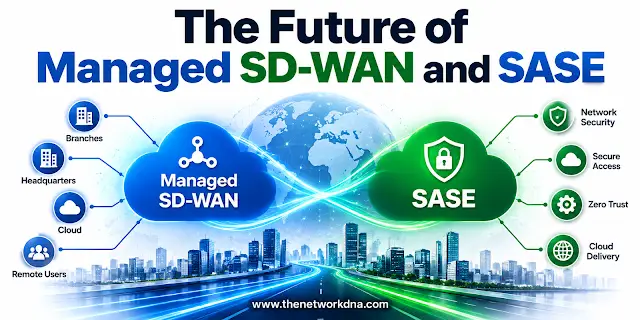
The first wave of WAN modernization was mostly a cost exercise. Swap expensive MPLS circuits for broadband, put a software overlay on top, and watch the bandwidth bill drop. That worked, but it left a gap that many teams are only now closing. Once branches started sending traffic straight to SaaS platforms and hyperscale clouds, the old data centre perimeter stopped meaning much. Network operations and security operations ended up running two architectures that barely talked to each other.
My read is that the wide-area and security stacks have effectively merged. Buyers are less interested in a branch router on its own and more interested in a single fabric that handles transport, inspection and access policy together. That's the space Managed SD-WAN and Secure Access Service Edge (SASE) are converging into, and the pressure is coming from distributed AI workloads, hybrid staff and cloud-first applications that legacy operations teams weren't built to run.
Why Convergence Is Really About Operations
On paper, converged SASE combines software-defined traffic engineering with cloud-delivered Security Service Edge (SSE) controls, all under one service-level agreement. Instead of hairpinning traffic to a hardware firewall at headquarters, identity-aware routing and zero-trust inspection happen at cloud points of presence close to each user, branch or workload.
The hard part isn't the architecture diagram. It's day-two operations. Building a global SASE fabric in-house means negotiating underlay circuits with dozens of regional carriers, managing physical branch CPE through its lifecycle, tuning CASB data loss rules, inspecting encrypted TLS 1.3 traffic through a secure web gateway, and staffing a 24x7 integrated NOC/SOC. Few internal teams can cover all of that well. Even large enterprises struggle to hire engineers who are fluent in BGP and in zero-trust policy orchestration at the same time.
That gap is why managed providers are growing faster than do-it-yourself builds. The better MSPs and telecom integrators aren't just shipping pre-configured boxes. They're bundling underlay procurement, cloud PoP peering and continuous threat telemetry into one consumption model. Whether that bundle actually reduces your workload depends on the contract, which is where most of the real negotiation happens.
Single-Vendor or Dual-Vendor: The Real Decision
The debate that comes up most in CIO planning is single-vendor SASE versus best-of-breed dual-vendor. Greenfield organizations tend to pick single-vendor stacks for unified policy and fewer processing hops. Large brownfield enterprises usually have multi-year investments in specialist SSE products and established branch SD-WAN hardware, so ripping those out isn't realistic.
Providers aiming at this middle ground are building API-driven abstraction layers that stitch dual-vendor tunnels together while moving branches onto converged platforms at hardware refresh time. It's a pragmatic answer. It also means you'll be running two policy models for a while, so budget for that overlap.
Across the maturity stages, the differences are clear enough to use as a checklist:
| Capability Pillar | Legacy DIY MPLS / VPN | First-Gen Managed SD-WAN | Managed SASE / NaaS |
|---|---|---|---|
| Traffic topology | Hub-and-spoke backhaul to regional data centres | Local internet breakout with static IPSec overlays | Cloud-native architecture with direct PoP peering |
| Security enforcement | Perimeter firewalls and castle-and-moat ACLs | Branch firewalls bolted onto routers | Unified FWaaS, SWG, CASB and ZTNA |
| Remote workforce | Concentrator-based IPSec or SSL VPNs | Managed separately from branch WAN policy | Zero trust network access everywhere |
| Operations and control | Manual CLI scripting and siloed NOC/SOC teams | Ticket queues with slow changes | Co-managed portals and self-healing networks |
| SLA metric | Port availability and packet delivery ratios | CPE uptime and underlay failover time | End-to-end digital experience monitoring scores |
| Commercial model | Heavy capex refresh and 3–5 year telco lock-in | Fixed monthly per-site contracts | Consumption-based network-as-a-service |
Five Shifts Worth Pricing Into Your Next RFP
Static managed connectivity offerings are losing ground quickly, and five trends are doing most of the damage.
Predictive path steering. Traditional SD-WAN reacts once packet loss or jitter crosses a fixed threshold, which is often too late for a live Teams call. Vendors now describe AIOps engines that predict carrier degradation before users notice and move critical flows early. Some MSP portals also add GenAI assistants for shadow IT audits, firewall rule conflict checks and root-cause queries in plain language. Treat those training-data and accuracy claims as vendor claims until you've tested them in a proof of concept.
Zero trust inside the office, not just outside it. There's an awkward paradox in early SASE deployments. A remote user on a coffee-shop connection faces continuous posture checks, but the same laptop plugged into the office LAN often inherits broad implicit trust. The next step is what some vendors call universal ZTNA or campus zero trust. Branch appliances enforce identity and device health locally, which is meant to stop lateral movement across office VLANs. If you run flat campus networks today, this is the piece most likely to force a redesign.
Co-managed delivery as the default. Outsourcing the WAN used to mean handing over the keys. Waiting two days for a ticket to block a newly found command-and-control domain is hard to defend now. In a co-managed model, the MSP handles circuit procurement, CPE replacement, firmware patching and underlay monitoring, while your own security team keeps role-based access and API hooks to push SSE policy changes in seconds. The contract has to spell out who owns which function, or you'll discover the gaps during an incident.
Multi-cloud and edge traffic. A growing share of traffic moves east-west between AWS, Microsoft Azure, Google Cloud and micro-data centres in retail or manufacturing sites. Managed platforms are extending SASE into multi-cloud backbones and edge nodes. On the access side, broadband is increasingly paired with 5G fixed wireless access and LEO satellite links. That combination lets a provider stand up a temporary site in hours rather than months, which matters for pop-up operations and remote plants.
Experience-based SLAs and elastic pricing. A healthy router dashboard means little if executives are staring at frozen Teams calls. Providers are starting to put digital experience monitoring agents on endpoints and PoPs, measuring latency hop by hop across Wi-Fi, ISP transit, inspection engines and SaaS servers. Those capabilities are being sold as network-as-a-service subscriptions that let you scale bandwidth and licences up or down during mergers or seasonal spikes. Ask what the DEM score is measured against, and who gets to dispute it.
A Migration Sequence That Survives Contact With Reality
Nobody should be planning a rip-and-replace weekend for this. A workable sequence looks more like this:
- Map identity and contract dates first. List MPLS expiry dates and branch firewall refresh schedules, then check that your identity provider groups are clean enough to support zero-trust policy.
- Start with remote access. Roll out ZTNA, SWG and CASB agents to mobile users before touching branch routers. This is usually the fastest way to retire aging VPN concentrators.
- Move branches in waves. Transition sites from MPLS to diverse fibre broadband plus 5G, steering encrypted tunnels into the nearest SASE PoP.
- Consolidate branch security as hardware contracts lapse. Fold standalone web filters and UTM boxes into centralized FWaaS policy as their maintenance agreements end.
- Agree on telemetry and RACI before go-live. Stream SSE logs into your SIEM or SOAR platform, write down who responds to what, and tie the MSP's accountability to the experience metrics you actually care about.
Where the Hard Limits Still Are
Managed SASE doesn't replace everything. At standard branch and retail sites, broadband, fibre DIA and 5G combined with cloud FWaaS often make MPLS and standalone branch firewalls unnecessary. Core manufacturing floors, trading environments and primary data centres are different. Many enterprises keep private wave circuits, cloud interconnects and physical next-generation firewalls there. Plan for a hybrid end state, not a clean break.
The co-managed model is also gaining ground because threats move in minutes while change tickets still take hours. Giving internal SecOps real-time portal access to zero-trust and threat policies, while the provider carries the circuit and hardware burden, is the trade most buyers are now making.
Here's my takeaway for teams heading into 2026 planning. Before you sign another multi-year telco deal, test how fast your provider can change a security policy, who owns each operational function in writing, and what the experience SLA actually measures. Those three answers will tell you more about your future network than any architecture diagram.


