Student-Run Online Stores: A Galician Marketing Class Builds Real WordPress Sites
- Tess Needham
- 717 views
A Galician vocational teacher has 42 students build fictional businesses on WordPress.com, from live websites to online stores, with the platform handling hosting.

Most marketing courses end with a slide deck and a mock campaign that nobody will ever see live. In one vocational classroom in Galicia, Spain, the final product is a working online store that a student can point to in a job interview. The interesting part isn't the store itself. It's the decision behind it: moving the whole teaching project onto a hosted platform and letting students own the result.
Elena Rodríguez Lago teaches digital marketing at CIFP Fontecarmoa, a vocational college in Galicia. Her background covers finance, social media and market research, and she wants students to see how those disciplines fit together once they leave the textbook. "I want students to experience how marketing decisions connect and work in practice," she says.
Trading server upkeep for classroom time
Elena's first setup was entirely hands-on. She installed and maintained WordPress on her own server and handled all of the technical work herself. That works for a while, but for a teacher it quietly eats the hours that should go to lesson design, feedback and marking. Every update, patch and troubleshooting session is time taken from the subject itself.
She then joined the WordPress.com Education program, and her assessment of the change is direct:
The WordPress.com Education program has saved me a considerable amount of technical and maintenance work.
— Elena Rodríguez Lago, Head of Commerce and Marketing Department at CIFP Fontecarmoa
For IT staff who support schools and colleges, the lesson is familiar. Self-hosting gives maximum control, but it also makes a single teacher responsible for uptime, security and software versions. Moving that burden to a managed platform trades some control for predictability, which is often the better deal when the person running the server has a full teaching load.
One fictional business, carried through the whole course
This academic year Elena has 42 students in the Digital Marketing module, spread across two Higher VET programs. The module is entirely project-based. Each student chooses a fictional business and works individually, applying every new lesson to that same business rather than to a series of unrelated exercises.
Over the year, the businesses develop in three stages:
- A business idea gets a real website: Students create a site and blog that reflect their brand and target audience.
- The marketing comes to life: Monthly blog campaigns, weekly social posts, SEO and search advertising put their ideas to work.
- They build an online store: Students add email campaigns and an online store.
The store isn't a separate assignment tacked onto the end. It's where months of earlier work come together. "This gives continuity to their learning: each new activity develops the business they have already been building," Elena says.
That continuity is the design choice worth noticing. Marketing skills are easy to forget when each task is graded and discarded. When the same brand gets a blog, a social calendar, an ad budget and a checkout, students have to make those pieces agree with each other, which is the point Elena is trying to make.
Sites that stay live after the course ends
Students build on the WordPress.com Student plan, which provides free professional WordPress hosting. The practical effect is that the sites don't disappear when the semester closes. Almost all of Elena's students keep them live as portfolios until they have real professional experience to show.
That changes the stakes. A graded exercise can be sloppy without consequence. A public-facing store that a student will later show an employer tends to get more careful copywriting, cleaner product pages and fewer broken links. Teachers running similar projects often find that a visible, persistent output raises the quality of work more reliably than any rubric.
Friction as part of the curriculum
WordPress isn't easy for everyone at the start. Elena says students often feel overwhelmed, especially when they already have a clear creative idea but don't yet know how to make the platform do what they want. The gap between vision and tooling is where many of them stall.
Her method is to set the problem, give students room to try, and step in only when they're truly stuck. "Working through those difficulties is part of how they develop autonomy," she says.
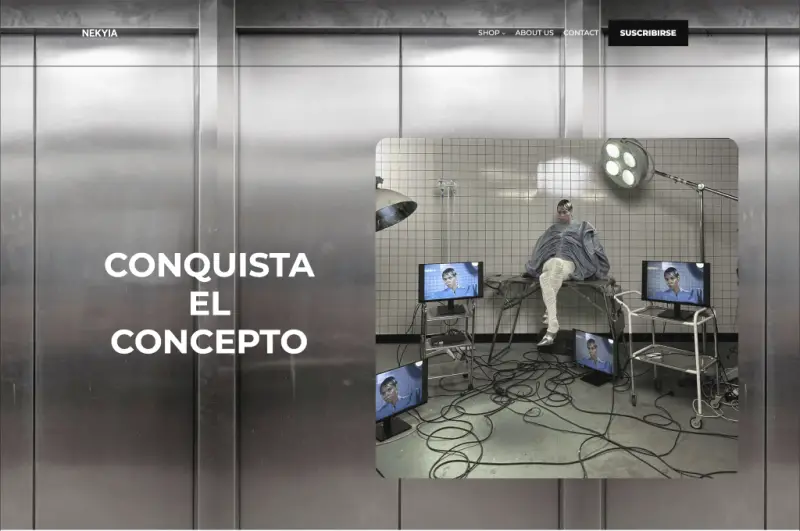
One example is Nekyia, a website for a marketing consultancy serving the fashion sector. The student behind it had a strong creative vision but struggled to turn it into a working website. Elena let them work through the problems themselves.
"It was very rewarding to see the student gradually take control of the platform and find ways to express that vision," Elena says.
Here's the thing: the difficulty is doing real work. A student who fixes a broken layout or rewrites a product description after three failed attempts learns more about the trade than one who follows a tutorial step by step. Teachers who step in too early tend to produce polished sites and students who can't build the next one.
What other teachers can take from it
Elena's advice is to give students space to experiment, make mistakes and work through problems before intervening. That patience is what builds the independence they'll need once the course is over.
Teachers, though, shouldn't have to work out the platform alone. Elena credits the WordPress.com Education team in Spain with providing training, helping with the technical setup and connecting educators so they can learn from each other. For a teacher adopting a new tool, that peer and vendor support can matter as much as the software.
"Not feeling alone makes a real difference," she says.
The approach is also spreading inside CIFP Fontecarmoa. Two colleagues have brought the program into their courses in Commercial Activities and in Digital Content Writing for Marketing and Sales. Elena is also interested in future WordPress certification opportunities for her students, which would give the portfolio work a recognised credential alongside it.
Her view of resourcing is blunt. "Resources at a public college are limited. Without programs like this, we simply couldn't offer this experience in its current form, and I'm very grateful for that support."
For administrators weighing a similar move, the takeaway is less about WordPress specifically and more about the pattern. A project that ends in something students can keep, show and maintain tends to teach more than one that ends in a grade. The open question for other departments is whether their own assignments could produce a live output, and who on the team would be left maintaining it once the semester is over.