Altera Agilex 9 Brings Direct RF Control to OQC's Quantum Processors Through NVQLink
- Harold Fritts
- 496 views
Altera, OQC and NVIDIA have built an FPGA controller reference design for quantum processors, with release planned for January 2027 and a live demo at SC26.
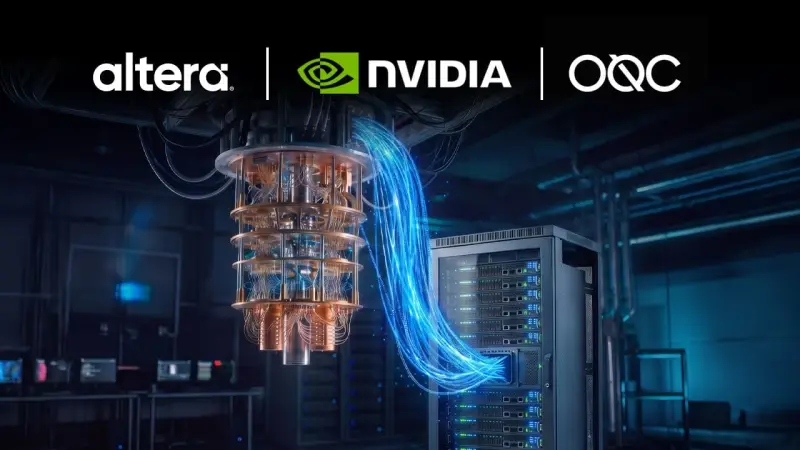
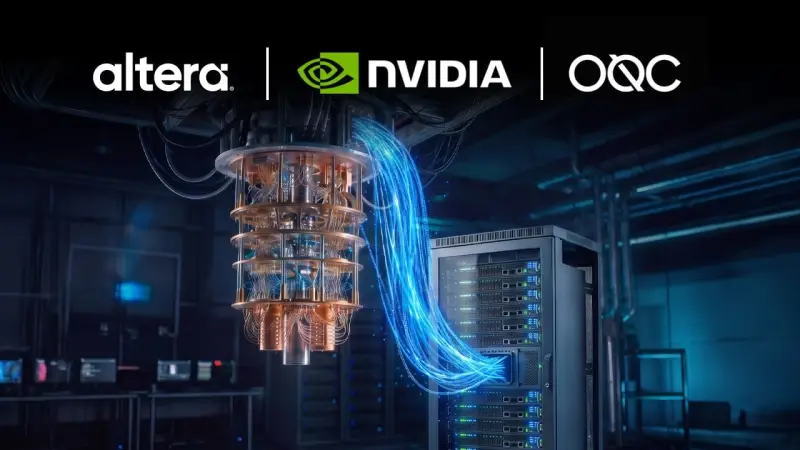
Altera has put together an FPGA-based controller reference design for quantum processors, built with Oxford Quantum Circuits (OQC) and NVIDIA. The core of it is an Altera Agilex 9 Direct RF FPGA running real-time control of a new-generation OQC quantum processing unit (QPU), with RF conditioning electronics built by OQC. NVIDIA's NVQLink ties the FPGA to GPU systems. Altera expects to release the design in January 2027 and is showing the full system at SC26 in Chicago.
For most infrastructure teams this is a quantum story you'll watch from a distance. But the design shows where the control side of these machines is heading, and that's a question of rack space and cabling as much as physics.
Why Density Is the Real Problem
Altera's argument starts with a scaling problem. Qubit counts are climbing faster than the room available for the classical equipment that controls them. Every extra qubit typically means more signal generation, more converters, and more interconnects, and that gear has to fit next to a cryostat that has limited space and tight thermal constraints.
The Agilex 9 Direct RF FPGA is aimed at that bottleneck. It integrates analog-to-digital and digital-to-analog converters on the device itself, so control and readout can run without a separate external RF up-conversion or down-conversion stage. Traditionally, that work sits in racks of discrete RF chains. Pulling it into one programmable device is the density pitch, and it's a sensible one. Fewer boxes means fewer cables, less power draw in the control stack, and fewer places for timing drift to creep in.
Altera lists direct RF sampling of up to 64 GSPS for the Agilex 9 Direct RF-Series. It hasn't said which specific device the reference design uses, so treat that figure as a family specification rather than a confirmed number for this build. Frequency multiplexing is the other lever. Several readout channels can share one RF port, which Altera says cuts the extra RF hardware needed as systems grow. That's the kind of detail that matters when you're planning how many channels a given cryostat can actually support.
What the FPGA Does and What the GPU Takes On
In the reference design, the FPGA handles the real-time work: qubit control, resonator readout, and spectroscopy, with scheduling synchronized across those functions. Timing-critical tasks stay in hardware, which is where FPGAs earn their keep.
The heavier computation moves to GPUs. NVQLink, which NVIDIA describes as an open architecture for coupling QPUs to GPU systems, connects the FPGA to accelerated computing. The GPUs handle calibration and machine learning-based readout classification. CUDA functions then feed back into the FPGA logic that runs the QPU. So you get a loop: the FPGA measures, the GPU interprets and adjusts, and the FPGA acts on the result.
That split is the part worth noticing if you run GPU clusters. Quantum control is starting to look like a latency-sensitive workload that needs a tight link to general-purpose accelerators, not just a standalone instrument on the bench. Altera says other quantum hardware builders, including Quantum Machines, have already built on NVQLink, which suggests the interface is gaining traction beyond this one design.
Software, Emulation and the Developer Angle
Altera describes a validated set of controller functions and a software stack. It covers qubit and resonator spectroscopy, qubit initialization, and resonator readout and classification. The package also includes a GPU-based machine learning readout classifier and example GPU-based initialization functions for the QPU.
Sam Stanwyck, director of quantum product at NVIDIA, described the package as a working reference design for exploring AI-driven calibration and readout. That's a fair framing: it's a starting point for experimentation, not a finished production controller.
The emulation path may matter more to teams than the hardware specs right now. Altera's built-in emulation lets developers bring up the controller and test algorithms before physical qubit hardware is available. Anyone who has waited on scarce lab hardware knows how much that can shorten a development cycle. It also means software groups can start work well ahead of the January 2027 release date.
Simon Phillips, CPO at OQC, said the FPGA gives the company a programmable, low-latency connection to its QPU. In his framing, it brings control and readout together while leaving room to refine calibration and feedback over time. Farhad Shafai, head of business solutions and marketing at Altera, said the demonstration "gives developers a clear path to build on."
What's Missing From the Numbers
Here's the thing: the headline specs are thinner than the pitch. Altera says the approach helps developers build smaller, lower-power, and lower-latency controllers, but it hasn't published latency, power, or qubit-count figures for this design. Until it does, claims about size and power are directional. If you're evaluating this for a lab or a shared research facility, those are the numbers to ask for first, along with the exact device used in the reference build.
That said, the architecture is coherent. Putting converters on the FPGA, sharing RF ports through multiplexing, and offloading calibration to GPUs over a defined link all address the same scaling pressure. Whether the design delivers on density will show up in real deployments, not on a demo floor.
What to Watch and Where to See It
The next concrete milestone is the January 2027 release. Between now and then, the useful signals are whether Altera publishes device-level specs, whether the emulation environment is available to outside developers before hardware ships, and how many other QPU builders adopt NVQLink as the GPU link. The live demonstration is running at Altera booth #2854 at SC26, which is the place to get specific questions answered while the system is up.
If you already run GPU infrastructure for research workloads, start tracking NVQLink now. The interface may end up on your network sooner than you'd expect, and it'll be easier to plan for it than to scramble later.