Cornelis CN6000 Brings 800G Omni-Path and Ethernet NICs to AI Clusters
- Harold Fritts
- 706 views
Cornelis CN6000 doubles CN5000 bandwidth to 800G with an Omni-Path SuperNIC, a 48-port switch and an RoCEv2 Ethernet SuperNIC. Systems are expected in Q1 2027.
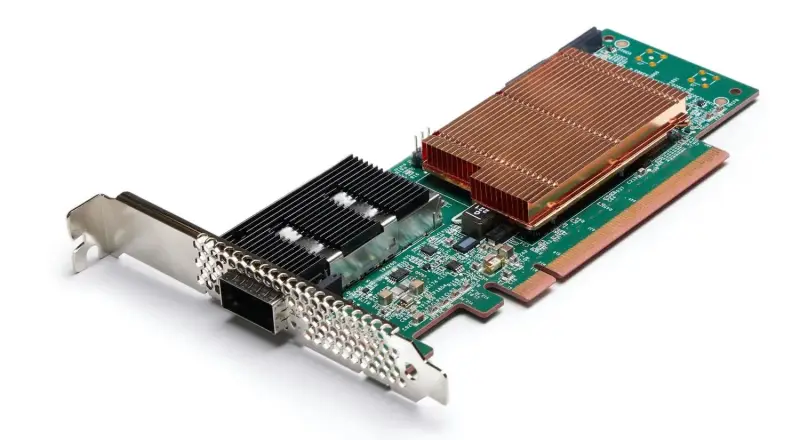
Cornelis has put a number on something cluster operators already feel: the cost of an accelerator sitting idle while packets crawl. Its new CN6000 family doubles the bandwidth of the CN5000 generation to 800G and covers three parts: an Omni-Path SuperNIC, a 48-port Omni-Path switch, and an Ethernet SuperNIC that speaks RoCEv2 to standard 800G switches. Cornelis says the adapters, switch and software are available now for evaluation and early deployments, with systems from OEM and system partners expected to start in Q1 2027.
CEO Lisa Spelman framed the launch around idle hardware. Every minute an accelerator waits on the network, she said, is "capacity our customers paid for and didn't use." That's the pitch in one line, and for AI and HPC buyers paying for GPU time, it's the right one to lead with. Whether CN6000 delivers on it depends on the numbers, so let's go through them.
The Omni-Path SuperNIC
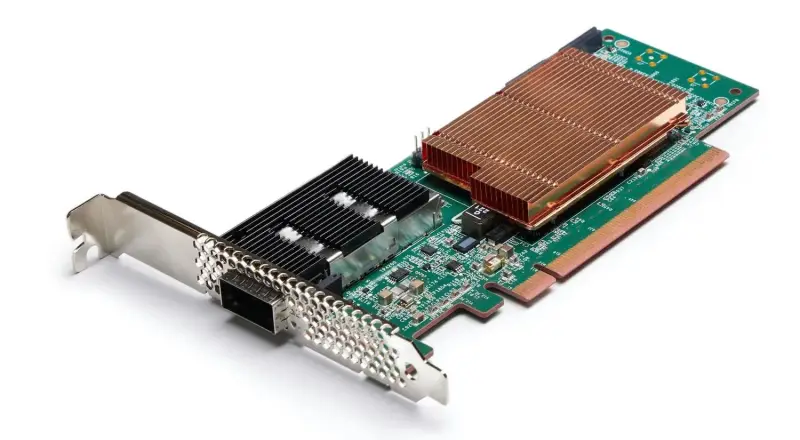
The CN6000 Omni-Path SuperNIC is a low-profile PCIe 6.0 x16 card with two QSFP-DD ports, each carrying a 400Gb/s data path for 800Gb/s total. Cornelis rates it at 1.6 billion messages per second, which it calls the industry's highest, and at sub-microsecond MPI latency. Both figures are design targets, and Cornelis describes the message rate as bidirectional. It hasn't published the test conditions behind the message-rate number, so treat it as a target until someone reproduces it. Typical power is 42.4W with passive copper cables and 57.5W with active optical cables.
Cornelis also claims MPI latency 21 percent lower than NVIDIA InfiniBand XDR at the same 800G speed. That comparison comes from internal Cornelis testing: an 8-byte MPI ping-pong run with Intel MPI, where the CN6000 Omni-Path SuperNIC measured 0.95µs against 1.2µs for InfiniBand XDR. These are vendor results, and we haven't run or audited them. Latency at this scale depends heavily on the MPI library, message size, host configuration and topology, so a 21 percent gap in one controlled test is a reason to benchmark your own workload, not a reason to change purchasing plans on its own.
The SuperNIC supports multi-plane and multi-rail configurations, which Cornelis says let operators isolate traffic and keep a fabric running through link failures. It uses credit-based flow control for lossless delivery. A dedicated hardware Root of Trust verifies firmware before the adapter joins the system, using SPDM 1.4 attestation and ML-DSA post-quantum signatures. Cornelis puts the scale of an Omni-Path fabric at more than 500,000 endpoints.
The 48-Port Switch and Its Power Budget
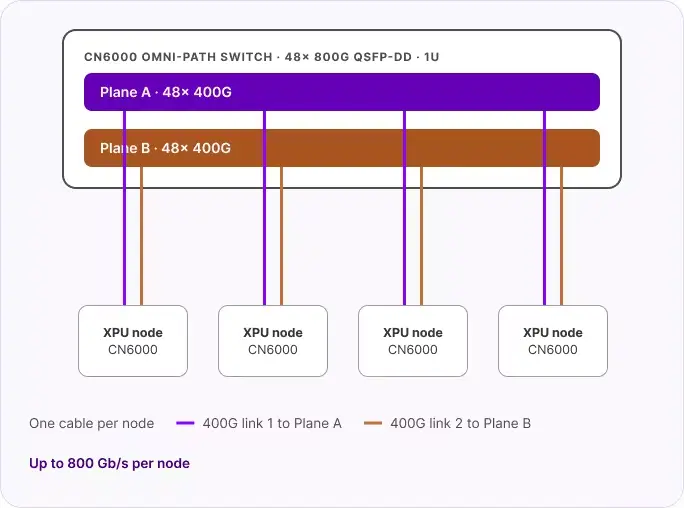
The CN6000 Omni-Path switch is a 1U system with 48 QSFP-DD ports at 800G, or 96 ports at 400G, for 76.8Tb/s of full-duplex capacity. It can also run as two independent 48-port 400G planes, which fits the dual-plane designs the diagram illustrates, where each node connects to both planes for up to 800Gb/s. Cornelis lists switch latency as low as 105ns. When paired with the SuperNIC, adaptive routing spreads traffic across available paths to reduce congestion.
Power is where a rack planner should slow down. Typical draw is 856W with all-copper cabling and 1,663W with active optical cables on every port. That roughly doubles the switch's envelope depending on cabling choice, so the cable decision and the power and cooling budget belong in the same conversation. The switch takes 240–277VAC or 48VDC through hot-swap N+N power supplies. Facilities teams should confirm which feed a given row provides before anyone orders the unit.
Ethernet SuperNIC and Software Continuity
The Ethernet SuperNIC uses the same low-profile PCIe 6.0 x16 form factor and dual QSFP-DD ports, and it connects to industry-standard Ethernet switches over RoCEv2. That's the option for sites that have standardised on Ethernet fabrics and want the adapter without adopting a second network architecture. Cornelis lists Priority Flow Control across eight priorities, IEEE 1588 PTP, SR-IOV, and GPUDirect support for NVIDIA and AMD accelerators.
Two features are still in progress. Ultra Ethernet support is in preview and will arrive through software updates, and NVMe-oF over RoCEv2 is on the roadmap. Cornelis hasn't given dates for either, so don't plan storage architecture around NVMe-oF yet. For the Ethernet SuperNIC, Cornelis lists Red Hat Enterprise Linux support, with other distributions available on request. If your fleet runs something else, that request is worth raising early.
On the Omni-Path side, CN6000 supports NCCL, RCCL, libfabric, MPI and OpenSHMEM, and it uses the same software stack and host driver as CN5000. That matters for operations teams. Sites already running the current generation can move to 800G hardware without relearning the software base, which usually shortens validation time more than the headline bandwidth figure suggests.
Platform Validation and Who Ships It
Cornelis says CN6000 supports AMD, Arm-based and Intel CPU platforms, along with AMD, NVIDIA and Qualcomm accelerators. It's validating the family with AMD EPYC 9006 Series CPUs and next-generation AMD Instinct GPU platforms, and it's extending its Intel collaboration to CN6000 and next-generation Xeon platforms. OEM and system partners planning validation and support include Dell Technologies, Hyve Solutions, Lenovo, NEC, Penguin Solutions and Supermicro.
Lenovo has qualified CN5000 across its ThinkSystem V3 and V4 servers and is now qualifying Cornelis hardware with its new AMD EPYC-powered ThinkSystem servers. Supermicro has validated CN5000 on its FlexTwin, BigTwin and Hyper platforms and plans to extend that work to CN6000. Penguin Solutions plans to validate and support CN6000 in its AI and HPC systems. Cornelis is demonstrating the family at SC26 in Chicago, which is where buyers can see the hardware running before the Q1 2027 system timeline arrives.
Here's my read: the CN6000 story is less about the 800G number, which every high-speed fabric vendor is now chasing, and more about continuity. The same driver stack, the same MPI and NCCL paths, and a choice between Omni-Path and standard Ethernet give teams a migration route that doesn't start from zero. The open questions are the ones the source leaves open: independent benchmarks, the Ultra Ethernet timeline, NVMe-oF dates, and how quickly OEM systems reach production. Until those land, the practical step is to put CN6000 on the evaluation list, ask your server vendor where its validation stands, and model power and cabling for 800G before the first purchase order.