NVIDIA's SC26 Lineup: Rubin HPC in 2028, Vera Racks in 2027, and a Faster Quantum Decoder
- Brian Beeler
- 329 views
NVIDIA's SC26 slate centers on the Rubin HPC GPU for 2028, Vera CPU HPC racks from early 2027, and a claimed 13,000x faster quantum decoder.
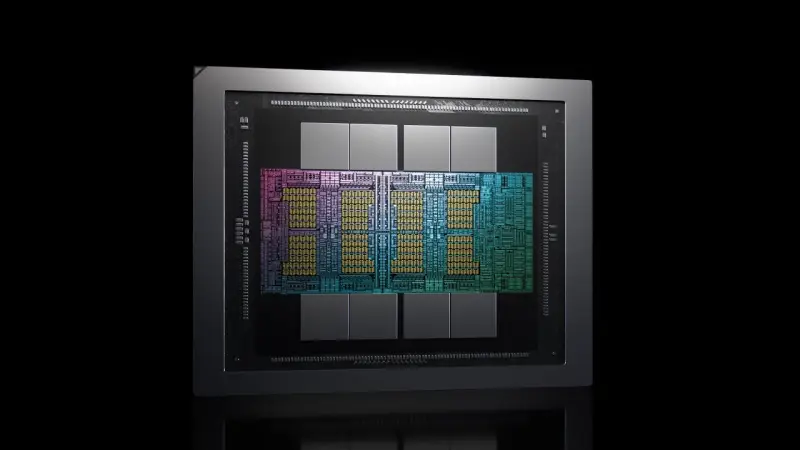
NVIDIA's SC26 announcements are mostly about feeding scientific workloads faster, not just adding more compute. The headline part is Rubin HPC, a GPU with more than 50,000 CUDA cores, due in 2028. But the nearer-term items matter more to anyone planning hardware: Vera CPU racks for HPC arriving in early 2027, and a set of software and quantum tools that are available now or soon.
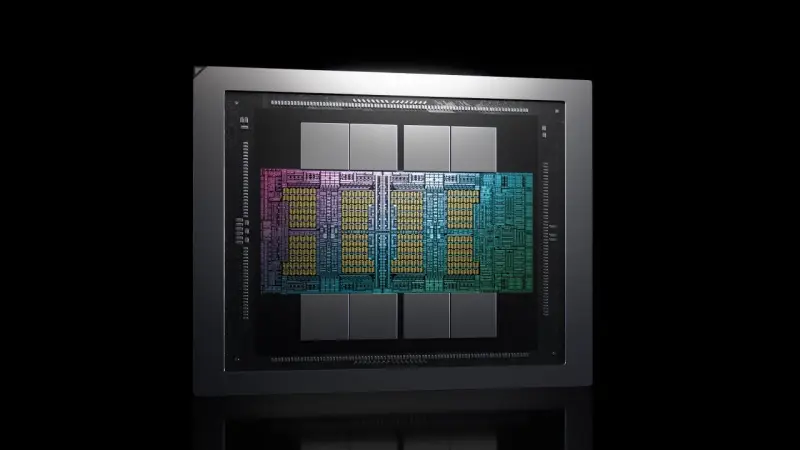
Rubin HPC: a GPU built around data movement
NVIDIA positions Rubin HPC as a GPU for simulation and data processing in science, engineering, and analytics. The company's pitch is that data movement has to scale alongside compute, or the cores sit idle. To that end it lists a sparse data acceleration capability that keeps the cores supplied with data, plus GPU-to-GPU links over seventh-generation NVLink.
The target workloads are sparse matrix operations, stencil computations, sorting, and reductions. Those patterns sit underneath climate models, engineering simulation, genomic analysis, and financial risk, so the design choice is aimed at the bottlenecks that slow real HPC jobs more than peak arithmetic does.
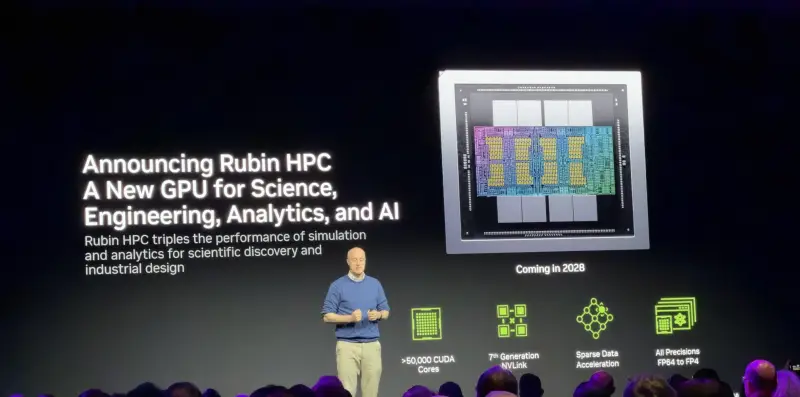
On stage, NVIDIA said Rubin HPC triples the performance of simulation and analytics and supports every precision from FP64 to FP4. Here's the thing: the company didn't name the baseline for that 3x figure. It also hasn't published memory capacity, FP64 throughput, power, or system configurations. Until those numbers appear, the 50,000-core count is the only hard spec on the table.
Ian Buck, vice president of hyperscale and high-performance computing at NVIDIA, framed the chip around agentic research, saying "faster simulation means faster discovery" for agents working on science and engineering problems. Intel is making a similar pitch with its FP64-capable GPU D270 for the same simulation workloads, so expect a head-to-head comparison once both parts have real numbers.
Vera CPU racks for HPC
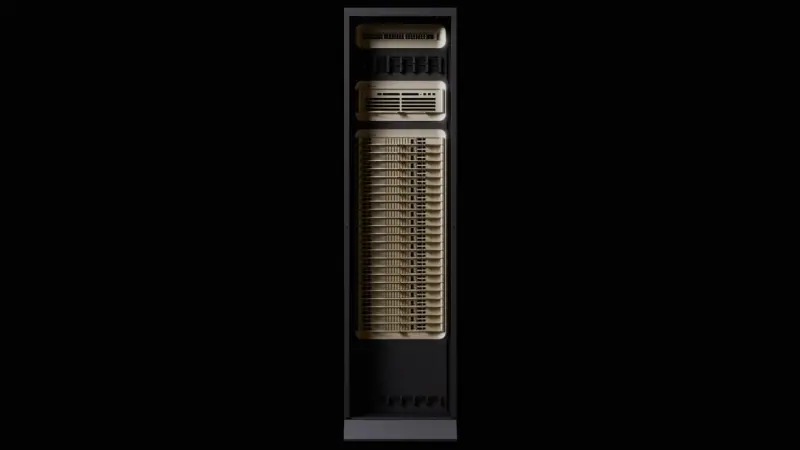
The Vera CPU platform for HPC is a liquid-cooled NVIDIA MGX rack holding 192 Vera CPUs, connected by Quantum-X800 InfiniBand. NVIDIA quotes about 300TB of memory, 1PB of storage, and more than 200TB/s of aggregate peak memory bandwidth. Each 1U tray carries eight CPUs with NVMe storage and management. The rack reuses the chassis, power distribution, and cooling of NVL72 systems, which should make it easier for facilities that already run that hardware to plan for it.
Each CPU has 88 Olympus cores, 176 threads, and SOCAMM2 LPDDR5X memory rated at up to 1.2TB/s. This is a different configuration from the 256-CPU Vera racks Dell and Supermicro announced for agent sandboxes at GTC Berlin. The HPC variant adds InfiniBand and SHARP in-network computing for tightly coupled simulation. NVIDIA says Dell Technologies, HPE, Lenovo, and Supermicro will offer the HPC racks starting in early 2027.
DKRZ, the German Climate Computing Center, has selected Vera CPUs for its Bull-built HLRE-5 supercomputer. That system also includes GB200 systems and Quantum-2 InfiniBand, and it's expected in early 2028.
NVIDIA claims twice the energy efficiency of x86 CPUs for Vera. In its tests, Vera delivered 1.9x the performance and 2.4x the performance per watt of x86 systems on the OpenFOAM motorBike Large case. It projects 1.6x the performance and 2x the efficiency on the Weather Research and Forecasting model. These are NVIDIA's own results, and the company didn't name the x86 processors it compared against, so treat them as directional. A separate Vera CPU review found a two-socket Vera system finished a large OpenFOAM mesh 1.44x faster than a 384-core EPYC 9965 system and 1.20x faster than a 240-core Xeon 6978P system. That's a more useful reference point for planning than the vendor chart.
On software, NVIDIA HPC SDK 26.11 is available now, with compilers and libraries tuned for Vera. A next-generation Fortran compiler, built with HPC centers and national labs, is in public beta. NVIDIA says it runs existing Fortran programs faster on its platforms without a code rewrite. For sites with large legacy Fortran codebases, that's the claim worth testing first.
Nemotron for Science and CUDA-X
Nemotron for Science bundles the Nemotron 3.5 Super VL open model with scientific evaluations, post-training recipes, and LitmusBench v0.2, an open dataset of nearly 50,000 chemistry reasoning questions. The model and dataset are available now on Hugging Face. NVIDIA says the model is optimized to run locally on a 128GB DGX Spark. Argonne National Laboratory is integrating it into its StructBioReasoner multi-agent system for protein-based therapeutics, and RIKEN has made it available on its RIKYU AI supercomputing platform.
Customer results are NVIDIA-reported. Lila Sciences nearly doubled quantum-dot synthesis accuracy to 61%, which NVIDIA says beats GPT-6 Astra's 54% at 10x to 20x lower inference cost. Terray Therapeutics recovered about 76% of annotated reactions on the RxnScribe test for reading chemical reaction diagrams. A KTH Royal Institute of Technology agent repaired 81% of broken GROMACS molecular dynamics setups in one overnight run on a single DGX Spark.
The CUDA-X additions are where the speedup claims get large. The cuPhoton toolkit correlates Event Horizon Telescope observations in eight minutes, where the analysis previously took more than a month. cuPotential speeds existing molecular simulation software by up to 3x. Daviator, a set of batched GPU kernels for the Vienna Ab initio Simulation Package, runs quantum-mechanical calculations up to 22x faster at up to 75% lower cost. NVIDIA didn't state the baselines for cuPotential or Daviator, so those figures need context before they go into a business case.
cuSpa and a GPU-accelerated HMMER library are now open source. cuSpa delivered a 900x speedup over CPUs on cell polygon calculations at Memorial Sloan Kettering Cancer Center. The HMMER library ran benchmark searches up to 84x faster than standard HMMER at Basecamp Research. The rapids-singlecell library, co-developed with scverse, now ships in a single container built for agents, and 10x Genomics has integrated it into its Sentira platform.
Quantum codesign with IBM and Fermilab
NVIDIA and IBM are colocating DGX B200 systems with IBM quantum computers, including systems running the IBM Quantum Nighthawk processor. The goal is a modular quantum codesign platform developed with Fermilab, where researchers will evaluate error-correction codes, decoding algorithms, and quantum-classical applications for high-energy and nuclear physics. IBM set up a similar arrangement with AMD and Oak Ridge National Laboratory, pairing Nighthawk with an Instinct MI355X cluster. NVIDIA gave no system counts, location, or timeline.
The bigger number is the decoder. NVIDIA released TCBP-JOBS in the CUDA-Q QEC 0.9.0 library, and says it decodes up to 13,000x faster than leading existing algorithms. It also says the computation behind new quantum computer designs drops from 12 weeks to 45 minutes. CUDA-Q also gains a decoder server, an expanded set of fault-tolerant primitives, a CUDA-Q Algorithms library of reusable application components, and CUDA-Q Pulse for shaping the control pulses that drive qubits.
On the scheduling side, NVIDIA says quantum processor deployments at supercomputing centers have grown nearly sevenfold in five years, with nearly 30 centers now running more than 50 processors. Slurm 26.11, due later in November, adds a quantum interface that lets a QPU builder describe hardware once, in a single file, and reuse that integration at every center. It supports the QRMI and QDMI quantum-HPC interfaces, with IBM contributing its Quantum Resource Management Interface, so centers can schedule quantum processors alongside CPUs and GPUs. Alice & Bob, IBM, IQM, Pasqal, Quantinuum, and MQSC are adopting it. NVIDIA acquired Slurm developer SchedMD in late 2025, which explains why the scheduler work sits inside NVIDIA's roadmap.
NVIDIA also pointed to quantum-classical chemistry work by IBM and RIKEN, a finalist for the 2026 ACM Gordon Bell Prize. That work calculated binding energies for protein-ligand complexes of up to 12,635 atoms, more than 40x the previous 303-atom quantum-classical benchmark. The classical side ran on RIKEN's ROQUO supercomputer, built on NVIDIA GB200 systems and Quantum-X800 InfiniBand.
Ecosystem projects are filling in the stack. Altera and Oxford Quantum Circuits built an FPGA-based quantum controller that links qubit control and readout to GPUs through NVQLink. Quantum Motion integrated its QUICHE chemistry framework with CUDA-Q. QunaSys used cuQuantum and 1,024 NVIDIA Hopper-generation GPUs on ABCI-Q to simulate more than 300 million quantum operations, reaching chemical accuracy for a four-hydrogen-atom model. NVIDIA researchers used the JUPITER supercomputer to simulate 104 qubits under realistic noise.
Lambda deploys co-packaged optics
Lambda is using NVIDIA Photonics co-packaged optics (CPO) switches to connect GB300 NVL72 racks in a deployment of more than 10,000 GPUs. Each switch has 144 ports at 800Gb/s and 18 external light sources that technicians can replace in the field. That matters for operations: with pluggable optics, a failed laser means swapping the whole module.

Testing cited by NVIDIA showed network latency about 4% lower at rack scale and up to about 10% lower at pod scale, with the same throughput as pluggable optics. Median optics temperature in the deployment was 36°C, against 51°C for conventional pluggable optics. NVIDIA rates its photonics switches at up to 5x better power efficiency, up to 15x higher reliability, and 4x fewer lasers than pluggable designs. Those are vendor ratings, and Lambda's deployment is the proof point to watch.
NVIDIA also used the show to mark 20 years of CUDA, which it says now has more than 11 million developers and more than 1,000 CUDA-X libraries.
My read: the near-term action items are the Vera HPC racks for early 2027 procurement planning, HPC SDK 26.11 and the Fortran beta for code-porting tests, and Slurm 26.11 if you run mixed quantum and classical queues. Rubin HPC is a 2028 conversation, and it'll need memory, FP64, and power numbers before anyone can size a cluster around it.


