Dell Exascale Adds Liquid-Cooled 32-Drive Storage and a 512-Core M8825 for AI Racks
- Harold Fritts
- 637 views
Dell's SC26 updates bring a 32-drive liquid-cooled Exascale node, a 20-drive 1U option, and a 512-core air-cooled PowerEdge M8825 for AI racks.
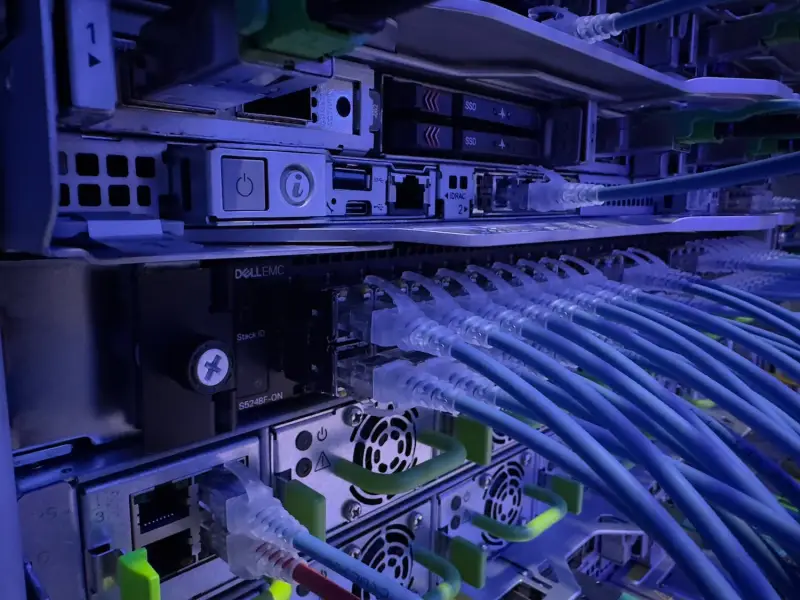
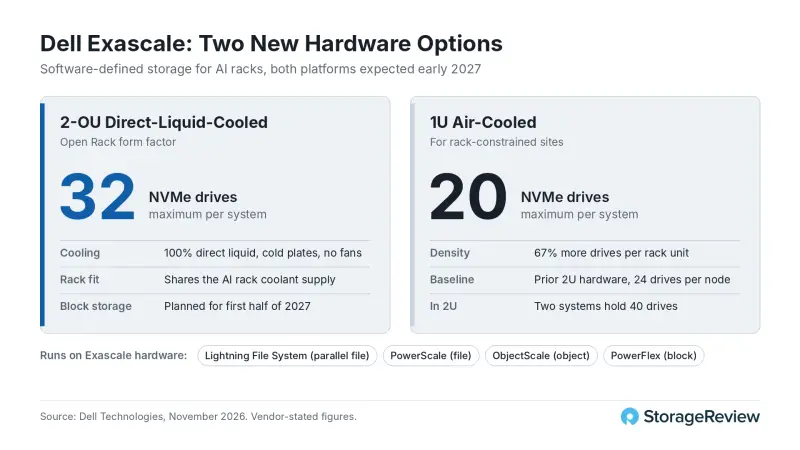
Dell's SC26 announcements are mostly about density and cooling, and the storage side matters most for anyone planning AI racks. Dell Exascale gets two new hardware platforms: a 2-OU direct-liquid-cooled chassis with up to 32 NVMe drives, and a 1U air-cooled unit with up to 20. Dell expects both in early 2027. The same batch adds an agentic data gateway, new rack-scale management tools, and a 512-core air-cooled PowerEdge M8825. Here's what's actually in it and what to check before you start planning around it.
Exascale Hardware: Liquid Cooling Comes to Storage
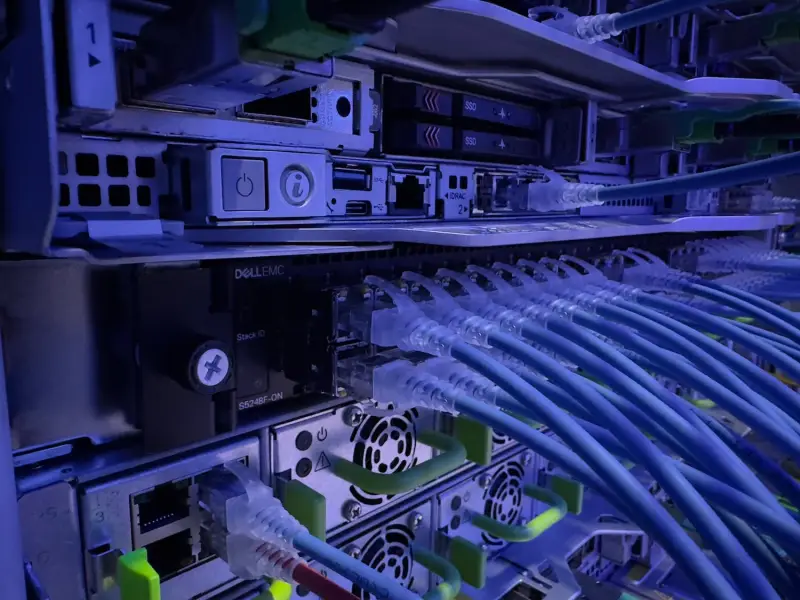
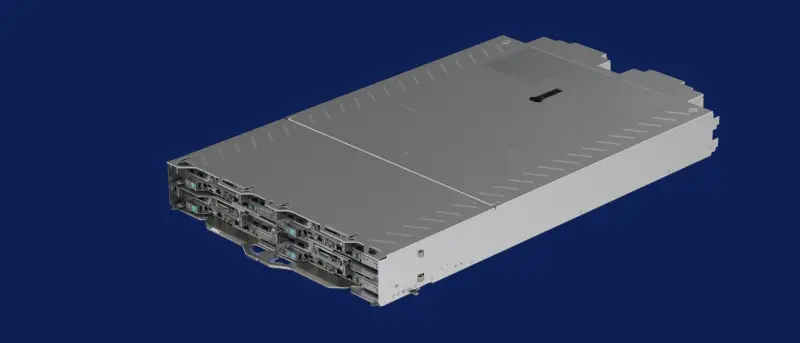
Dell Exascale runs four storage software stacks on common PowerEdge hardware: Lightning File System for parallel file, PowerScale for file, ObjectScale for object, and PowerFlex for block. The new liquid-cooled model takes that stack into Open Rack designs. The 2-OU chassis holds up to 32 NVMe drives, and cold plates cover every heat-producing component, so the box runs without fans. The practical point is that storage can sit in the same rack as liquid-cooled compute and networking and draw from the same coolant loop. If your AI racks are already moving to direct liquid cooling, that's the reason to pay attention.
Dell describes the platform as the world's first direct-liquid-cooled storage for rack-scale AI. That's Dell's claim, based on a November 2026 comparison of enterprise storage systems that ship with storage software and have been announced for commercial availability. Block support on the liquid-cooled hardware isn't due until the first half of 2027, so for now it's a file and object story.
The 1U platform is the air-cooled option for sites that are short on rack space or don't have liquid infrastructure yet. It holds up to 20 NVMe drives. Dell puts drive density 67% higher per rack unit than its previous 2U Exascale hardware, which holds 24 drives per node. Two of the new 1U systems put 40 drives in the same 2U footprint, which is where that figure comes from. Both platforms can be deployed as a PowerRack for Storage or as part of an integrated rack. Dell also notes that software-defined PowerScale on Dell Exascale has earned NVIDIA-Certified Storage validation at the Foundation level.
Agentic Data Gateway and Data Orchestration
The software change that could matter most to data teams is the Agentic Data Gateway in the Dell AI Data Platform. It's a customer-controlled MCP server and LLM gateway inside the Data Orchestration Engine. An agent connects once and reaches governed data, tools, and models through a single endpoint. Authorization, quotas, logging, and cost tracking are handled centrally. Dell says the gateway and everything behind it run inside the customer's environment, which is the detail most security and platform teams will ask about first.
Dell's internal testing reports that reusing context through the gateway cut token consumption by up to 76% and raised answer accuracy from 60% to 94%. The test used a synthetic toll-plaza operations corpus, 20 questions across six workload types, and NVIDIA's Nemotron-3-Super-120B-A12B model served through NVIDIA NIM. These are Dell's results, and nobody outside Dell has run or audited them. Treat them as a starting point for your own testing, not a planning baseline.
Hybrid pipeline orchestration runs data processing where the data already sits, across on-premises private clouds, the Dell AI Factory with NVIDIA, non-Dell infrastructure, and public clouds. The idea is that large unstructured datasets don't have to be copied to be prepared. Storage Intelligence and Data Intelligence report where data came from, its quality, and how it's used. Dell says its scanner reads only metadata, at about 11,000 files per second, and captures 61 metadata fields per file. That throughput is Dell's figure, so it's worth checking against your own file counts and metadata requirements.
A unified pipeline now prepares tables, images, video, and documents together, and routes vectors to whichever database the customer already runs. Dell cites up to 12x faster indexing. That number traces to Elastic's published benchmark of Elasticsearch with NVIDIA cuVS, which compared GPU-accelerated and CPU-only vector indexing on a single AWS g6.4xlarge instance. Read that as a single-instance result, not a general speedup. Data Orchestration also adds integrations with LangChain, OpenAI Codex, and Unstructured.io. Dell lists the AI Data Platform updates for December 2026.
OpenManage Rack Scale and Fabric Manager
OpenManage Rack Scale is a new management platform that spans everything from a single server up to complete Dell PowerRack systems. Dell says one instance manages up to 100,000 devices. The current ceiling for OpenManage Enterprise 4.8 is 8,000, and that gap is the basis for Dell's claim of up to 12x scale. It deploys on premises as a virtual machine, and operators can query system health, alerts, firmware, inventory, power, and performance in natural language. Dell says OpenManage Enterprise customers have a defined migration path to Rack Scale.
Dell's internal testing put Day-0 firmware update preparation at about one minute in Rack Scale, compared with roughly five hours using manual methods. The platform is available now.
Dell Fabric Manager, also available now, handles intent-based automation, lifecycle management, and observability across network fabrics that mix network operating systems and switch silicon. It covers digital-twin design validation, zero-touch provisioning, upgrades, and drift auditing across data center, AI, HPC, and edge deployments. Dell cites up to 80% less Day-2 operational effort and 100% accurate device inventory. Those figures come from BE Networks lab testing of manual procedures against Fabric Manager automation. Enterprise SONiC Distribution by Dell Technologies adds support for the PowerSwitch Z9964F-ON and NVIDIA's SN4700 Spectrum platform, with routing and resiliency additions such as L2 VXLAN multihoming and packet trimming. Dell lists that release for January 2027.
PowerEdge M8825 and AMD Modular Platforms
The PowerEdge M8825 is a two-socket, air-cooled AMD EPYC server with up to 512 cores and 1,024 threads per node. That core count matches the PowerEdge R9825 with two 256-core EPYC Venice processors. Dell designed the M8825 for Open Rack deployments drawing 35kW to 75kW per rack. Dell's internal analysis puts up to 46 servers in a rack, depending on configuration, power limits, and cooling capacity. The specifications are preliminary, and Dell is targeting the first half of 2027.
Dell's modular AI configurations with AMD put AMD Instinct MI350P PCIe GPUs into PowerEdge XE7745 and R7725 servers, alongside PowerSwitch networking, PowerScale storage, and the Dell AI Data Platform. Dell is also adding validated support for AMD Enterprise AI Suite, Red Hat OpenShift Container Platform, and Red Hat AI Enterprise. According to Dell, a deployment can start with one compute node and grow by adding GPUs, nodes, storage, or networking.
For the largest builds, the AMD Helios Rack-scale Solution from Dell pairs 72 AMD Instinct MI455X GPUs with Dell PowerRack networking and storage, plus Dell's deployment and lifecycle services. Dell quotes up to 2.9 exaflops per rack, a figure from AMD's internal analysis that matches the FP4 number AMD gave for Helios at launch. Dell hasn't published availability dates for the modular configurations or the Helios rack.
Validated Blueprints and Delivery Services
Dell says the Dell AI Factory with NVIDIA now spans more than 420 offerings and more than 6,500 customers. Arthur Lewis, president of Dell's Infrastructure Solutions Group, framed the SC26 updates around the full stack: "AI outcomes don't come from models alone."
New and updated blueprints in the Dell AI Ecosystem Program cover AI security with F5 and JFrog, agentic AI with DataRobot, observability with Dynatrace, computer vision with Ipsotek, data for AI with Iternal Technologies and Teradata, knowledge assistants with Aible, Atolio, and Maven AGI, a code assistant with OpenAI, and governance and orchestration with Klique by ClearML and JFrog. The DataRobot, Dynatrace, Aible, OpenAI Codex, ClearML, and JFrog items are available now. The Ipsotek blueprint is due in Q4 2026, and the F5, Teradata, Iternal, Atolio, and Maven AGI blueprints in Q1 2027.
A newly validated modular architecture pairs Dell PowerStore with PowerEdge XE9785 servers carrying NVIDIA HGX B300 GPUs and Dell-supported NVIDIA AI Enterprise. Dell positions PowerStore as block storage for the stateful services agents depend on, such as databases, queues, logs, and recovery data. The servers and software are available now, and the validated PowerStore design follows in Q4 2026.
Dell AI Factory Engineers is a delivery model that assigns one team, made up of an AI strategist, architect, data specialist, and engagement manager, to cover platform, workload, data, governance, and security work, with knowledge transfer to the customer's staff. It's available now. Dell Services for AI Data Centers, due in Q4 2026, assesses whether a facility's power, cooling, and space can support planned AI hardware, and produces facility designs to close any gap.
My read: the Exascale liquid-cooled node is the item to track, mainly because it lets storage share the coolant loop with compute. Plan for early 2027, confirm block support timing against your workload, and treat the performance and efficiency numbers as Dell's own until you've tested them in your environment. Dell Exascale Storage