BLUETTI Apex 300 Brings 240V and a Wall Limit to One Portable Battery
- Kevin OBrien
- 560 views
BLUETTI's Apex 300 delivers 240V from one 3,840W unit and caps grid draw from 1A to 50A, so two workstations can share a 20A circuit.
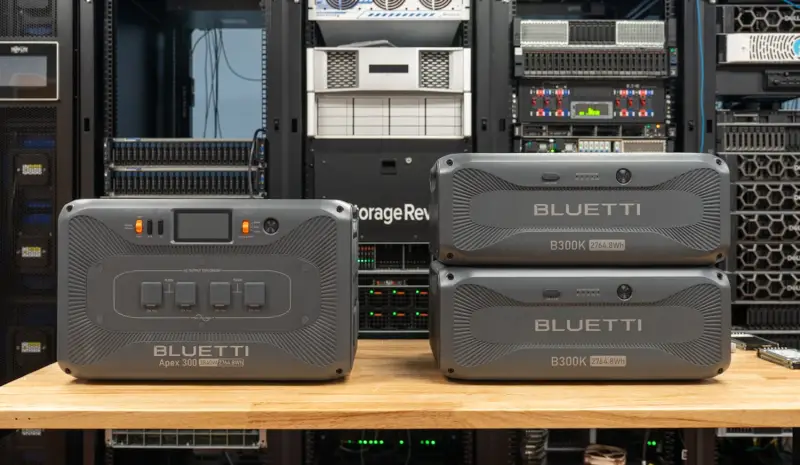
The BLUETTI Apex 300 is a 2,764.8Wh portable power station with a 3,840W inverter, and two of its features set it apart from the smaller units we've tested. It outputs 240V from a single box, and it lets you cap how much current it pulls from the wall, in 1A steps. The battery covers whatever the connected gear needs above that cap. Those two features push it out of the camping and storm-backup category and into the lab and the home office, where the real problem is often a 20A circuit feeding two workstations rather than a power cut.
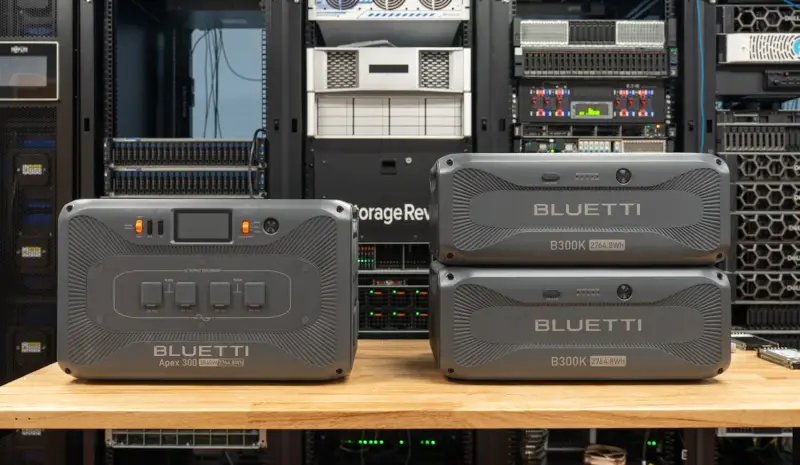
Why the Circuit Matters More Than the Outage
Most portable power stations are sold on runtime and outage readiness. The Apex 300 is built around a different question: what happens when the equipment on a circuit wants more power than the circuit can safely deliver? Workstations such as the DGX Station class systems are designed to draw close to the ceiling of a 15A or 20A circuit. Put two of them on one circuit and something has to give, either the breaker or the workload.
That's the gap the Apex 300 is trying to fill. With the unit between the wall and the equipment, the wall sees no more than the limit you set. The battery supplies the difference until the load drops back under that number. The same unit also acts as a UPS for everything plugged into it, which means one battery for the room can replace the small lead-acid unit under each desk. Here's the thing, though: that only works if the inverter, the input limit and the transfer behaviour all hold up under real load. That's what we set out to check.
Where the Apex 300 Sits in BLUETTI's Lineup
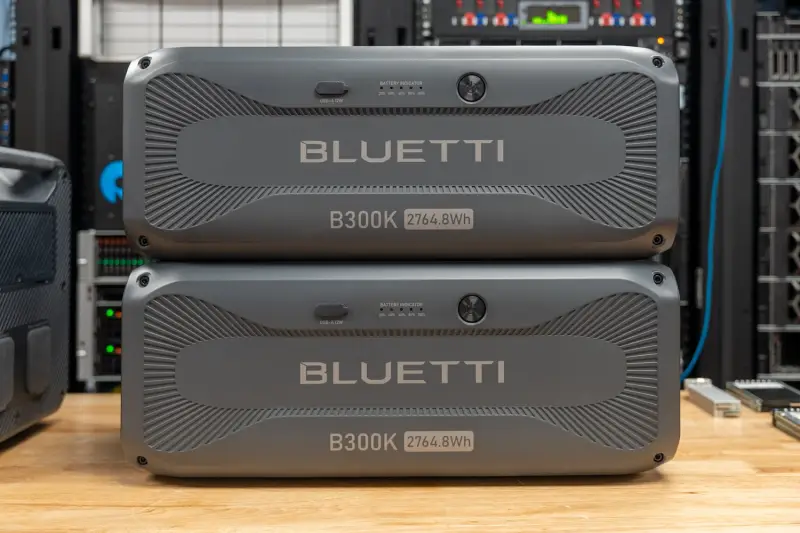
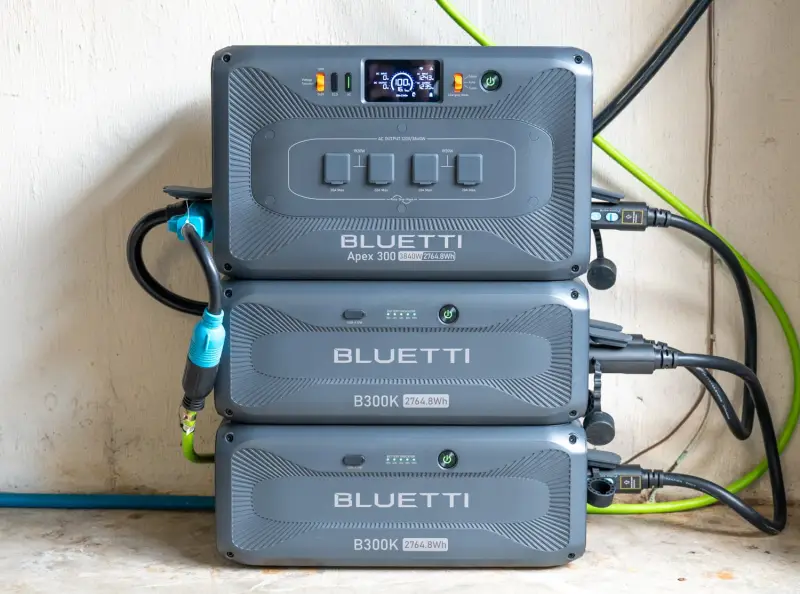
The Apex 300 sits above the Elite 300 and Elite 400 on output and sits below the Elite 400 on battery capacity. The design priorities differ, though. The Elite units are sealed single-inverter stations with a fixed set of 120V outlets. The Apex 300 is designed as the head of a modular system. A battery expansion port on one end accepts up to six B300K packs, for a stack of 19,353.6Wh. A 50A input/output port on the side handles high-current charging and pass-through. The inverter can charge at 120V while it supplies 240V loads, or charge at 240V while it feeds 120V equipment.
That flexibility is the reason the unit is interesting for the kind of equipment we run. It's a different machine from the ones we've previously tested, and it's aimed at a different buyer.
Specifications That Matter for Lab and Office Use
The figures below come from BLUETTI's US product page for the Apex 300, as of November 5, 2026. The USB-C, USB-A, cigarette-lighter, DC5521 and Anderson outputs require the optional Hub D1, and they're listed as BLUETTI gives them.
| Specification | BLUETTI Apex 300 |
|---|---|
| Battery Capacity | 2,764.8Wh (51.2V, 54Ah) |
| Battery Chemistry | LiFePO₄ (Lithium Iron Phosphate) |
| Cycle Life | 6,000+ cycles to 80% original capacity |
| Expansion | Up to 6x B300K / B300S / B300 per unit (B300K: 2,764.8Wh, 65.04 lbs, $1,099) |
| Continuous AC Output | 3,840W Max. total, 120V/240V, pure sine wave |
| Lifting Power | 7,680W |
| Bypass | Up to 12kW (BLUETTI figure, via the 50A input/output port) |
| AC Outlets | 4x AC outlets (20A, NEMA 5-20R), 1x NEMA TT-30R (120V/30A), 1x NEMA 14-50R (120/240V, 50A), 1x AC input/output port (P050A, 50A) |
| AC Input (standard cord) | 120V, 50/60Hz, 15A Max., 1,800W Max. with bypass |
| Turbo Charging | 3,840W Max. (80% in 45 minutes at 59°F to 77°F) |
| Solar Input | 2x 1,200W, 12 to 60VDC, 2x 20A |
| Maximum Input | 3,840W (Apex 300 alone), 6,240W (Apex 300 with one to six B300K) |
| Dimensions (L x W x H) | 20.67 x 12.87 x 12.6 in (525 x 327 x 320 mm) |
| Weight | 83.78 lbs / 38 kg |
| UPS Switching Time | 0ms or 20ms (BLUETTI figures) |
| App Connectivity | Wi-Fi and Bluetooth |
| Warranty | 5 years |
Build, Ports and the 240V Layout
The Apex 300 is a wide, low box measuring 20.67 x 12.87 x 12.6 inches and weighing 83.78 pounds. That puts it 2 pounds under the Elite 400, but without the Elite 400's wheels. BLUETTI sells a folding trolley as an accessory. The shape is meant for stacking, since a B300K pack shares the same footprint at 8.23 inches tall, so the head unit sits on top of its batteries. For a unit that will live under a bench or beside a rack, that's the right shape. Moving 84 pounds by the molded handles at each end is still a two-person job.
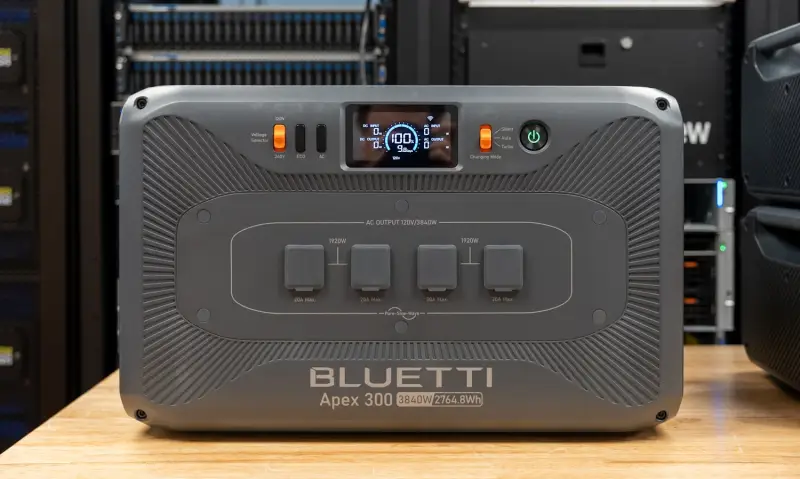
The front panel is simpler than the spec sheet suggests. Four 20A outlets sit in the centre, labelled as two 1,920W pairs under a 3,840W total. A voltage selector to the left of the display switches output between 120V and 240V. Charging modes (silent, auto and turbo) and the power button sit on the right, so the settings you change day to day are reachable without opening the app.
The voltage selector follows from how 240V works in North American homes. The supply is split-phase: two 120V lines, each 120V to neutral, and 240V between them. The Apex 300 carries two inverters, one per line, which is how a single unit produces both lines and the 240V between them. In 120V mode every outlet runs at 120V. In 240V mode the 14-50R on the side carries both lines plus neutral and ground, so it can feed a 240V load or 120V loads on either leg, depending on how the downstream outlet is wired. The four front outlets stay at 120V.
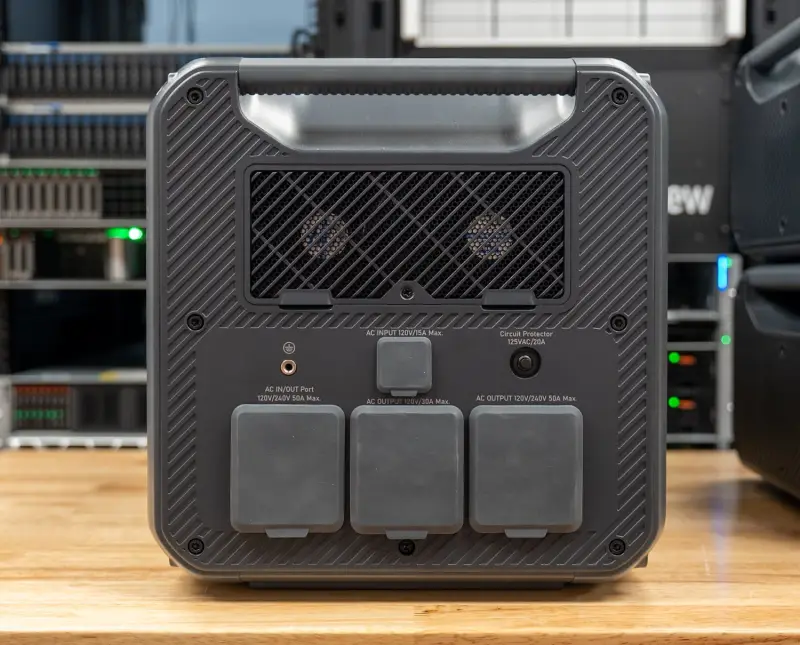
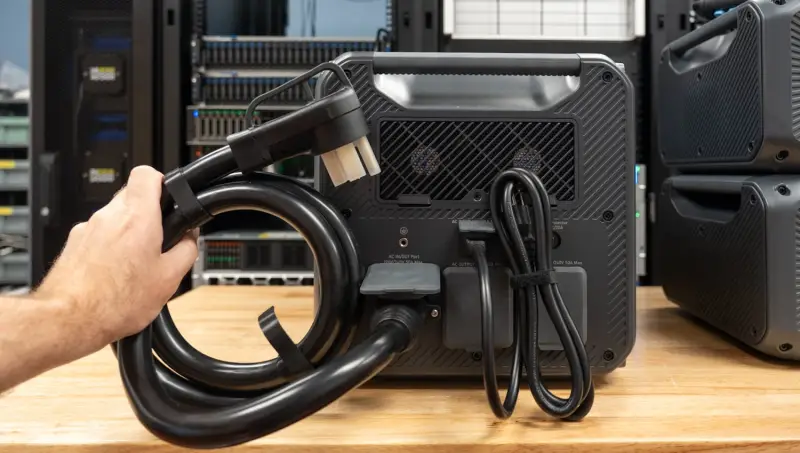
The high-current connections sit on one end under a molded handle and the fan grille. Across the top are the grounding terminal, the standard 120V 15A AC input and a 20A circuit protector. Below them are three covered outlets: the P050A port, a 50A input/output connection rated for 120V or 240V that takes BLUETTI's 30A or 50A AC charging cables; a TT-30R rated at 120V and 30A; and the NEMA 14-50R rated at 120/240V and 50A.
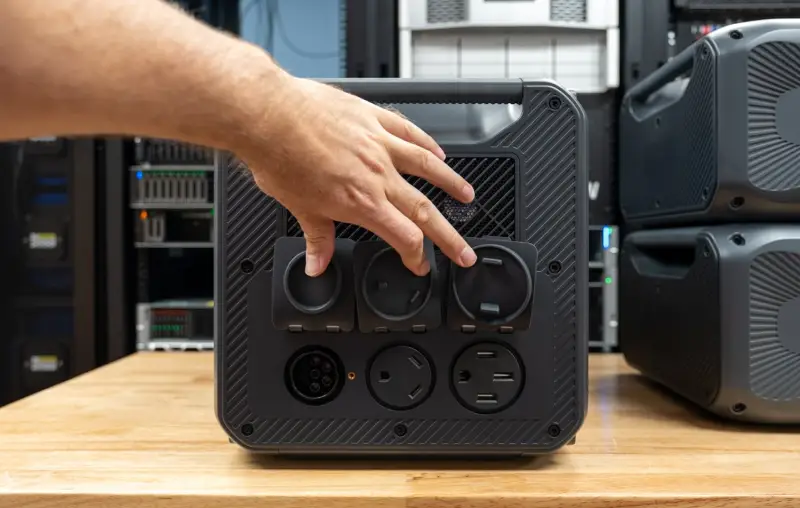
Through the P050A port the unit charges at up to 3,840W. In bypass it can pass loads well above what the 15A inlet supports, and BLUETTI quotes a 12kW bypass figure for EV charging and HVAC through that port. The 50A cable is heavy and stiff, with a 14-50P plug on the wall end, and it can be connected alongside the standard 15A cord. The opposite end of the unit carries the battery expansion port and the solar and car DC input under a second grille, with a removable dust filter over the intake.
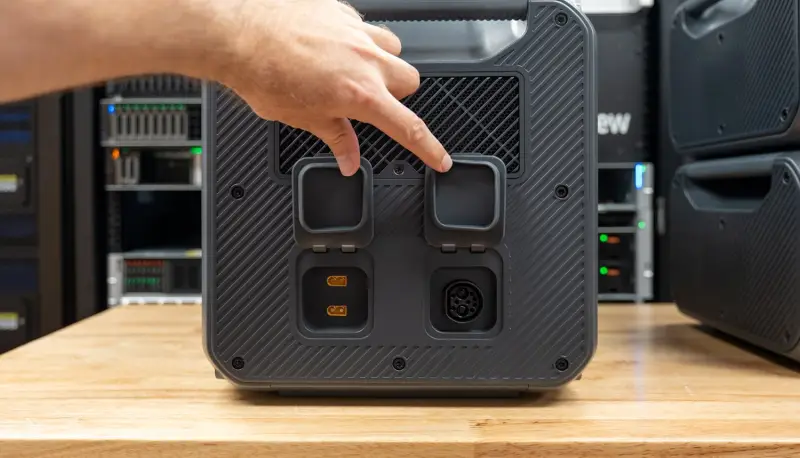
What the Apex 300 doesn't have is any DC output on the unit itself. USB-C, USB-A, cigarette-lighter, DC5521 and Anderson connections all live on the optional Hub D1, a $299 box rated at 700W that plugs into the unit. For a station aimed at AC loads, that's a defensible choice, and it keeps the front panel to the outlets that matter at this power level. If you plan to charge a laptop from the station, budget for the hub.
App Controls and the Grid Input Limit
The BLUETTI app connects over Wi-Fi or Bluetooth and shows the same power-flow view we saw on the Elite 400. That covers grid, solar, DC and AC in and out, state of charge and estimated runtime at the current load. The Apex 300 adds the control that matters most for this unit. The grid input limit sets the maximum current the unit will draw from the wall, from 1A to 50A in 1A steps, depending on which cord is connected. Output voltage is set with the selector on the front panel.
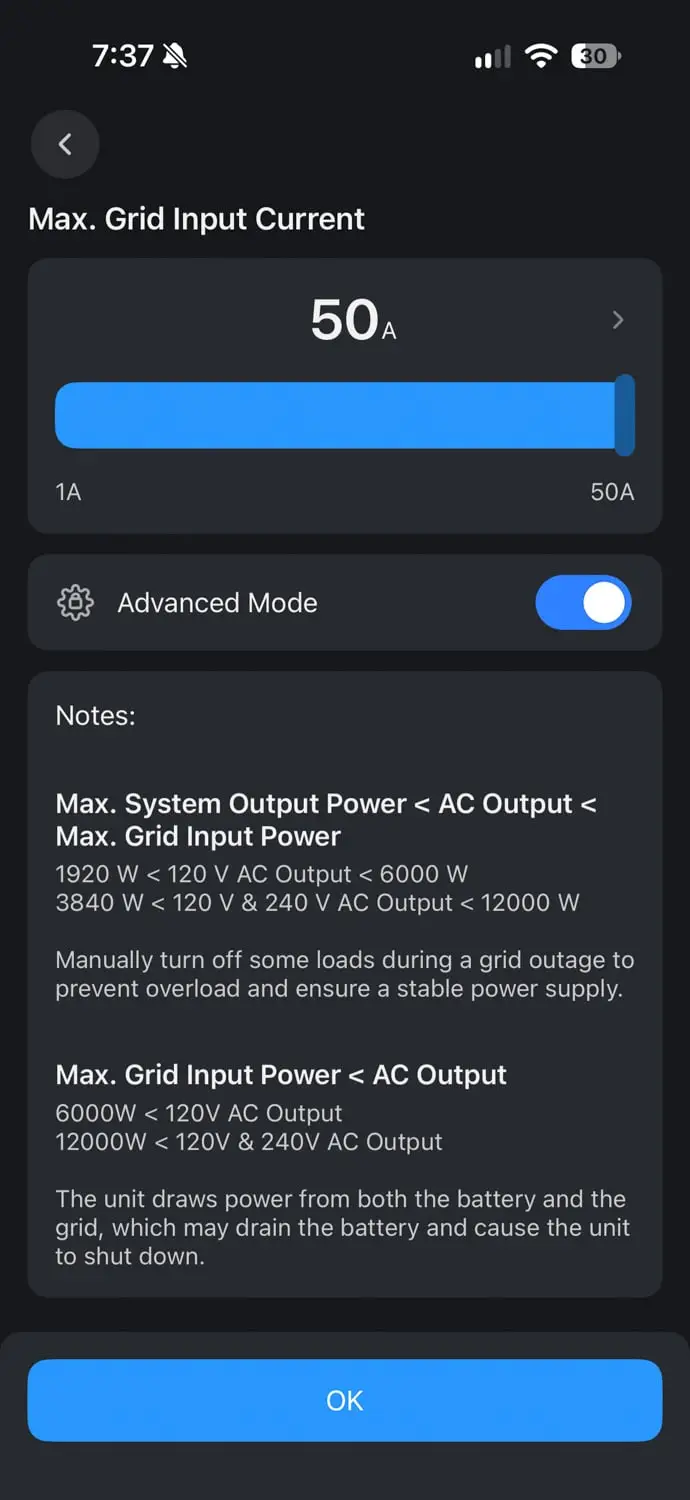
The grid input limit in the BLUETTI app, set here to the 50A maximum
Charging modes work as they do on the Elite series. Silent charging keeps the fans down at the cost of speed, and turbo runs them up. Extreme Weather Alert, which tops the battery off ahead of a forecast outage, carries over from the Elite line.
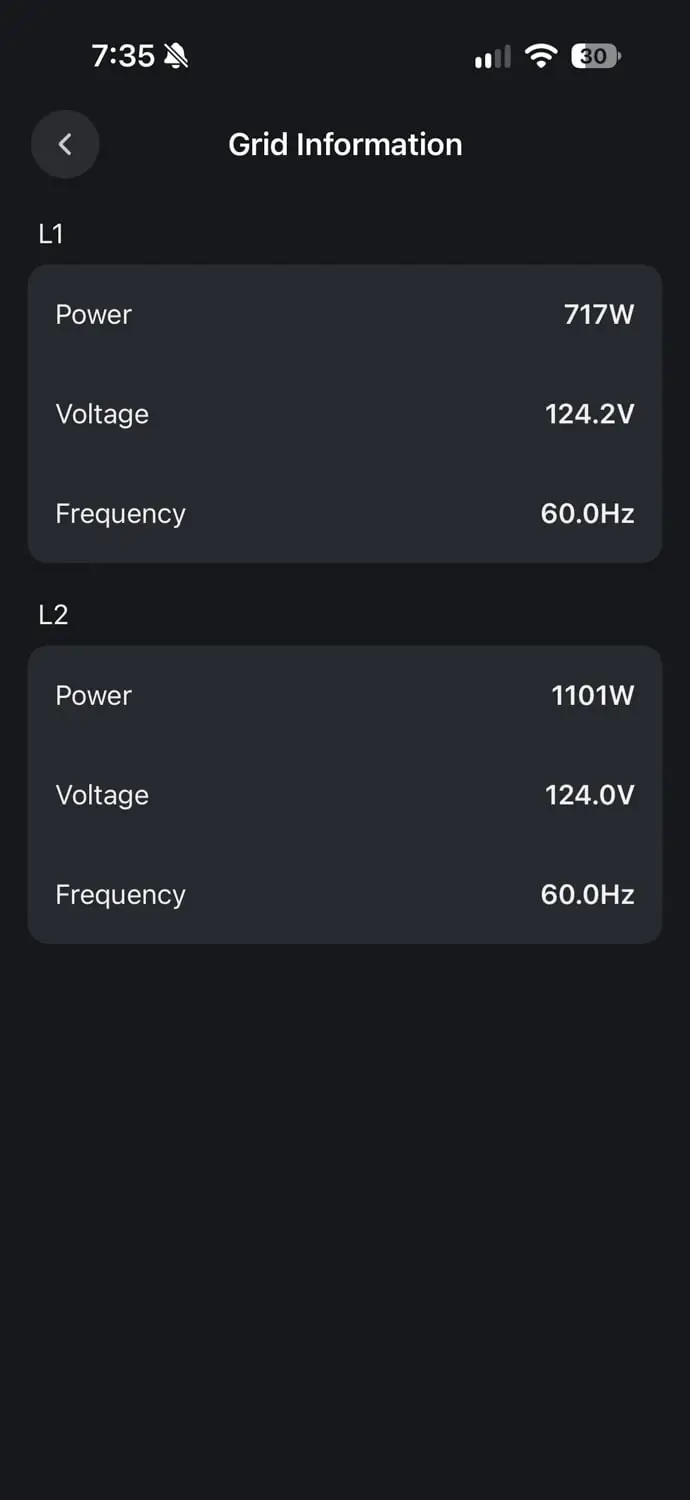
Grid Information on a 240V input: 717W on L1 and 1,101W on L2
The input limit interacts with the voltage mode, and this is the detail to get right before you rely on it. On a 120V supply with the unit in 120V mode, the amp limit applies to that single line, which is the simple case. On a 240V supply with the unit still in 120V mode, the limit applies to one line only. The unit charges through a single inverter and draws from just one leg of the incoming 240V. It won't pull from both legs until the output is switched to 240V mode.
In the Grid Information screen above, the Apex 300 is set to 240V output on a 240V input, and the app reports the load on each line separately: 717W on L1 and 1,101W on L2. The split follows the arrangement described earlier. In 120V mode only one inverter handles the charging, whatever is plugged into the input. In 240V mode the charging spreads across both lines. Anyone charging from a 240V circuit through the 50A port should set the output to 240V so the draw is balanced across both legs.
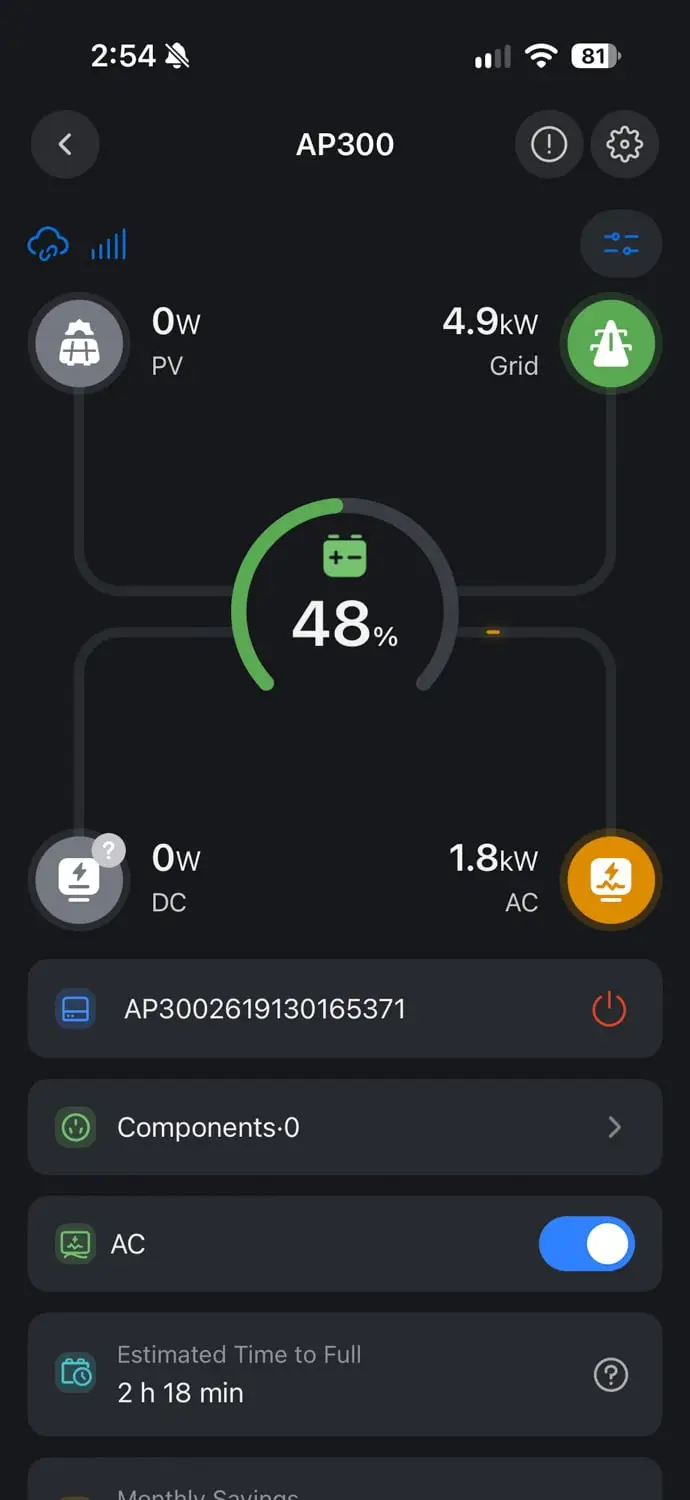
The power-flow view while charging from the grid at 4.9kW with 1.8kW out on AC
There's a side benefit to 240V supply. A load drawing the same wattage needs less current on a 240V circuit, so smaller breakers can do the job. 30A from a single 120V line gives 3,600W. A two-pole 30A breaker at 240V gives 7,200W.
Measured Capacity and Round-Trip Losses
The 2,764.8Wh rating is nominal battery capacity. Energy available at the AC outlets is lower once the inverter and the unit's electronics take their share. For discharge testing we ran a large blower fan as a steady inductive load, with our power meter between the unit and the fan, and logged the delivered energy until the unit shut down. We then recharged from 0 to 100 percent and logged the draw from the wall.
The single Apex 300 delivered 2.39kWh before powering off, 86 percent of its rating. It took 3.30kWh from the wall to refill, a round trip of about 72 percent. With two B300K packs attached, the 8,294.4Wh stack delivered 7.38kWh, or 89 percent of the combined rating, and took 10.01kWh to recharge. That's a round trip near 74 percent. The expansion packs returned a slightly larger share of their capacity than the head unit alone, which makes sense if the inverter overhead is spread across three batteries.
At the 740W workstation load we used in the Elite 400 review, 2.39kWh works out to a little over three hours. The three-battery stack covers about ten. At a 100W networking load the single unit lasts about 24 hours.
UPS Switchover Under Load
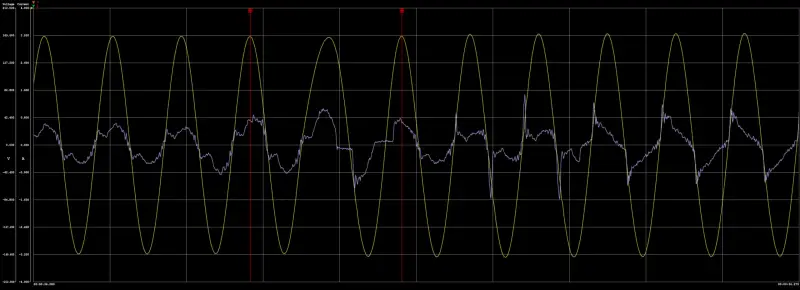
For the backup test we put a Dell Pro Precision 9 T2 workstation on the output, measured through our Quarch power analyzer, and cut the incoming AC. With the workstation idling near 100W, the transfer from utility to battery measured 16ms between the capture cursors. The return to line power was clean. The first cycle showed a slightly wider wave and a small voltage rise as the inverter resynchronised, but power didn't drop on the way back. The capture shows only some noise through that window.
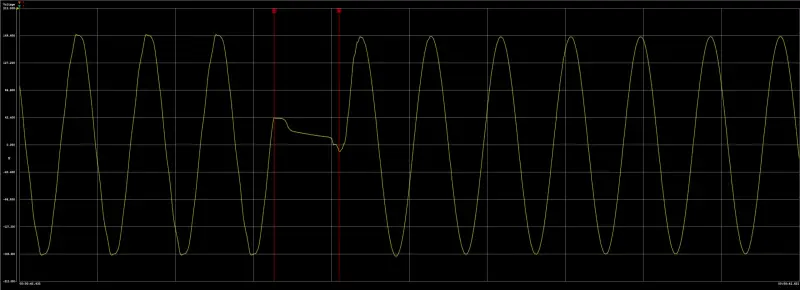
We repeated the test with the workstation under a benchmark load near 700W. The transfer was again 16ms, with a rougher waveform for the first cycles on either side.
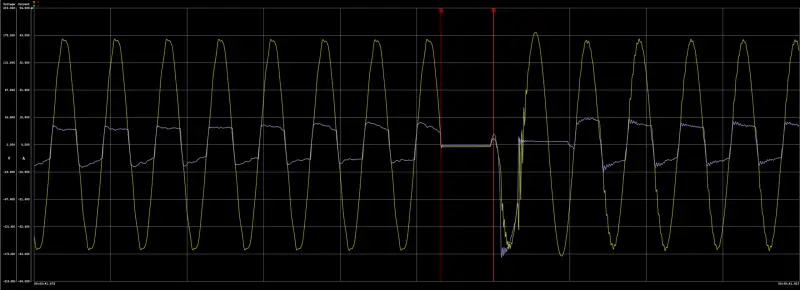
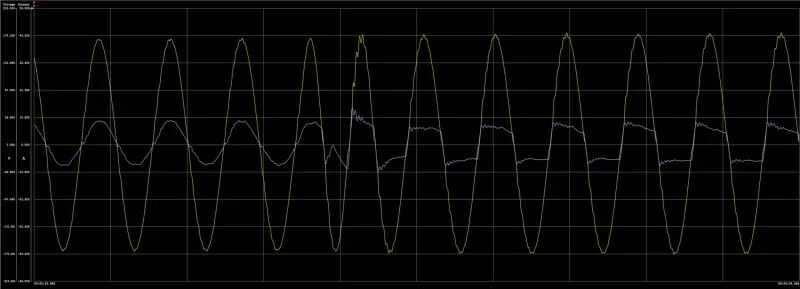
BLUETTI advertises both 0ms and 20ms switchover, and which one you get depends on voltage mode and outlet. Our captures ran in 120V mode, which is the 20ms path. The 16ms we measured at the outlets sits inside that figure. It's slower than the 8ms to battery on the Elite 300 and the 6ms on the Elite 400.
On return to power, under both the 100W and 700W loads, output never dropped. The signal was just slightly dirty for a single waveform. The workstation rode through both transitions in both tests. The only equipment we can think of that might notice a 16ms gap is something with no input capacitance, such as an old CRT.
The 0ms figure comes from the dual-inverter design. With the unit in 240V mode on a 120V input, the wall supplies only one of the two lines. The unit generates the second 120V line itself through double conversion. The two left front outlets ride on that generated line and switch with no gap. The two right outlets are fed through bypass from the wall and see the same short delay we measured. On a 240V input in 240V mode, both inverters run in bypass and every outlet sees the delay. We didn't capture the 0ms path this round.
Capping the Wall: Two Workstations on One Circuit
The grid input limit is the feature that sets the Apex 300 apart. A 20A circuit at 120V is 2,400W, and the 80 percent rule for continuous loads brings the safe figure to 1,920W. A 15A circuit gives 1,800W and 1,440W. Workstations built near that ceiling leave no room for a second one on the same circuit, and two peaking together will trip the breaker. The Apex 300 lets you set the most it will pull from the wall. When the connected load goes above that number, the inverter draws the difference from the battery.
We set the limit to 700W with two Dell Pro Precision 9 T2 workstations on the output and logged the draw on the charging cable with the Quarch analyzer. With both systems idle, wall draw sat near 220W. When the benchmark started and the systems drew about 1,100W together, the draw climbed past the limit with a brief peak near 880W before the limiter clamped it. It then held between 680W and 700W for the rest of the run, while the workstations pulled more than that from the outlets and the battery supplied the excess. When the load dropped, wall draw fell back to around 300W.
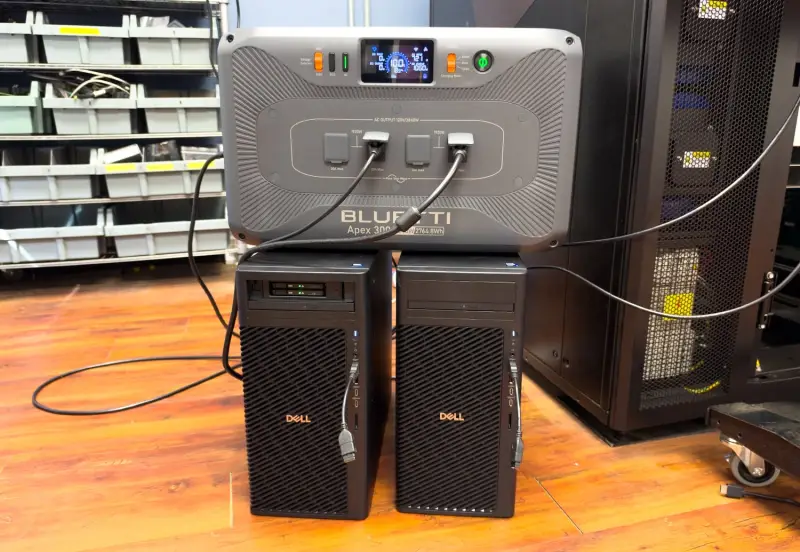
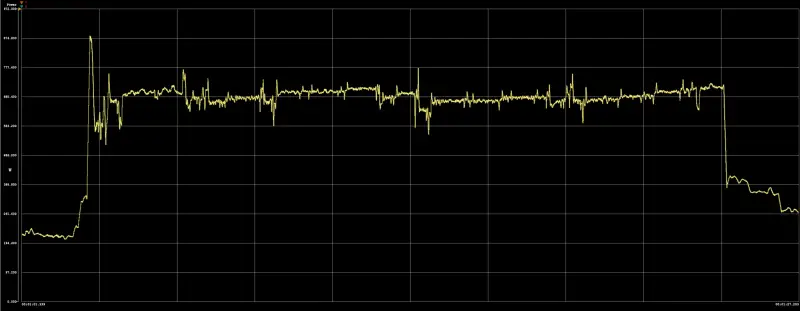
The battery can't carry that difference forever. Think of the limit as a buffer for peaks, not a way to run 3,000W of equipment on a 15A circuit all day. For two systems that cross the limit for minutes at a time, it keeps the circuit under its rating and the workloads online. The same arrangement scales toward the inverter's 3,840W ceiling when a 240V load runs on the 14-50R. Our test case was two GB300 workstations on one 20A circuit. The Apex 300 is the first portable unit we've tested that handles that setup without a transfer switch or a second circuit.
Against the Elite Units
| Specification / Test | BLUETTI Apex 300 | Apex 300 + 2x B300K | BLUETTI Elite 400 | BLUETTI Elite 300 |
|---|---|---|---|---|
| Rated Battery Capacity | 2,764.8Wh | 8,294.4Wh | 3,840Wh | 3,014.4Wh |
| Continuous AC Output | 3,840W (120V/240V) | 3,840W (120V/240V) | 2,600W (120V) | 2,400W (120V) |
| Measured AC Energy Delivered | 2.39kWh (86%) | 7.38kWh (89%) | 3.07kWh (80%) | 2.67kWh (89%) |
| Measured Recharge Energy | 3.30kWh | 10.01kWh | 3.96kWh | 3.49kWh |
| Measured Transfer to Battery | 16ms | Not measured | 6ms | 8ms |
| Grid Input Limit | 1A to 50A, 1A steps | 1A to 50A, 1A steps | Charging current only | Charging current only |
| Weight | 83.78 lbs | 213.86 lbs | 85.98 lbs | 57.98 lbs |
| Price at Review | $1,499 | $3,697 | $1,399 | $1,199 |
The Apex 300 returns a larger share of its rating than the Elite 400, 86 percent against 80 percent, from a smaller battery. The two deliver 2.39kWh and 3.07kWh from 2,764.8Wh and 3,840Wh. Where the Apex 300 pulls ahead is everything after the battery: 3,840W against 2,600W, 240V on the 14-50R, the 50A port and the input limit. The Elite 400 is still the better pick if you want the most runtime from one box with wheels underneath. The three-battery Apex stack at $3,697 delivers 7.38kWh, about 2.4 times the Elite 400's measured figure, for roughly 2.6 times the price and 2.5 times the weight.
Pricing, Warranty and What to Budget
The Apex 300 lists at $1,499 at the time of review, down from a $1,699 list, with a five-year warranty. The B300K expansion battery is $1,099 alone and $2,599 bundled with the head unit, and carries a three-plus-one-year warranty. The 50A AC charging cable, the $299 Hub D1, the $219 Charger 1 alternator charger and the solar bundles are all sold separately. BLUETTI's page lists the Apex 300 as shipping from early December, so check availability if the purchase is time-sensitive.
Plan the total around the jobs you need it to do. A single Apex 300 covers the UPS and power-limiting use cases in this review on its own. Expansion packs add runtime, and the 50A cord adds charging speed and bypass capacity above the 1,800W the standard cord allows. The accessories add up quickly, though. The head unit with two B300K packs comes to $3,697 before the cord.
The Takeaway
The Apex 300 is the first portable power station we've tested that earns a place in the lab for reasons other than keeping the lights on. Its 3,840W dual-inverter output supplies 240V from one unit through the 14-50R. The grid input limit turns it into a buffer that holds a shared circuit under its rating while the battery covers the peaks. In our test, two Dell Pro Precision 9 T2 workstations ran a benchmark behind a 700W wall limit, with the draw clamped between 680W and 700W after a brief peak near 880W.
On the UPS side, the transfer to battery measured 16ms at idle and at a 700W load. That's inside BLUETTI's 20ms figure, though slower than the Elite 300 and Elite 400, and the workstation never noticed. BLUETTI's 0ms figure applies to the two left front outlets in 240V mode on a 120V input, a path we didn't capture this round. For a system where an interrupted shutdown would be expensive, those outlets or a dedicated online UPS remain the conservative choice.
The trade-offs are weight and modularity. At 83.78 pounds with no wheels and only molded handles, the Apex 300 is built to be placed and left. Every DC output, USB-C included, requires the $299 Hub D1. Here's my read: the expansion packs and the 50A cord are the right accessories for runtime and charging speed, but they're a second purchase, not a footnote.
At $1,499 with a five-year warranty, the Apex 300 is the unit to buy when the problem is the circuit rather than the outage. It can replace a lead-acid UPS under each desk with one battery for the room, and it gives a workstation pair headroom a single circuit can't. It scales to a 19,353.6Wh stack if runtime becomes the next problem. For pure backup runtime on wheels, the Elite 400 is the easier unit to live with. For anything that draws 240V or needs the wall held to a set number, the Apex 300 is the one to test first.