Cadillac F1's CIO Built IT From Scratch and Let the Data Set the Pace
- Kelsey Ziser
- 472 views
Cadillac F1 CIO Chris Green built an IT team from zero, picked ERP before the coffee machines, and used AI to rebuild lost part-traceability records.
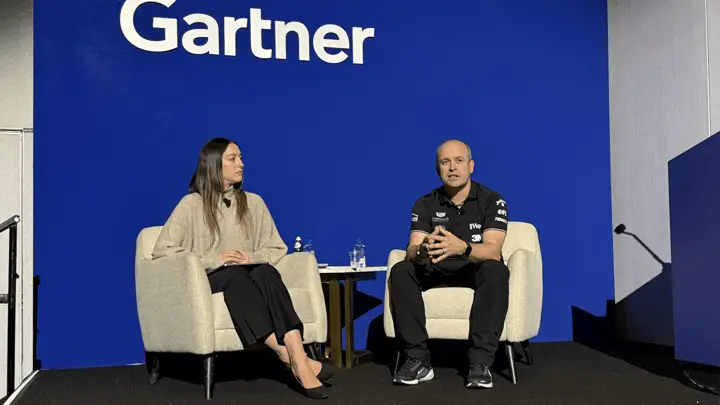
Most IT leaders inherit a tangle of legacy systems and spend years untangling it. Chris Green got the opposite problem. As CIO at Cadillac F1, he joined the team as a department of one and had to build the entire technology stack before the car could be designed, made and raced. Speaking at Gartner Symposium/ITxpo, he described a greenfield build that moved fast, made a lot of decisions quickly and, by his account, paid off when the team reached its first season.
Starting with a lot of cables and no team
The early days were not glamorous. Green began by running cables and setting up equipment himself, working out of about eight temporary offices. He calls that phase "quite scrappy," and it's an honest description of what a greenfield start looks like on the ground. There's no legacy debt to drag you down, but there's also no existing process to lean on, and every choice lands on the same desk.
Green says the upside of starting clean is the ability to set up accurate data collection and management from day one. The downside is pressure. The team had to build its own infrastructure and move quickly while the racing side of the business was ramping up. Green's supervisor gave him significant operational autonomy, which helped. He also told his team he'd be satisfied if they got 80% of their decisions right, a useful line for any IT group facing a long list of calls with no time to review each one.
Hiring into a sport that rarely builds from zero
Most Formula One teams enter the sport through acquisition, so there's little precedent for building an IT function from nothing. Cadillac's IT team was built the same way the technology was: from the ground up. Green said plenty of people with sport experience, or who wanted to get into it, were interested in joining that effort. The team grew as the racing operation grew, and Green kept a people-first approach in hiring and management. His guiding order is people first, then process, then technology.
Why the car itself drives the data problem
What makes F1 unusual from an IT perspective is that teams don't buy their cars off a shelf. Green put it plainly: in other racing series the car is largely bought from a catalog, but in Formula 1 the team has to design and manufacture its own. That means the first tool the IT team needed was a CAD system. Designing Cadillac's car took nearly 300 engineers about three years, according to Green. Every one of those engineering hours produces files, revisions and dependencies that have to be tracked.
That volume of design data is why the sequence of IT decisions mattered. As the team moved from design into manufacturing, the next major choice was an ERP partner.
ERP before the coffee machines
Green selected IFS technology to handle procurement, design and manufacturing processes, sourcing, supply chain management and financial transactions. He said ERP was so central to the data strategy that the team settled on it before buying coffee machines for the office. By that point the IT team had grown to 60 employees.
The IFS software also tracks almost every part of the car. Each component is monitored so the racing team gets an alert when servicing or maintenance is due. Sensor data from the car feeds into software licensed from General Motors, and servicing records flow back into the ERP system. For a team that is both a manufacturer and a race operation, that closed loop between the track and the back office is the point of the whole architecture.
Traceability gaps and an AI-assisted fix
Sourcing from third-party vendors is only part of the picture. The team also manufactures some of its own parts, and each one needs its serial number correctly attributed. Early on, a few parts weren't tracked properly, which created a traceability problem.
The fix came from an AI tool from IFS, which the IT team used to work backward and reconstruct the missing serial-number records. Green said the AI-assisted reverse engineering took a few days. Doing the same work manually would have taken 20 to 50 weeks, according to his estimate. That's a figure from Green, not a benchmark, but it shows where AI tends to earn its place in this kind of work: reconciling messy historical records that people would otherwise have to reconstruct by hand.
Data first, AI second
Green was clear that AI in this environment depends on the data underneath it. When people asked about the team's AI strategy over the past two years, his answer was always that it's a data strategy. If the data is protected and captured properly from the start, he argued, the AI tools available today are fairly straightforward to apply to the target.
That's the lesson I'd take from this for anyone running a data-heavy operation, racing or not. Plenty of organisations buy AI tools before they've fixed their identifiers, ownership rules and integration points. Green's approach reverses that order, and his team's traceability fix is a concrete example of why that order matters.
What the first season tells you
Cadillac F1 entered its first season this year, after years of lobbying Formula One to open its entry process. The team reached its first race at the Australian Grand Prix in March. Green's measure of success on the people side was simple: a year ago, his objective was to keep the same team together. A year later, he said, "They're all still here. They're still part of the project."
My read is that the greenfield approach helped more than it hurt, but only because Green made data architecture the first decision rather than an afterthought. For IT teams facing their own build-from-zero projects, the practical takeaways are to sequence ERP and data governance before the tools that depend on them, to keep serial numbers and part records clean from the first day, and to treat AI as a way to repair and query that data rather than a substitute for it. Whether that discipline holds once the car is on track every weekend is the next question worth watching.