Cisco SD-WAN or SD-Routing: Whether Your Branches Need an Overlay
- [email protected] (Route XP)
- 579 views
Cisco SD-WAN and SD-Routing run on the same cEdge hardware under one manager. The deciding question is whether your branches need an overlay.

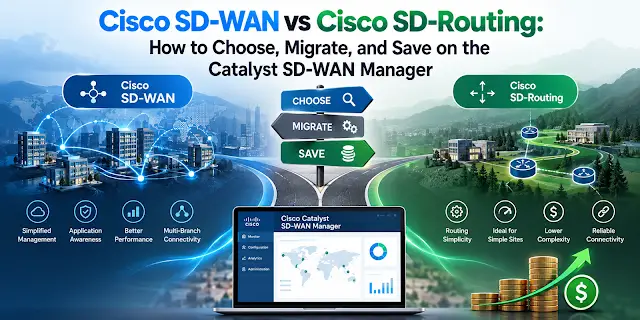
Cisco's two IOS XE WAN edge modes now sit under one management plane, which makes the choice between them look more like a configuration decision than a platform decision. It isn't quite that simple. The modes share hardware and a manager, but they differ in what the router does once it's running. My read is that most teams get this wrong by asking which product is better, when the useful question is whether a given branch needs an overlay at all.
What Stays the Same, and What Doesn't
Cisco SD-WAN (IOS XE SD-WAN, controller mode) and Cisco SD-Routing (IOS XE SD-Routing, autonomous mode) run on the same cEdge platforms. The source lists the Catalyst 8000V and C8000V, Catalyst 8500, Catalyst 8300, Catalyst 8200, ISR 4000 and ASR 1000. Both are managed by Catalyst SD-WAN Manager, which the source describes as the renamed vManage. Device templates, feature templates and configuration groups configure both modes, so the operations team doesn't need a second console to see the whole estate.
That shared management layer is the selling point, and it's a fair one. It also means the real differences sit underneath the template. SD-WAN brings an overlay with its own control and forwarding behaviour. SD-Routing doesn't.
The Overlay Is the Whole Decision
In controller mode, the cEdge joins a control plane made up of Manager, Controller and Validator components. It learns routes over OMP, keyed by TLOC (system IP, colour and encapsulation). It measures every path with BFD and carries traffic in service VPNs over IPsec. That's a lot of machinery, and it's what gives you application-aware routing and SLA-based steering across a mix of MPLS, broadband and LTE.
SD-Routing strips that away. The source describes it as standard BGP, OSPF or static routing with VRFs and ACLs, with no overlay to operate and no controllers in the forwarding path. A branch on SD-Routing keeps forwarding if the management plane is unreachable, which is a useful property when you're planning for failure. You trade away steering intelligence for simplicity.
So the test is straightforward. If your sites need to make path decisions based on application behaviour, you're looking at SD-WAN. If they need to route reliably and the transport is already settled, SD-Routing covers it.
When SD-WAN Earns Its Place
The source points to several situations where controller mode is the right call. The first is application-aware routing with SLA-based steering, where voice and video go over the low-latency path and bulk traffic takes the cheap one. Teams that have struggled to keep real-time traffic clean over consumer broadband usually feel this pain first.
The second is cloud connectivity. Cloud OnRamp covers multicloud connections to AWS, Azure and GCP, and Cloud OnRamp for SaaS covers SaaS paths. If your traffic patterns have shifted towards cloud workloads, the overlay is the mechanism that makes those connections manageable at scale.
The third is the SASE direction. The source describes sending traffic to a Secure Internet Gateway, naming Zscaler and Prisma Access, using DIA and NAT and service chaining. It also mentions centralised policy pushed from the Manager, IPsec encryption and service VPN segmentation. Assurance tooling from ThousandEyes and vAnalytics is listed as part of the picture. Those are the capabilities that justify the higher cost, and if you're not going to use them, you're paying for features you won't touch.
When SD-Routing Is the Better Fit
Routing-only sites are the obvious candidates. If a branch runs BGP, OSPF or static routes over MPLS or direct internet access and has no overlay to operate, SD-Routing fits. The source says it offers lower TCO and a simpler Cisco DNA bandwidth tier, and that it improves ROI for these sites.
I'd flag one subtlety. SD-Routing devices still onboard to Catalyst SD-WAN Manager and take device and feature templates, so you keep one pane of glass without taking on the full overlay feature set. That's a useful middle ground for teams that want consistent management but don't need steering.
Automation is the other angle. The source lists NETCONF and YANG, gNMI streaming telemetry, and Terraform and Ansible under a NetDevOps model. Both modes are programmable, so this isn't a reason to pick one over the other on its own. It does mean an SD-Routing estate can be automated without signing up for overlay licensing you won't use.
Migration: Replace the Hardware First, Then Change the Mode
The source suggests a staged path, and I'd follow it. Start by inventorying the estate in Catalyst SD-WAN Manager and exporting device and feature templates so you have a baseline. Then replace vEdge devices with cEdge platforms in waves. The source notes that cEdge is the IOS XE successor to vEdge and the migration target for ageing vEdge fleets.
Keep autonomous mode for the first wave if the site is routing-only. Once the hardware is in place, flip individual sites to controller mode, validating OMP, BFD and application-aware routing before you move on. Add SASE and Cloud OnRamp last, after the overlay is stable. That ordering keeps each change small enough to roll back.
The source describes this as an MPLS migration or SD-WAN migration, with the option to offload MPLS over time. Whichever label you use, the sequencing matters more than the speed. Changing the hardware, the mode and the security stack in the same window is how sites end up down for reasons nobody can isolate.
Cost and Lock-In
Both modes run on Cisco DNA subscription bandwidth tiers. SD-WAN carries the richer feature set and, according to the source, higher TCO. SD-Routing is positioned as the lower-cost option for sites that only need routing. The source doesn't give pricing, so you'll need to work from your Cisco agreement and your own bandwidth numbers.
Either path means accepting some vendor lock-in to the Cisco ecosystem. The source frames that as the price of a coherent stack, with TAC support and a Cisco Validated Design. That's a reasonable trade for many organisations, but it should be a conscious one. Model CapEx for hardware and OpEx for subscriptions and operations on a per-site basis before you commit to a mode. Branches differ, and a single answer across the estate usually costs more than it should.
Can You Run Both?
Yes, and the source suggests most enterprises will. A hybrid WAN with SD-WAN branches and SD-Routing sites, all visible in Catalyst SD-WAN Manager, is the expected end state for many estates. The practical question is which branches belong in which bucket, and that's a site-by-site exercise. Start with the sites that already have application-level problems, since they'll show the value of the overlay fastest. Leave the routing-only sites alone until there's a reason to move them.
The Practical Takeaway
Ask whether the site needs an overlay. If it does, because you need application-aware routing, SLA steering, Cloud OnRamp multicloud or SASE, choose controller mode. If it needs solid BGP, OSPF or static routing at a lower cost, choose autonomous mode. Run both where the estate calls for it, replace vEdge hardware in waves, and let the manager handle the template side. The change window will go more smoothly if you decide the mode per branch before anyone touches a device.


