Agentic AI Moves Network Security From Alert Triage to Autonomous Response
- [email protected] (Route XP)
- 684 views
Autonomous AI agents are shifting enterprise network defense from alert triage to real-time containment. Here's what to pilot first and what to guard against.

The interesting part of agentic AI in network security isn't better dashboards. It's that the software now makes and carries out response decisions that used to wait in an analyst's queue. For teams that have spent years tuning SIEM rules and watching alert counts climb, that's a real change in who does the work.
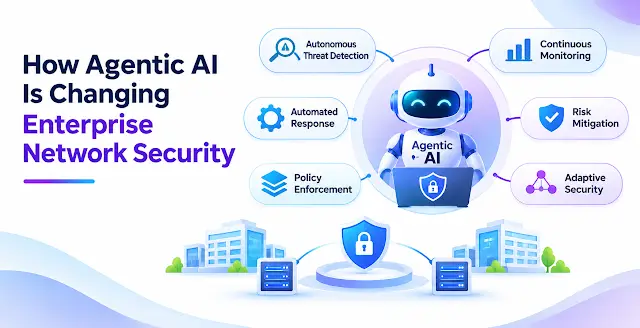
The pressure behind it is well documented. IBM's Cost of a Data Breach Report 2025 puts the average breach at $4.44 million, with 241 days taken to identify and contain it. Meanwhile, ISC2's 2024 workforce study points to a global talent shortfall of nearly 4.8 million security professionals. Security operations centers are being asked to absorb more telemetry with fewer people, and most of the tooling they rely on was built to detect and report, not to act.
That gap is what agentic AI is aimed at. Every minute an analyst spends triaging a false positive is a minute an attacker can spend somewhere else.
What Makes an Agent Different
The term separates AI that assists from AI that acts. A generative chatbot drafts a summary when asked. A SOAR playbook runs a fixed sequence when its trigger fires. An AI agent decides which tools to use, executes the steps, checks the result, and adjusts if the outcome falls short.
In network security, that typically runs as a continuous loop:
- Perceive: ingest telemetry from firewalls, endpoints, cloud workloads, identities and applications
- Analyze: correlate signals, score risk and rank what actually matters
- Decide: choose a response, or escalate when confidence is low
- Act: isolate a device, block traffic, revoke sessions or patch a configuration
- Learn: refine later decisions based on what happened
That loop is the real shift. It turns a static set of defenses into one that adjusts as it goes.
Why the Old Model Is Wearing Out
Four pressures stand out. Alert volume is the first: large SOCs receive thousands of alerts a day, and a large share are false positives, so real threats get buried. Second, static rules struggle against attackers who rotate infrastructure and use AI themselves. Third, the perimeter has dissolved. Cloud, remote work and IoT have pushed assets well beyond any firewall's view. Fourth, the speed gap is widening. Automated attacks can unfold in minutes, while human-led investigations often take hours, and there aren't enough skilled people to close that difference.
Traditional tools generate questions. Agentic systems are designed to answer some of them without waiting for a person.
Five Shifts in Practice
Detection that connects weak signals
Agents watch network traffic, endpoints, identities and cloud workloads together, building behavioral baselines for each user and device. Because they see across those silos, they can tie together an odd login, a small rise in data egress and an unusual process on a server into one higher-confidence incident. The practical payoff is fewer false positives and a better chance of catching slow, low-volume attacks that single-domain rules tend to miss.
Investigation and containment in seconds
Once a threat is confirmed, the agent can pull logs, map behavior to MITRE ATT&CK techniques and estimate the blast radius. Then it acts: isolating an endpoint, blocking a malicious domain or revoking session tokens. The goal is to compress mean time to respond from hours to minutes, which shrinks the window an attacker has to move laterally.
Self-correcting configurations
Agents don't stop at flagging misconfigurations. They can rotate exposed credentials, tighten firewall rules, quarantine a vulnerable segment and then check that the fix held. Policy stops being a static document. Access decisions get re-evaluated per session against current risk rather than last quarter's rule set.
Zero trust that runs continuously
Zero trust depends on verifying every request, and humans can't do that at scale. Agents evaluate identity, device posture, behavior and context on each access request, in line with NIST SP 800-207. A compromised credential can be flagged because its behavior deviates, not just because a login failed, and microsegmentation can tighten as risk changes.
Hunting and patch prioritization
Rather than waiting for alerts, agents can run hypothesis-driven hunts across the estate, model likely attack paths and rank vulnerabilities by real exposure instead of generic severity scores. That moves patching effort toward the flaws attackers are most likely to use first.
IBM's 2025 report offers one data point on the payoff. It found that organizations making extensive use of security AI and automation saved an average of $1.9 million per breach compared with those that didn't. That's a correlation across surveyed organizations, not a guaranteed return for any single deployment.
Agents Versus Traditional Stacks
The distinction is less about features than about who makes the call. A traditional SIEM and SOAR stack runs predefined rules, with humans approving each action, and response ranges from minutes to days depending on analyst availability. Coverage tends to stay siloed by tool and domain, and capacity scales with headcount. An agentic setup makes contextual decisions within guardrails, responds in seconds around the clock, spans network, endpoint, cloud and identity, and adapts continuously. Its capacity grows with infrastructure rather than hiring plans.
Where the Platforms Stand
Agentic features are moving from demos into mainstream products. Microsoft Security Copilot offers multi-agent experiences for phishing triage and vulnerability investigation. CrowdStrike Charlotte AI provides agentic investigation and guided response on the Falcon platform. Palo Alto Networks XSIAM brings AI-driven SOC automation, triage and response. Darktrace offers self-learning AI for autonomous network detection and response. Google has embedded Gemini across its security stack, while Cisco AI Defense focuses on securing AI systems themselves.
The pattern to watch is absorption. Agentic capabilities are being built directly into XDR and SIEM platforms, so autonomous operations are becoming a native feature rather than a separate integration project. For most admins, that means the decision isn't whether to buy an agent layer. It's how much authority the existing platform's agents get, and under what conditions.
The Risks Come Attached
Autonomy cuts both ways. The most immediate risk is error. An agent that wrongly isolates a core router doesn't generate an alert; it generates an outage. Adversarial manipulation is a second concern, since attackers can attempt prompt injection, data poisoning or other techniques to steer an agent toward harmful actions. Explainability is a third. Auditors and anyone reviewing an incident afterward will want to know why the system acted, so every decision needs a defensible trail.
Gartner predicts that over 40% of agentic AI projects will be canceled by 2027, citing escalating costs, unclear ROI and inadequate risk controls. Data quality is the quiet fourth problem. An agent is only as good as the telemetry and identity data it can reach, and many environments have gaps in both.
Adopting It Without Handing Over the Keys
Start where the blast radius is small. Alert triage and false-positive reduction are good first candidates, because they add value before the agent is allowed to change anything. Next, define autonomy levels explicitly. Begin read-only, and require human approval for any destructive or business-critical action.
Guardrails matter as much as the model. Set rate limits, constrain blast radius and provide a manual kill switch for every agent. Log everything, and map agent decisions to the NIST AI Risk Management Framework and NIST CSF 2.0 so the audit trail holds up later. Measure outcomes rather than milestones: mean time to detect, mean time to respond, false-positive rates and cost per incident. Deployment checklists don't tell you whether the agent is working.
Finally, plan for the people side. Analysts shift from triage to supervising agents and hunting novel threats, and that transition needs training as much as tooling. Teams that skip it tend to end up with agents nobody trusts or understands.
What Comes Next
Gartner expects 33% of enterprise software applications to include agentic AI by 2028, up from less than 1% in 2024. Security is one of the domains pushing hardest, because the speed problem leaves few alternatives. The likely next step is multi-agent operations, with specialized agents for network, identity, cloud and email defense coordinating under a supervising layer, and humans setting policy at the top. It also means defenders' agents will increasingly face attackers' AI, which makes securing the agents themselves a priority in its own right.
My read: the organizations that get the most out of this will be the ones that set governance and measurement up now, before the agents have broad authority. Waiting doesn't avoid the decision. It just means making it during the next incident.


