Quantum Scalar i7 RAPTOR Packs Up to 80PB of Raw Tape Capacity Into One Rack
- Brian Beeler
- 536 views
Quantum’s Scalar i7 RAPTOR holds up to 2,000 LTO-10 cartridges per rack, with modular drive options and a serviceable robot for large data archives.
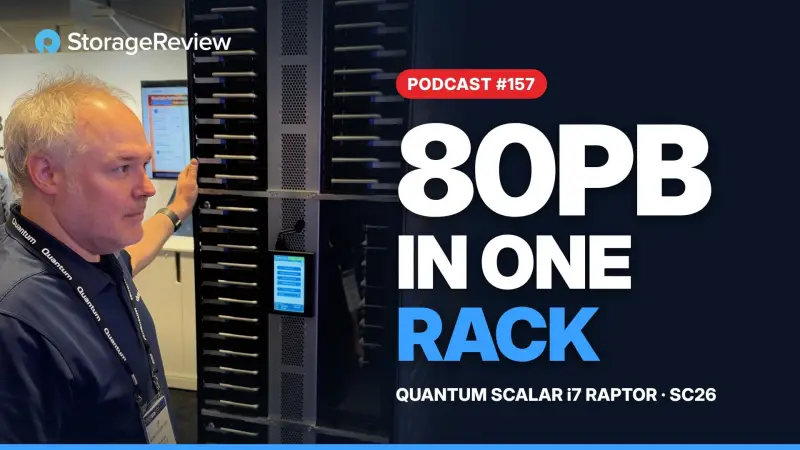
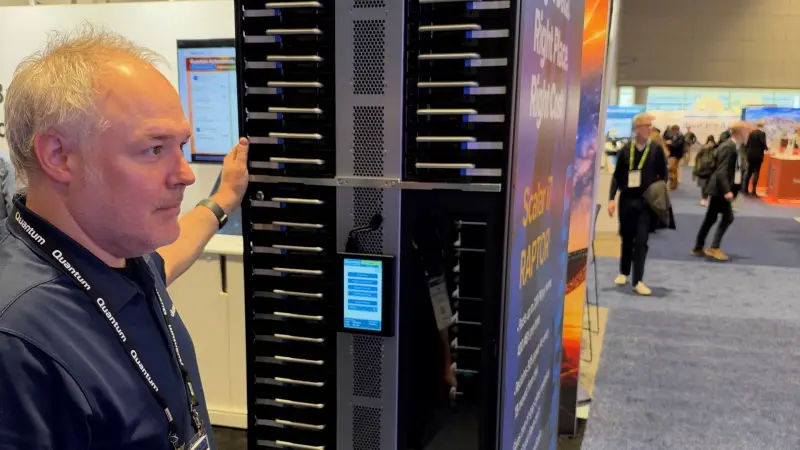
For teams managing AI, high-performance computing and research data, Quantum’s Scalar i7 RAPTOR puts tape capacity and retrieval hardware in a single rack-scale system. Quantum Head of Product Marketing Skip Levens says a rack can hold 2,000 LTO-10 cartridges, reaching up to 80PB raw or about 200PB when the data is compressible. The design also supports incremental deployment, earlier LTO generations and up to 20 drives.
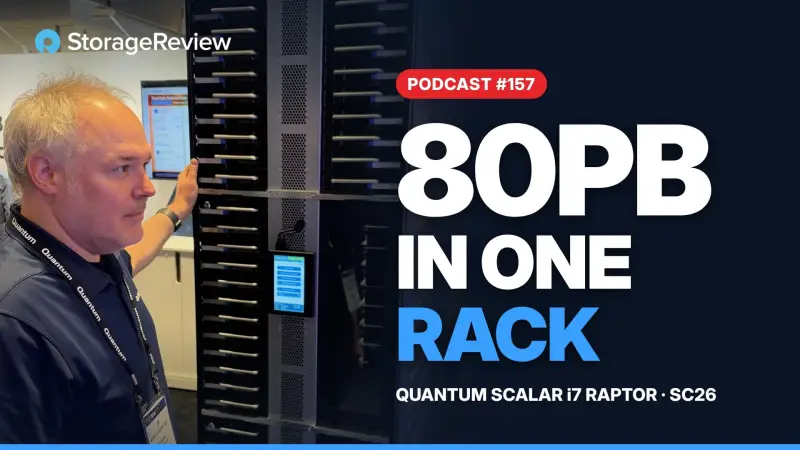
The capacity starts with the LTO-10 cartridge, which holds up to 40TB raw. Levens says Quantum developed the Scalar i7 RAPTOR alongside hyperscalers seeking high cartridge density and the ability to replace components within minutes. The result is a modular library that can be configured to suit a smaller initial deployment or expanded toward the rack’s maximum capacity.
Scale capacity and drives as needed
A full rack is the upper limit, not the only starting point. Customers can begin with 12 or 24 tapes and add capacity as requirements grow. They choose the number of drives, up to 20 in one system, and can expand by adding more. Levens says the library supports earlier LTO generations as well as LTO-9 and LTO-10 drives. That gives customers a way to keep LTO-9 in use while they work through a media migration.
Drive count shapes how much data the library can move at once. Levens gives a maximum rate of up to 400MB/s per drive. With 20 drives installed, the system can serve multiple retrievals in parallel, although the practical result depends on workload and how reads are scheduled. For administrators planning a deployment, capacity and throughput are separate decisions: the number of stored cartridges sets the archive ceiling, while the installed drives affect how quickly data can be returned.
Robot design targets service and access
The library stores cartridges two deep. To reach a cartridge in the rear position, the robot removes the one in front, rotates to collect the target, then returns the first cartridge without requiring the library to re-index. Levens describes the mechanism as leaving the robot one movement away from any cartridge. He says the efficiency matters across millions of operations.
The robot head has two bays, allowing it to hold one cartridge while handling another. Levens demonstrated the head after bringing the robot out from its home position. The service design also allows customers to keep a spare robot available and swap it in if the installed unit fails. For a large archive, that approach makes a replaceable component part of the operational plan: teams can consider the spare alongside drive count, media capacity and the process for maintaining access during service.
Tape can sit closer to active workloads
Levens argues that tape’s reputation for slow access often comes from experiences with cloud archive services, where retrieving data can take weeks unless a customer pays for faster access. A library that an organization owns and operates offers a different setup. With retrievals planned around the installed drives and workload, he says tape can function as a warm tier rather than being treated only as a distant, offline archive.
Quantum also uses tape as a cold tier in its object storage system. Levens says the data presents through a single object storage pool, combining tape capacity with the object storage view. That model could suit organizations that want a large archive accessible through their storage environment, while keeping frequently used data on other tiers. The discussion doesn’t specify retrieval times or performance for that configuration, so teams would need to assess those against their own access patterns.
AI and research data are driving interest
Levens says LTO-10 media shipments are doubling and sees that forecast as a sign that buyers are returning to tape. He also says he doesn’t expect sites to keep petabytes and exabytes at scale on flash. During the discussion, Brian points to the difficulty of moving very large data sets in and out of cloud services, as well as chain-of-custody needs in regulated industries. These are reasons some organizations may consider keeping more archive capacity under their own management.
Research and higher education organizations face a related challenge as they gather data for AI and HPC work. Brian describes scheduled transfers between institutions, including moving a petabyte from one university to another, as a potential use for tape. Levens says these organizations need to retain growing data sets without letting storage costs break their budgets.
For infrastructure teams, the key planning questions are how much data needs to remain available, how many drives can support the expected retrieval workload, and whether an LTO-9 transition should happen at once or over time. The Scalar i7 RAPTOR’s stated limits—2,000 cartridges, up to 20 drives and up to 400MB/s per drive—provide a starting point for that assessment. A rack’s 80PB raw figure is a maximum based on cartridge count; the approximately 200PB figure applies when data is compressible.