KIOXIA GP2 Targets 18 Million IOPS, With Evaluation Samples Due by End of 2027
- Brian Beeler
- 445 views
GP2 doubles GP1’s random read rating to more than 18 million IOPS. KIOXIA lists PCIe 6.0 and XL-FLASH Gen 3; samples are planned for late 2027.
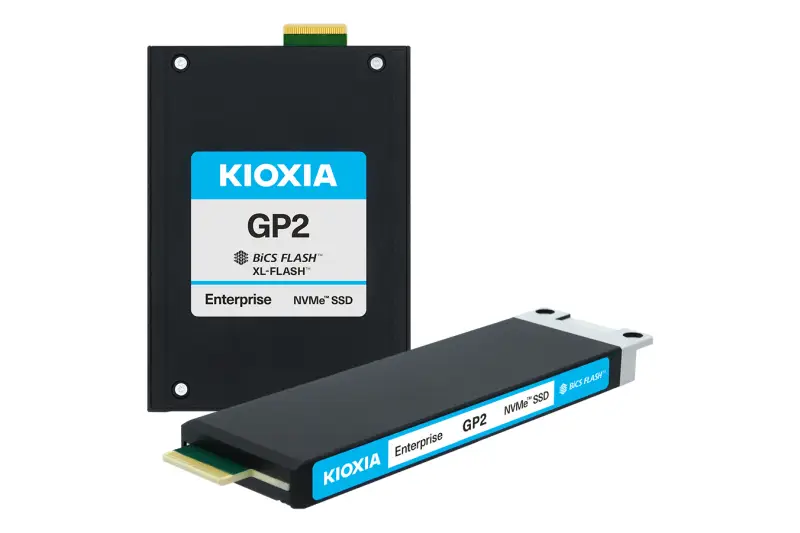
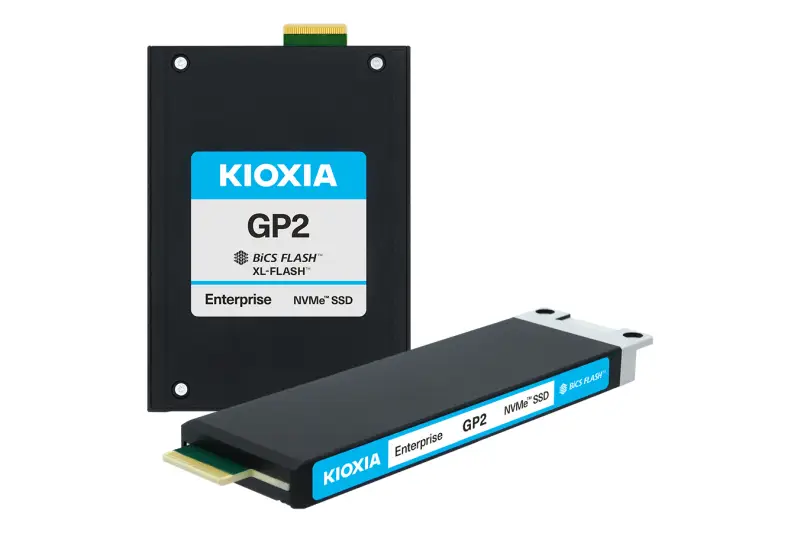
KIOXIA’s GP2 points to a faster flash tier for GPU workloads, but it remains a roadmap item: evaluation samples for select customers are scheduled by the end of 2027. The company rates the drive at more than 18 million random read IOPS with 512-byte blocks, nearly twice the 10 million IOPS specified for the GP1 Series. For infrastructure teams, the performance target is notable; the distant sample window and missing capacity, latency, write and power figures are just as relevant to planning.
The GP Series is designed to place flash alongside GPUs as an additional memory tier. GPU-initiated reads can reach the SSD directly, extending the capacity available beyond High Bandwidth Memory (HBM). KIOXIA has cited vector search, graph neural networks and recommendation engines as workloads that may need random access to datasets larger than GPU memory. The intended tradeoff is more data capacity at lower cost than adding HBM or DRAM, while keeping GPUs better supplied with data. Those are the company’s stated goals; the GP2 announcement does not provide workload benchmarks demonstrating them.
What the performance figures cover
The headline figure uses 512-byte blocks, a small access size associated with the targeted GPU workloads. At that block size, more than 18 million IOPS corresponds to about 9.2GB/s. That number describes random reads; it should not be read as a general throughput result across different block sizes or mixed workloads.
GP2 uses XL-FLASH generation 3, following the generation 2 media in GP1. KIOXIA says the new flash delivers about 2.5 times the random read IOPS of its TLC-based CM10 Series at the same 512-byte block size. The company also describes higher endurance and lower power per I/O, but has not given figures for either comparison.
Sequential reads are listed at up to 28GB/s, an expected figure that KIOXIA says would saturate a PCIe 6.0 x4 link. The company bases that estimate on the link’s bandwidth and results from drives still in development. It is not a published test result for a shipping GP2 drive. The product’s interface is PCIe 6.0 with NVMe 2.3, compared with NVMe 2.2 for GP1.
Form factors and details still pending
KIOXIA lists E1.S at 9.5mm and E3.S as form factors under consideration. GP1 also offers a 15mm E1.S option, which is not listed for GP2. The new drive supports direct liquid cooling. GP1’s listed cooling approach is a cold plate on E3.S and E1.S 9.5mm models, so teams comparing the two generations will need to confirm what chassis and cooling arrangements the final GP2 configurations support.
Endurance is listed at up to 50 drive writes per day (DWPD), matching GP1’s stated ceiling. The comparison available so far is limited to headline specifications:
| Specification | KIOXIA GP2 Series | KIOXIA GP1 Series |
|---|---|---|
| Interface | PCIe 6.0, NVMe 2.3 | PCIe 6.0, NVMe 2.2 |
| Flash | XL-FLASH generation 3 | XL-FLASH generation 2 |
| Random read, 512-byte blocks | More than 18 million IOPS | Up to 10 million IOPS |
| Sequential read | Up to 28GB/s, expected | Not stated |
| Endurance | Up to 50 DWPD | Up to 50 DWPD |
| Form factors | E1.S 9.5mm and E3.S under consideration | E1.S 9.5mm, E1.S 15mm and E3.S |
| Cooling | Direct liquid cooling supported | Cold plate on E3.S and E1.S 9.5mm |
| Evaluation samples | Select customers by the end of 2027 | Select customers by the end of 2026 |
For capacity planning or procurement comparisons, the missing specifications matter: KIOXIA has not published GP2 capacities, latency, write performance or power figures. It also has not supplied a volume production date. The evaluation units are intended for functional assessment, and KIOXIA says specifications may change before mass production. The sample schedule for GP1 is a year earlier, by the end of 2026.
The roadmap and a separate GPU storage test
The GP2’s disclosed target differs from an earlier roadmap description. Earlier this year, KIOXIA characterized the second-generation GP product as a PCIe 7.0 design targeting 100 million IOPS, with release expected in 2027. GP2 is instead specified for PCIe 6.0 and more than 18 million IOPS. KIOXIA now places the 100 million IOPS goal with future generations that it has not named. Neville Ichhaporia, senior vice president and general manager of the SSD business unit at KIOXIA America, described GP2 as “another step toward our long-term vision of 100 million IOPS-class storage.”
Separately, KIOXIA described a proof of concept with NVIDIA using SSDs to extend GPU-accessible memory through NVIDIA SCADA (Scaled Accelerated Data Access), a software library that enables direct GPU access to NVMe drives at small block sizes. The test used a GB200 NVL72 rack containing 18 server nodes and 144 KIOXIA XD8 Series 7.68TB E1.S SSDs, eight per node. KIOXIA calculates that as about 1.1PB of raw flash, with nearly 60TB of extended memory per node.
The company says the setup supports 512-byte accesses and could hold a database of 2 trillion 512-byte vectors, or about 1PB of vector data. It did not provide throughput or latency results. The test used XD8 drives, not GP Series hardware, and KIOXIA and NVIDIA are still evaluating the technical feasibility and performance of SCADA and the Storage-Next architecture. For teams weighing this approach, the demonstration offers system scale and a workload target, while leaving the performance evidence and GP2’s final specifications to come.