Azure Agents Can Now Change Resources Under Azure Policy
- Tom Fenton
- 325 views
Azure’s ARM MCP Server can create and update resources under existing Azure Policy controls. Microsoft also reports faster remediation from Azure SRE Agent.
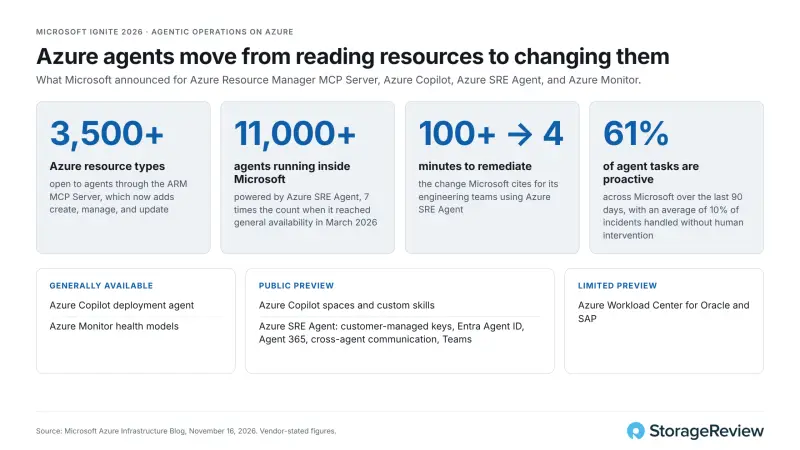
Azure agents can now make infrastructure changes through Azure Resource Manager (ARM), with Azure Policy evaluating each request. That moves Microsoft’s agentic operations plans beyond reading resource data: compatible agents can create, manage and update resources across more than 3,500 resource types. For administrators, the key question is how to let agents act while keeping the same controls that govern other Azure changes.
Microsoft presented the change alongside updates to Azure Copilot, Azure SRE Agent and Azure Monitor at Ignite 2026. The company says its engineering teams have cut some remediation work from more than 100 minutes to four. That figure describes Microsoft’s experience; the practical result for other teams will depend on their environments, operating procedures and the tasks they delegate.
Context is the foundation for useful action
An agent with access to commands or telemetry still needs to understand how an environment fits together. A service failure can involve dependencies, configuration and recent changes, so an alert alone may not point to a useful fix. ARM and Azure Resource Graph (ARG) already contain information about resources, their relationships and their change history. Microsoft is building an intelligence engine on that base to give people and agents operational context.
Brendan Burns, corporate vice president and technical fellow for Azure cloud native and management platform, says that when the engine handles how resources relate, people can “spend their time on what they want to accomplish.” In practice, an agent that knows how network, compute and storage connect may need less step-by-step direction. Administrators can describe the intended outcome, then assess the proposed action against their environment and controls.
Azure Policy applies to agent requests
The updated ARM MCP Server is intended for teams bringing their own agents to Azure. Any agent compatible with the Model Context Protocol (MCP) can use it to make changes through the Azure control plane. Azure Policy evaluates those requests under the policies administrators have configured, including controls that block noncompliant deployments, require tags or limit regions and SKUs.
That matters because it gives infrastructure teams an existing place to define boundaries for agent activity. An agent’s request is evaluated through the same control plane as a change made in the portal. Teams still need to decide what permissions and policies apply, and how they will review actions and confirm results. The ability to make changes expands what an agent can do; it doesn’t remove the need for operational oversight.
Azure SRE Agent is designed to investigate incidents, identify root causes and automate operational tasks. Its new features are in public preview: customer-managed keys, Entra Agent ID, Agent 365 integration, communication between agents, and Microsoft Teams integration for investigations spanning clouds. Microsoft says the first three give organizations more control and governance across the agent lifecycle.
Availability and reported results
Azure Copilot’s deployment agent is now generally available. It converts natural-language requirements into infrastructure and deployment code. Azure Monitor health models are also generally available, providing a real-time view of application health that connects telemetry with architecture, dependencies and business impact. That context can help an agent assess how a failing resource affects an application before it recommends or automates a response.
Microsoft says more than 11,000 agents powered by Azure SRE Agent now run inside the company, seven times the number when the product became generally available in March 2026. During the last 90 days, 61 percent of their tasks were proactive work, and an average of 10 percent of incidents were handled from start to finish without human intervention.
Ecolab, a customer cited by Microsoft, reports finding root causes 60 percent faster and reclaiming three to four hours per incident. These figures come from Microsoft and its customer, and shouldn’t be treated as a guarantee of results for other organizations. Teams assessing the product will want to compare any time savings with their own incident types, escalation procedures and review requirements.
Skills and workload support
Microsoft expects organizations to adapt agents to local environments with skills. Azure agents come with skills for cloud operations, while custom skills can capture an organization’s architectures, procedures and requirements. Azure Copilot spaces and custom skills are in public preview, offering a way to keep environment-specific context available to agents.
Azure Workload Center, in limited preview, extends workload monitoring and configuration validation to Oracle and SAP workloads. The release stage matters for teams planning adoption: the ARM MCP Server’s expanded change capability, the generally available Copilot deployment agent and health models, and the preview features have different availability.
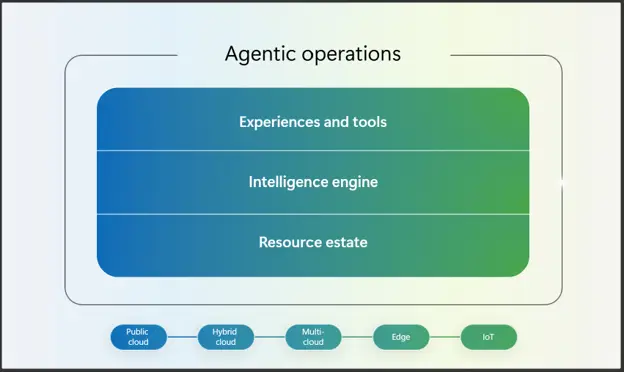
Microsoft’s approach runs through the Azure control plane; systems outside Azure typically connect through Azure Arc. That makes the connection between an agent and an organization’s managed estate a planning consideration, particularly for teams with on-premises or edge resources. Microsoft’s diagram includes public cloud, hybrid cloud, multi-cloud, edge and IoT, but the article does not specify setup steps or coverage details for each environment.
What administrators should assess
For IT teams, the shift is toward defining objectives and guardrails, then checking what agents do. Before enabling infrastructure changes, administrators should review which policies apply to agent requests and which identities and permissions the agents use. They should also consider how they will verify proposed fixes and handle cases that require human review.
Several Ignite features remain in preview, so availability and maturity differ across the Azure operations stack. The immediate takeaway is that agent access can now extend to resource changes under Azure Policy. Teams can use that control point to evaluate where automation fits, while tracking which features are ready for their environments and which remain in preview.