Why AI Agent Security Needs Runtime Checks Beyond Zero Trust
- Sangita Patel
- 412 views
Zero Trust limits agent access, but runtime checks can catch unsafe actions driven by untrusted content before they execute.
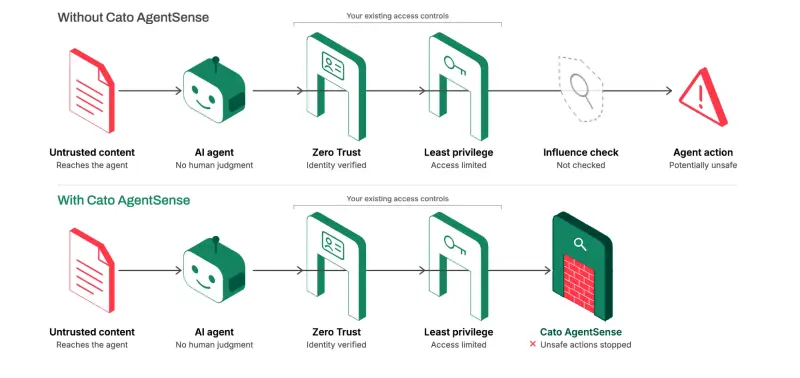
An AI agent can have valid credentials, narrowly scoped access and an approved connection, yet still take an unsafe action. For IT teams deploying agents that read documents, call tools or update business systems, access control is only part of the security problem. They also need to examine how an agent is using its permissions while it works.
That distinction matters because agents combine machine speed with authority granted by their operators. An agent may need to read support records or send messages to complete an assigned task. If material it reads steers it toward a different action, its identity and access rights can remain unchanged while the result becomes harmful.
Access boundaries don’t validate every action
Zero Trust removes implicit trust and makes access conditional. Least privilege narrows the resources and capabilities available to a user or workload. NIST’s Zero Trust architecture also calls for dynamic authorization and ongoing reevaluation, extending verification beyond the initial login.
Those controls are essential for AI agents. A support case summarization agent, for example, should receive only the access its assigned work requires. Limiting its reach reduces the damage a mistake or compromise could cause.
But an allowed operation can still be used in the wrong way. An agent permitted to read support records and send a summary might include confidential details in that message. The read and send operations could both pass access checks, even though the combined behavior exceeds the task’s purpose.
That’s the gap runtime checks are meant to address: permissions say what an agent can do, while runtime inspection asks whether a particular action makes sense in the current task and context.
Untrusted content can steer an authorized agent
People can often recognize that instructions inside a supplier proposal or web page don’t override the work they were asked to do. An AI agent processes trusted instructions alongside emails, documents, web pages and tool responses in the same context. It can be influenced by directions embedded in the material it reads.
OWASP describes this risk as indirect prompt injection: external content changes a model’s behavior in unintended ways. The outcome can include disclosure of sensitive information or misuse of connected tools. An attacker may not need to take an agent’s credentials or gain new privileges if the agent already has access to the target systems.
Consider an agent asked to review supplier proposals. Reading a proposal is part of its assignment. But if the document tells the agent to retrieve internal pricing and send it outside the company, complying would turn ordinary document processing into an unsafe action. The concern is not that the agent’s permissions changed; it’s that untrusted content influenced how it used them.
This makes the point of enforcement important. Before the task begins, the malicious instruction may not be present. Once a disclosure or transaction has happened, logging can help explain the sequence, but it can’t reverse the action. A runtime control needs to assess the proposed action before it reaches the connected tool or system.
Why existing controls leave gaps
Identity and access controls define which resources an agent can reach. They don’t, by themselves, determine whether an action serves the assigned task. Predeployment testing and posture reviews can find weaknesses, but they can’t account for every document or tool response an agent will encounter in production.
Pattern based detection looks for recognizable signs of an attack, so unfamiliar wording or tactics may be harder to identify. Retrospective monitoring and logs support investigation after an event, but they don’t stop a completed disclosure. These controls still have a role; runtime enforcement addresses the narrower question of whether an action should proceed in the context that produced it.
How AgentSense describes its runtime checks
AgentSense, from Cato AI Labs, assesses agent actions and is designed to stop unsafe ones before execution. Cato says its Untrusted Influence Detection distinguishes trusted instructions from untrusted content, then traces how that content affects an agent’s behavior and output.
According to Cato, when untrusted content pushes an agent toward an unsafe action, AgentSense blocks that action before execution. The company says the approach examines the influence of content on the action being proposed, rather than relying only on whether an input resembles a previously identified attack.
Cato also reports that AgentSense is 16X more effective at detecting attacks than the next best defense on the public AgentDojo benchmark. That is a vendor claim tied to a named benchmark; the supplied details don’t include test conditions or a breakdown of the compared defenses.
For enterprise teams, the stated capabilities are runtime verification of how agents use privileges, assessment of trusted and untrusted influence, and intervention before risky actions execute. The operational question is where those checks sit in the agent workflow and which actions they can block.
Agent security needs Zero Trust and runtime enforcement
What to assess in an enterprise deployment
Cato says it brings agent protection into its converged network and security cloud, with visibility, policy and enforcement across local, custom and managed agents. Its Agentic AI Security offering is positioned for that role. Cato also describes AI Security for Applications as inspecting prompts, responses and agent actions at runtime to help prevent data exposure and enforce policy.
For administrators evaluating runtime protection, the practical checks are whether the control evaluates the action in context, whether it can intervene before execution, and which agents and connected tools it covers. Teams should also establish how the control handles the information needed for inspection and how blocked actions appear in their operational monitoring.
Zero Trust sets boundaries around an agent’s access. Runtime enforcement addresses what happens inside those boundaries, where untrusted content can influence a permitted capability. As agents take on more work in business systems, the decisive safeguard may be whether teams can stop an unsafe action before it runs.