DapuStor Details 512TB E2 SSD, 120-DWPD Storage Class Memory and PCIe Gen6 Plans
- Brian Beeler
- 985 views
DapuStor’s 512TB R6060 targets dense storage, while its 120-DWPD X5900P and next-quarter PCIe Gen6 samples address other data center workloads.
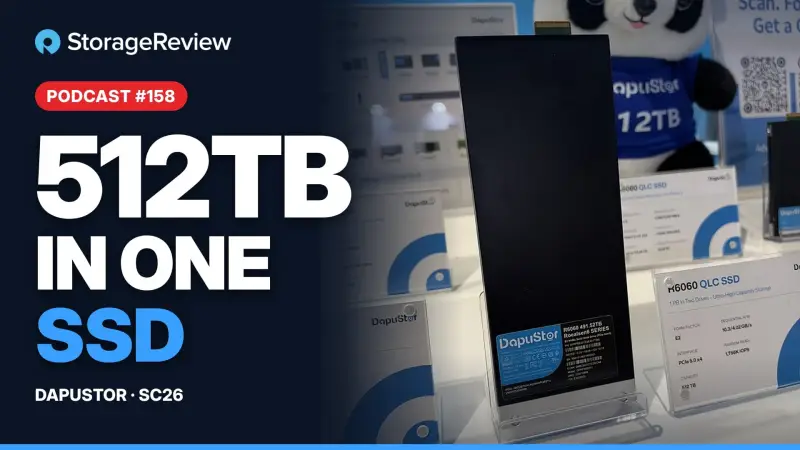
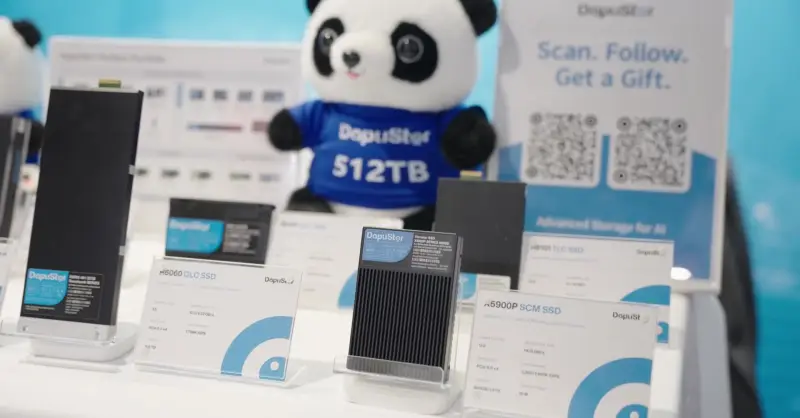
DapuStor’s 512TB R6060 puts an unusually large flash capacity in one E2 drive, while the company’s X5900P storage class memory SSD targets write-heavy work. Those products point to two different pressures on data center design: fitting more capacity into limited rack space and placing low-latency, high-endurance storage close to demanding workloads. DapuStor also plans to sample PCIe Gen6 drives next quarter, adding a faster interface to an already broad range of form factors.
At DapuStor’s SC26 booth in Chicago, Roger Peene, the company’s general manager for the Americas, discussed the R6060 and the rest of the lineup with Brian. Peene took on the Americas role in May 2026. Before joining DapuStor, he led Micron’s Storage Business Unit as vice president and general manager, then headed sales and marketing at MemryX.
The R6060 has grown through 122TB and 245TB capacities to the 512TB QLC model Peene showed in E2. An E3.L version is expected to follow shortly, and Peene said the 512TB drive will sample soon. DapuStor’s earlier 122TB R6060 review covered the drive at a smaller capacity; the company had also shown the 512TB model at FMS.
Capacity for storage constrained by power and space
For GPU systems, the case for dense QLC storage is tied to how a rack’s power and physical space get allocated. Brian pointed to terabytes per watt as a measure buyers are watching: if storage needs less power for a given capacity, the system can reserve more of its power budget for GPUs. A 512TB drive also reduces the number of devices needed to reach a given raw capacity, though deployment decisions still depend on the server’s supported form factors and workload requirements.
Peene connected demand for capacity to the growth in tokens processed by AI prompts and the resulting need to store key-value cache data. Storage that can take on some of this data may help limit the work assigned to GPUs. The discussion did not specify a particular configuration or quantify how much GPU capacity a drive could free, so teams will need workload measurements to assess the effect in their own systems.
X5900P pairs low latency with high write endurance
The other featured drive, the X5900P, is DapuStor’s storage class memory SSD. Peene said it uses the latest Kioxia NAND and is available in 800GB and 1.6TB capacities, with a 3.2TB version to follow. Its rated endurance reaches up to 120 drive writes per day (DWPD), alongside the low latency Peene highlighted.
That profile could suit workloads that write repeatedly and need quick access to data. Brian cited key-value cache and checkpointing as examples of write-heavy activity that can consume the endurance of a TLC drive. Some customers build storage class memory into their core architecture, Peene said; high-performance computing sites use it for checkpoint and recovery, persistent write buffers, and global metadata.
Those uses depend on the role the drive plays in a system. A team evaluating the X5900P would need to compare its capacity, latency and endurance with the data’s write pattern and recovery requirements. The stated 120-DWPD rating describes the drive’s rated endurance; the conversation supplied no workload test results or deployment measurements for the X5900P.
Tiering flash around workload and cost
Memory prices and GPU server economics led the discussion to storage tiering. Brian suggested that a GPU server with less RAM and a storage class memory drive behind it could extend what the server can do. Peene described another approach: some customers use a small storage class memory footprint as a hot cache in front of larger QLC drives, moving away from TLC for that design.
Peene framed SCM, TLC and QLC as parts of a memory-to-storage hierarchy, with each tier assigned according to workload, power and price. The practical question for administrators is where data belongs: frequently accessed or heavily written data may need a different tier from capacity focused data. The interview did not provide cost comparisons or prescribe a tiering policy, so the right balance will depend on the system’s workload and budget.
Form factors remain a deployment variable
DapuStor’s capacity range extends from a 240GB M.2 drive to the 512TB R6060. Its experience with E3.S also shows why a drive’s capacity and interface don’t settle the deployment question by themselves. Peene said the company’s first E3.S sample was a 2T drive, twice the thickness of a 1T model, but the market did not want that version. DapuStor now has 1T samples available.
Peene said adoption of E2 remains uncertain. At SC26, Brian also saw server vendors showing E1.S, E3.S and E1.L designs. For infrastructure teams planning refreshes, that variety makes chassis support and drive dimensions worth checking alongside capacity and performance. A dense drive only helps when the target server can accept its form factor.
PCIe Gen6 samples planned for next quarter
DapuStor plans to sample PCIe Gen6 drives next quarter. Peene expects the interface to push servers from U.2 toward short and long E3 form factors. Brian put top-end Gen6 read speeds at about 28,000MB/s and noted that the AMD Venice and NVIDIA Vera platforms discussed at the booth support the interface.
Peene also listed liquid-cooled drives, inline hardware compression and support for the latest OCP specifications among the technologies DapuStor is delivering. Those features could affect system design, but the conversation did not give model details or performance figures for them. Brian expects agentic workloads on newer platforms to change storage use, although customers are still working out what those patterns will require.
Controller and firmware development
DapuStor develops a controller in house for part of its portfolio, uses Marvell controllers for other products and writes its own firmware stack, Peene said. Brian noted that the lab has worked with DapuStor for the better part of a decade. Peene plans to send the 512TB drive and a Gen6 drive to the lab for testing on Venice and Vera.
Those tests should give teams more evidence on how the high-capacity drive and next-generation interface behave on the named platforms. Until then, the clearest planning signals are the R6060’s 512TB E2 capacity, the X5900P’s up-to-120-DWPD rating and DapuStor’s sampling target for PCIe Gen6 next quarter. Administrators evaluating them should match each drive’s capacity, endurance and form factor to the server and workload they intend to support.