AI Data Centers Need Clearer Stories Than Sustainability Slogans
- Natalie Stipan
- 354 views
Data center operators face a license-to-operate fight over power, water and land. Clear, tradeoff-aware explanations will matter more than green claims.
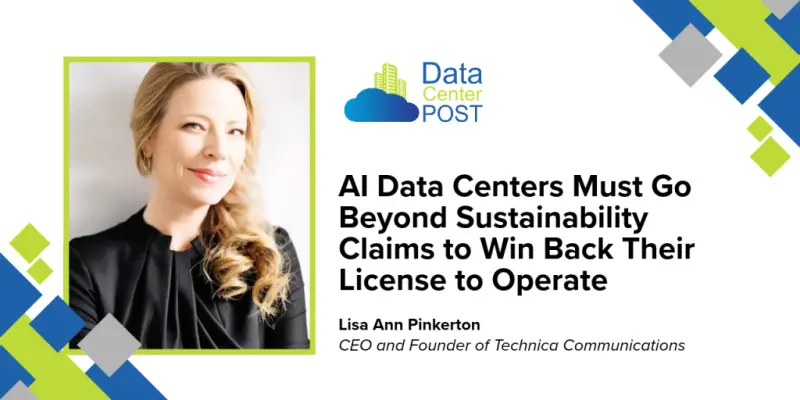
The pushback against AI infrastructure has moved well past the sustainability report. Communities are now asking hard questions about electricity costs, water draw, emissions, land use and who actually benefits from the investment. Lisa Ann Pinkerton, CEO and founder of Technica Communications, argues that for data center developers this has become a license-to-operate problem, and that a sustainability message alone won't resolve it.
The Wall Street Journal recently described the wider backlash against AI as an "American rebellion against AI." For the data center sector, that resistance is showing up in concrete ways. Some local bodies have paused new development while they review the rules that govern these projects, and objections are shifting from public meetings into organized, sustained campaigns. Pinkerton's read is that you can't quell that kind of pressure with better PR copy.
Good Engineering Doesn't Explain Itself
Pinkerton is clear that many developers are making serious investments in more efficient systems and smarter facility design, and that these changes can meaningfully reduce environmental and community impact. The trouble is that most of these technologies are unfamiliar outside the industry, mainly because the industry has never needed to describe them to the public before.
Take a cooling system that dramatically improves thermal performance. An operator hears a strong engineering story. A neighbour hears a single question: will this facility draw from the water supply I depend on? Pinkerton's point is that "it's better for water or energy" doesn't answer that question. Communities need to understand what the facility uses, why that choice was made, how it changes the facility's impact, and what the region might gain from it.
Here's the thing: the public isn't only asking whether a data center is efficient. It's asking how that efficiency turns into shared benefit and what the real-world results look like. Treating those questions as uninformed or hostile, Pinkerton warns, will deepen the mistrust companies are trying to repair.
Transparency Without Giving Away the Design
The obvious advice is to be more open, and Pinkerton agrees that it's largely right. But she says transparency in this sector is more complicated than publishing every detail. In interviews for her Earthlings 2.0 podcast series on data centers, she found that many developers, hyperscalers and operators treat infrastructure decisions as closely guarded assets. Cooling and backup power, vendor selection, energy strategy, facility design and operating models are all seen as sources of competitive advantage.
That creates a genuine tension. Communities need enough information to judge whether a project is responsible, beneficial and accountable. Companies need enough confidentiality to protect systems that shape deployment speed, compute density and operational performance. Pinkerton's argument is that pretending the tension doesn't exist hurts both sides.
Her proposed middle ground is what she calls educational transparency rather than total disclosure. A company doesn't have to reveal every proprietary design choice. It can explain the categories of systems it uses, the purpose each one serves and the tradeoffs involved. That gives residents a fair basis for judging the safeguards in place and the outcomes they can reasonably expect, and it keeps the design details that the business needs to protect.
Efficiency Isn't the Same as Less Demand
Pinkerton identifies what she considers the most important nuance in this debate. A more efficient data center doesn't necessarily use less total energy. In AI workloads, efficiency often enables more computing for the same power, so the facility does more work without necessarily consuming less. For operators, that's a real gain. For a community, total demand on the grid, on land and on water may stay high or even rise.
This is where sustainability messaging becomes fragile. If a company implies that efficiency automatically means lower overall resource use, and residents later learn that the gains are being spent on more compute, the message can feel misleading, even when the technology is valuable. In Pinkerton's framing, efficiency isn't the problem. Overstating what efficiency means is.
A more credible model separates resource intensity from total resource demand. A facility might use less energy per unit of compute while still drawing more power overall as workloads grow. A cooling approach might use less water than the alternatives while still creating a water demand profile that nearby residents are entitled to understand. Pinkerton concedes that this level of detail can feel uncomfortable for companies used to speaking in technical or investor language. Still, she argues, communities don't need simplified claims that hide complexity. They need clear accounts of how a project affects them.
Readiness Beats Speed
For PR professionals, Pinkerton's prescription goes beyond engaging early. Teams need to be ready before a project is introduced publicly. Once a company seeks approval for a new AI facility, every stakeholder will raise questions about water, electricity demand, emissions, jobs, land use, reliability and community benefit. If leadership is still working out its answers at that point, communications become reactive rather than strategic.
That's why she recommends that PR teams work with engineering, operations, permitting, legal and executive leadership well in advance. The aim isn't just to draft messaging. It's to understand the reasoning behind key infrastructure decisions, anticipate where legitimate concerns will surface and build explanations of both the opportunities and the tradeoffs that non-technical audiences can follow.
Pinkerton is also realistic about what communications can do. PR can't make a water-intensive project water-light, turn a vague jobs promise into a workforce plan or make concerns about power demand disappear. What it can do is help companies answer hard questions consistently, with context and credibility, rather than improvising under public pressure. The goal, she says, is not to win over every community. It's to enter the conversation prepared, with messaging that is accurate and grounded in the actual project.
What the New License Looks Like
Pinkerton reads the AI backlash as a sign of how quickly public sentiment is turning. The bigger issue for data center operators, in her view, is that communities are starting to connect AI's sweeping promises with its physical footprint on their regions and residents. The license to operate will depend less on technical performance, capital spending or broad sustainability language, and more on whether companies can explain their infrastructure choices in ways that are credible, understandable and tied to local benefit.
For communicators, that changes the job. The task is no longer translating engineering performance into marketing. It's translating infrastructure decisions into outcomes that communities can actually evaluate. Teams that start building that explanation now, before the next project goes public, will be in a much stronger position when the questions arrive.