AI Capacity Growth Hinges on Grid Planning, Reuse and Local Trust
- Natalie Stipan
- 605 views
AI data centre demand is outpacing grid and permitting capacity. A seven-step sequence, from workload definition to public impact reporting, shows where operators can add capacity responsibly.
AI demand for computing capacity is arriving faster than many power systems, equipment supply chains and local permitting processes can absorb. The scale is the central problem. The 2024 United States Data Center Energy Usage Report from Lawrence Berkeley National Laboratory, prepared for the Department of Energy, estimated that data centers used 176 terawatt-hours of electricity in 2023, or 4.4% of all U.S. electricity. Its scenarios put 2028 consumption between 325 and 580 terawatt-hours, or 6.7% to 12% of U.S. use. A June 2026 Berkeley Lab update extends the outlook to 2030, with a central estimate of 649 terawatt-hours (11.8% of U.S. electricity use) and a range of 521 to 843 terawatt-hours (9.5% to 15.3%).
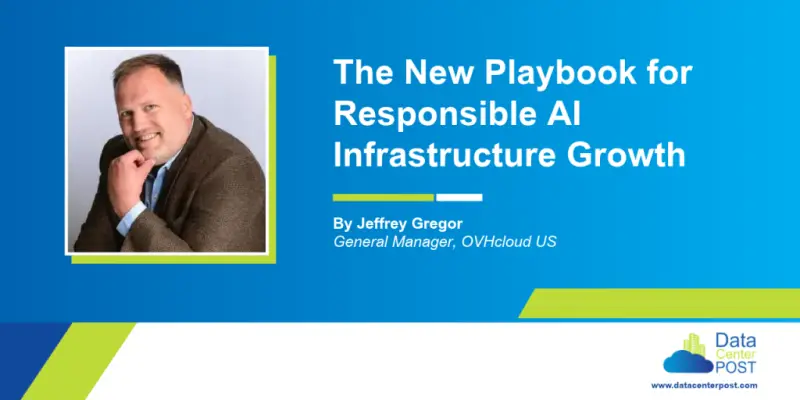
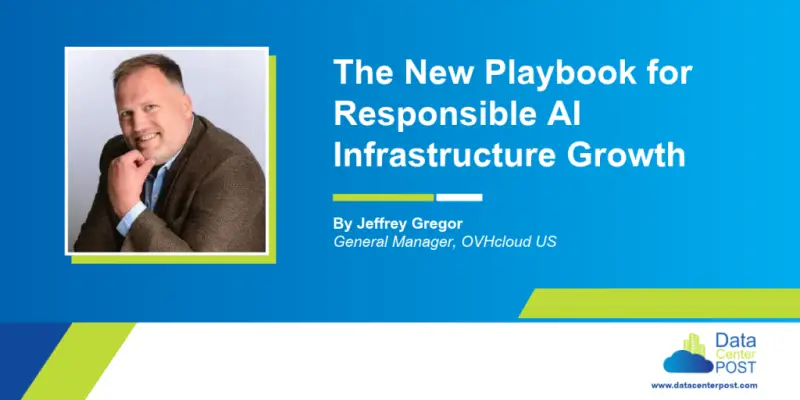
Those numbers explain why the conversation has shifted from building more campuses to using existing power and space far more carefully. The approach outlined by OVHcloud's General Manager for the US market, Jeffrey Gregor, breaks the work into seven steps. My read is that the sequence matters as much as the individual steps, because each one depends on the answer before it.
Start With the Workload, Not the Building
Training a frontier model, running inference and supporting enterprise applications each put different pressure on power density, latency, resiliency and location. The 2024 Berkeley Lab report estimated that servers allocated to inference accounted for nearly 60% of AI server energy use in 2023. Training servers are projected to overtake inference by 2028 as higher-power GPUs get allocated to training.
That split has a practical consequence. Many inference workloads are latency-sensitive, so they can run closer to users instead of only in large centralised campuses. A distributed footprint also spreads demand across more markets, which can ease pressure on any single grid. If you haven't classified your workloads by latency and resiliency needs, you're probably sizing facilities on guesswork.
Plan Power Before You Pick a Site
The Federal Energy Regulatory Commission staff's 2025 State of the Markets report points to size, speed of interconnection and load flexibility as the defining traits of data center demand. Developers are advised to work through interconnection queue timing, transmission and substation upgrades, rate design and cost allocation with utilities and grid operators before committing to land.
On-site generation or storage needs the same scrutiny. Proposals should be evaluated with the utility for reliability, emissions, fuel supply, permitting and consumer-cost effects. Flexible workloads can support phased energisation or demand-response agreements, but service commitments and operating controls need to be written down at the outset, not negotiated later.
Find the Capacity You Already Have
The Uptime Institute's 2026 Global Data Center Survey reports growing concern about capacity forecasting and power availability, and says legacy infrastructure and cooling constraints continue to slow efficiency gains. That's a warning for anyone assuming spare floor space equals spare capacity.
Measure actual IT load against UPS and cooling capacity. Identify stranded electrical and thermal headroom. Validate redundancy and network limits before you put denser systems into space that looks empty on the drawings. Often the real constraint is not square metres but the power and cooling path to them.
Reuse Existing Buildings Where the Numbers Work
A building with suitable power access, fibre, structural strength and industrial zoning can be a sounder choice than ground-up construction. Former factories, warehouses and other large industrial structures can sometimes be adapted, which reduces demand for new land and building materials.
OVHcloud's Beauharnois campus in Quebec is one example. It occupies a converted former aluminium smelter and houses one of the company's server-production plants. Each candidate building still needs a close look at floor loads, cooling, backup generation, security and expansion room. Treat reuse as a site-selection strategy, with economics and engineering deciding where it's feasible.
Design Cooling and Water Together
Uptime's 2026 survey notes that average rack densities keep rising, and more operators now report peak densities of 30 kW per rack or above. Direct-to-chip liquid cooling removes heat close to high-density CPUs and GPUs, which allows denser racks with less cooling energy.
Water needs a specific target, not a vague pledge. A 2026 paper from the National Academy of Engineering, citing the Berkeley Lab 2024 report, puts U.S. data center water consumption at 140 to 280 billion litres in 2028 (about 37 to 74 billion gallons). Closed-loop systems that recirculate water and use dry coolers for much of their heat rejection can keep ongoing consumption low. Cooling choices also shape energy use, noise, building design and how much compute fits in an existing footprint, so they belong in the first site assessment, not a later retrofit.
Stretch Hardware Life
The Global E-waste Monitor 2024 found the world generated 62 million metric tonnes of electronic waste in 2022, and only 22.3% was documented as formally collected and recycled. Extending server life, moving machines to lighter workloads and harvesting usable components all ease pressure on supply chains and waste systems.
Procurement is where this gets decided. Servers designed for disassembly, repair and redeployment can serve several roles over their life. Teams should score serviceability and reuse alongside performance, price and energy efficiency, rather than treating them as afterthoughts.
Publish the Local Impact Numbers
Residents and local decision-makers want to know how a facility will affect electricity, water, traffic, noise, views and public finances. Gregor's recommendation is to publish projected electricity and water use, noise levels, backup-generator testing schedules and traffic impacts before approval, then report actual site performance after opening.
Community benefit agreements can fund local priorities such as workforce training or infrastructure. Heat-reuse projects can warm nearby buildings or industrial users where a stable off-taker exists. Site selection should account for nearby homes, zoning, and visual and acoustic mitigation, and engagement should carry on well after construction ends. Projects that treat disclosure as a one-off exercise tend to lose trust quickly.
What to Take Into Your Next Planning Cycle
Meeting AI demand will take more than new data centers. It means getting more out of the power, buildings and equipment already in place, making deliberate cooling and water choices, and being open with communities about each project's impact. Done well, that's how capacity gets added without pushing the costs onto the grid, the environment or the people living nearby. For IT and infrastructure teams, the practical starting point is simple: pull your real load-versus-capacity figures this quarter, before the next procurement request arrives.