Data Center Build Schedules Are Outrunning the Grid
- Natalie Stipan
- 339 views
Grid interconnection can take up to seven years while AI data centers are ready in two to three. Here's how developers are bridging the gap with on-site power.
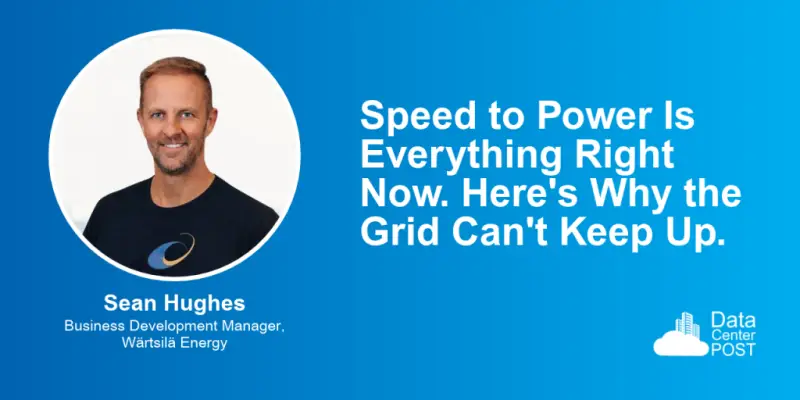
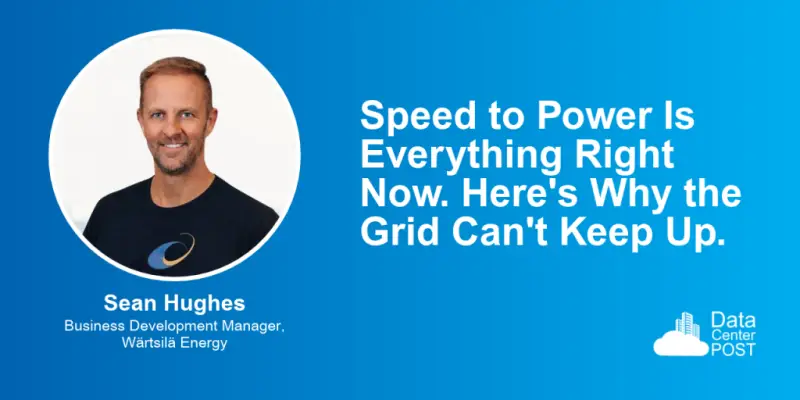
For most AI campus projects right now, the hard question isn't about cooling, chips or land. It's when the power arrives and how much of it there will be. Sean Hughes, business development manager at Wärtsilä Energy, argues that this single constraint now shapes how data centers get planned, financed and delivered in the U.S. market.
The conversation usually goes something like this: the land is secured, the tenant is lined up, and the utility's answer is a connection date several years out. Developers can assemble the site, the capital and the customer. What they increasingly can't assemble is a grid connection that matches their construction schedule.
Two clocks running at different speeds
A hyperscale or AI campus can move from site selection to ready-for-load in roughly two to three years, according to the vendor's account. The grid infrastructure needed to serve that campus runs on a much slower timeline. Hughes puts the interconnection wait at up to seven years.
The bottleneck is physical as well as administrative. New transmission lines take most of a decade to plan, permit and build. Large transformers and switchgear carry long lead times. Developers across the country are being quoted multi-year waits for large new loads, and grid operators in PJM, ERCOT, MISO and SPP are revising how they study and connect those requests.
Demand is climbing through all of this. Lawrence Berkeley National Laboratory estimates data centers consumed about 4.4% of U.S. electricity in 2023 and could reach between 6.7% and 12% by 2028. Hughes notes that utilities haven't planned for load growth of this kind in a generation.
He's also fair to the utilities. Their job is to keep other ratepayers from paying for capacity nobody uses, and their queues are crowded with speculative requests. The system was designed for slow, steady growth, and it's now facing a step change. A developer with a signed tenant, though, doesn't have seven years to wait.
The four levers developers are pulling
Hughes argues that waiting on the grid isn't a strategy. When the grid date and the build date diverge, he describes four levers that developers can pull, and the strongest projects typically use more than one.
The first is phasing. A partial connection is often available well before a full one, so building the campus to energize in stages lets revenue start while the rest of the capacity catches up.
The second is demand flexibility. A facility that can cut its grid draw for a limited number of hours each year is easier to connect, and Hughes says utilities and grid operators are beginning to reward that behavior.
The third is bringing power on site. Dispatchable generation can carry some or all of the load until grid service arrives, and it can then move into a different role once the connection is live.
The fourth is site selection. Locations with existing headroom, retired power plant sites that still hold interconnection rights, and places near new generation have become much more valuable than they were a few years ago.
Primary power is not backup power
Hughes says this is where he sees the most confusion. Backup generation works like a spare tire: it sits unused and you hope it stays that way. Primary power is the engine. It runs every day as the main source of supply. The two call for different equipment, different economics and different operating models, and developers facing primary power for the first time need to treat it as its own problem.
Going primary doesn't have to mean cutting the grid out. A fully islanded campus has to carry all of its own redundancy and reserve margin, and it gives up the resilience a large interconnected system provides. Hughes describes a middle path he calls a macro-grid: dependable on-site power that can run the campus independently, with a connection to the grid added when the timing works. Once connected, he suggests operators could explore exporting power, which he argues would help both nearby communities and the data center's own revenue, while adding capacity that could ease electricity prices.
That's a vendor's view, and it deserves scrutiny on the economics. Still, the underlying engineering point holds. On-site capacity that can flex down at peak or support the system during tight periods changes how a utility sees the load. A large facility that can flex is far easier to connect than one that can't.
What to ask before signing
Hughes says developers want two answers from any power provider: will it be on when we need it, and can you fix it when it isn't? He warns that the second question matters more than many buyers expect. Several newer players are winning U.S. data center work, and not all of them have field technicians, spare parts and service coverage in place. A primary power plant is only as dependable as the people and parts behind it, so he recommends asking about service before signing rather than after the first outage.
Fuel deserves the same scrutiny. A plant built for primary duty will likely run for decades. Fuel flexibility, predictable operating costs and efficient use of each unit of fuel all contribute to cost certainty over the asset's life. Hughes frames that as sound business and responsible resource use.
Where this leaves project planning
Hughes's core advice is to stop treating power as a procurement task that begins after the site and design are fixed. By that point, options have narrowed and the schedule is already exposed. Power should sit at the start of the plan, next to land and fiber. Talk to the utility before committing to a site, and treat its realistic timeline as a design input. If on-site generation will carry load for a period, plan its permitting, fuel and service from day one, and bring EPC and power specialists in early so generation and grid connection are engineered as one system.
The grid will catch up. Utilities and grid operators are investing heavily, and new transmission and generation are on the way. Hughes's point is that the timeline runs to years, while the AI build-out is moving on a faster schedule. For IT and facilities teams tracking capacity plans, the practical takeaway is to get the power date in writing early and let it drive the build sequence, rather than discovering the constraint once the design is frozen.