Why Data Center and Hospital Fuel Systems Can't Be Built From the Same Template
- Natalie Stipan
- 491 views
Data centers and hospitals both rely on standby generators, but their fuel systems need different engineering. Here's what IT and facilities teams should weigh.
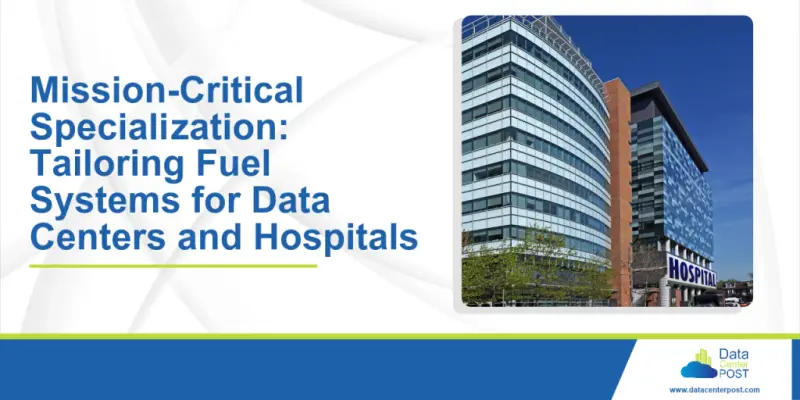
Most IT managers have heard that the generator is the last line of defence. Fewer have asked what happens between the utility failing and the generator actually running on fuel that's in the right place, at the right quality, in the right quantity. That gap is where mission-critical fuel design either holds up or doesn't, and my read is that it's where a lot of standardised equipment packages start to show their limits.
The core argument from ESI Total Fuel Management is straightforward. A data centre and a hospital can both depend on standby generators during an outage, yet their facilities, operating priorities, emergency procedures and infrastructure constraints differ enough that one fuel design won't serve both well. ESI says it is built for environments where fuel-related generator failure isn't an acceptable outcome, and it lists data centres, hospitals, utilities, financial institutions and government infrastructure among them.
Data centres: scale and repeatability pull in different directions
For data centres, the problem grows with the facility. Storing enough fuel is the easy part. Fuel has to be received, maintained, monitored, distributed and delivered to generators in a way that supports the site's critical power strategy, and that's true whether the facility is one building or a campus that keeps adding capacity.
ESI describes the system as a set of parts that have to work together: bulk tanks, day tanks, transfer equipment, receiving infrastructure, monitoring technology and generator supply. Its stated approach is to manage fuel quality, storage, distribution and generator supply as one unified system rather than as separate components. That framing matters because a problem in one element, such as a transfer pump or a receiving point, can affect whether a generator gets fuel when it needs it.
Operators running several sites often want common engineering standards and a repeatable way of judging fuel system performance. Here's the thing, though: repeatable doesn't mean identical. Tank configuration, generator requirements, site access, local conditions and facility design can all vary from one location to the next. The practical goal is a shared standard with site-specific engineering underneath it, not a single drawing copied across the estate.
Hospitals: continuity of care sets the constraints
Hospitals face a different set of demands. A facility has to keep essential operations running through a power disruption while still functioning as an active care environment. That means the fuel system can't be designed in isolation from the building around it.
Existing tankage, facility layout, available space, delivery routes and emergency access can all limit what gets installed and how fuel moves across the site. ESI notes that a system may need to integrate with infrastructure that has been running for years rather than one designed as part of a new campus. In practice, that's the harder job. Retrofitting into a live site with working tanks and fixed routes usually involves more compromise than a greenfield build, and the fuel design has to acknowledge those compromises rather than assume them away.
Regulatory requirements sit inside that operating environment too. ESI says its fuel assurance model covers handling, storage and usage with the aim of supporting operational readiness, regulatory requirements and audit confidence. The source doesn't go into specific rules or standards, so teams should check their own jurisdiction's requirements against any vendor's model rather than relying on a general assurance claim.
Emergency fuel access deserves its own planning. Extended outages, severe weather and grid instability can make normal deliveries harder to get. ESI identifies disaster preparedness and emergency fuel access as core parts of mission-critical fuel management, which is a useful reminder that on-site storage has a ceiling. Facilities should know what happens when an outage runs longer than their tanks can cover.
The system changes after commissioning
A tailored fuel system shouldn't be frozen at handover. Facilities expand, equipment ages, loads shift and operating requirements change. A data centre may add generators and capacity. A hospital may renovate or extend existing infrastructure. Either can face new compliance expectations or revised emergency plans.
Each of those changes can alter how fuel behaves across the system and what the facility needs from it. ESI says its model covers fuel-related performance across the lifecycle, with systems evaluated, maintained, monitored and optimised as conditions change. The company frames this as ongoing accountability rather than performance at commissioning alone. That's a sensible position, though it's ESI's own framing and worth testing against a service contract's actual scope.
Operational data is the piece that makes lifecycle claims checkable. Insight into consumption, fuel condition and system performance lets operators compare the assumptions they built the system on with what the system actually does. That comparison is how a facility finds out whether its readiness still matches its load, before an outage does it for them.
What IT and facilities teams should take from this
ESI's core message is that fuel should be treated as a performance-critical part of mission-critical infrastructure, not a commodity that gets trucked in when the tank runs low. Its stated method is to start with what the facility protects, then engineer and support the fuel system around that.
For a data centre team, the next step is to check whether the fuel design on each site matches a common standard while still reflecting that site's tanks, generators and access. For a hospital, it's to map where the existing infrastructure limits what can change, and to confirm how emergency fuel access works once outage duration exceeds on-site storage. Neither task requires a new product decision. Both start with a clear picture of the mission the generators have to support.