Modular Data Centres: Methodology, Not Container Hype
- Natalie Stipan
- 312 views
Panellists at DCD Connect Virginia 2026 argued modular builds speed AI capacity, but flexibility, maintenance access and supply chains still need planning.
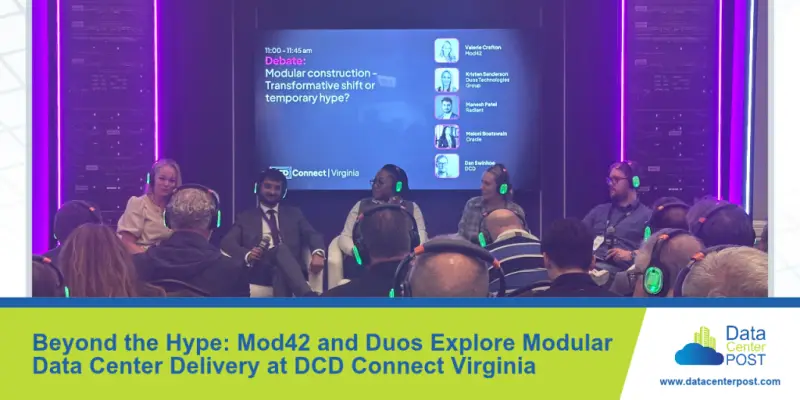
Modular construction for data centres has moved past the "is it a fad?" stage. The useful question now is narrower: which parts of an AI facility benefit from being built off-site, and what does an operator have to lock down before those savings show up on the project schedule? That was the thread running through a debate at DCD Connect | Virginia 2026, where the speakers spent less time defending the label and more time on design trade-offs.
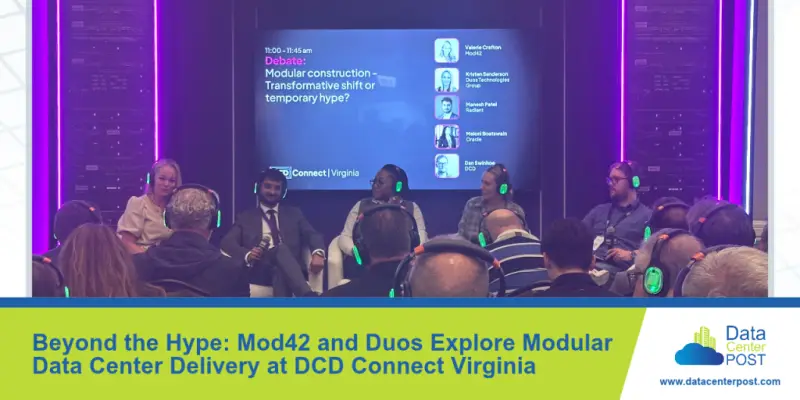
The November 4 session, titled "Debate: Modular construction – Transformative shift or temporary hype?", put Valerie Crafton, Chief Revenue Officer at Mod42, and Kristen Sanderson, Senior Vice President at Duos Technologies Group, on the same stage as Meloni Boatswain, Director of Data Center Infrastructure Delivery at Oracle, and Manesh Patel, Head of Data Center Development at Radiant. DCD Editor in Chief Dan Swinhoe moderated. Their common ground was that modular is a way of sequencing a build, and that the sequencing is where the value sits.
Off-site is a sequencing decision
Both Crafton and Sanderson pushed back on the picture of a modular data centre as a shipping container with servers inside. Crafton described Mod42's approach as reaching well beyond prefabricated electrical or cooling skids. In her account, the whole AI facility is integrated in a factory and configured around the technology that will run in it. Sanderson made a complementary point: modular buildings can be designed for regional conditions, and they can sit inside a conventional building shell if the customer wants extra enclosure or security.
The scheduling argument is the one I'd focus on. While the site is still being prepared, electrical rooms and mechanical systems can be assembled elsewhere, rather than waiting for the envelope to close before anything else starts. That changes the order of work on site. Moving a few components off-site is a smaller change than rethinking when each piece of the project happens, and that second change is where the time savings come from.
Phased capacity as an earlier revenue line
Crafton tied faster delivery to revenue timing. Customers don't have to wait for a full campus to be finished before they start running workloads. If initial capacity can be energised while later phases are still under construction, the facility earns against demand sooner. That's the commercial case for phasing, and it's a stronger argument than "the building went up faster."
Sanderson gave a concrete case from Duos's work in Columbus, Georgia. The company repurposed a vacant building using modular electrical houses and chillers. She described a deployment of roughly 7 MW of critical load at a site that can scale to 20 MW, with capacity brought online in stages as the customer got its computing equipment ready. Her examples sat in the roughly 1–20 MW range, while Crafton spoke to phased delivery across larger campuses. Put side by side, the two talks suggest the method scales in more than one direction, though the tooling and commercial terms will look different at each size.
Where flexibility gets tested
The panel was not a sales pitch. Boatswain asked how prebuilt infrastructure copes when a customer changes its requirements mid-project, such as moving from air-cooled workloads to denser, liquid-cooled systems. That is the question that tends to expose a standardised design. If the mechanical and electrical plant was specified for one cooling approach, a late switch can ripple through the whole building.
Patel raised maintenance access, equipment replacement and land constraints. His point was that a faster build still has to produce a facility people can operate. Standardisation doesn't answer how a unit will be serviced, swapped or upgraded five years from now. Sanderson said Duos handles this through customer-specific design, redundancy and replaceable units, with future expansion adding different modules or buildings as needs change. Crafton acknowledged that modular won't make economic sense on every project. Even so, she said, "I think it's a greater risk not to consider it at this point."
Workforce and community angles
Factory work brought workforce development into the conversation. Crafton said repeatable tasks in a controlled environment can support training and cut down on weather-related disruption. Boatswain linked that to a wider need to bring students and early-career tradespeople into digital infrastructure work. Sanderson described the Columbus project as a community effort, using local labour, working with community leadership and hiring interns as Duos grows its footprint.
Two site-selection points came up as well. Crafton pointed to reusing industrial buildings as a route to capacity. Sanderson warned that available power on its own isn't enough, because network connectivity has to be part of the site decision too. For teams scouting old industrial stock, that's a useful reminder to check fibre routes early, not after the electrical design is locked.
Supply chains still set the pace
Panellists were direct that modular doesn't remove supply-chain risk. Long-lead equipment and smaller components can still hold up delivery. Their answer was to manage the risk, not pretend it's gone: forecast demand, coordinate closely with suppliers and reuse designs where possible. Patel stressed repeating familiar delivery and commissioning processes from one project to the next. Crafton urged engineers to design around equipment availability and customer needs, rather than falling back on conventional layouts by default.
Sanderson's closing remark captured the customer-first logic: "It's not what we want. It's what we're building for them." For IT and facilities teams evaluating modular options, my read is that the useful test is whether a vendor can show how a design will change when requirements do, how the plant will be serviced, and how long-lead items will be sourced. Speed matters, but a facility that is quick to build and awkward to maintain only moves the problem later. You can find more on the companies at Mod42 and Duos Technologies Group.