ThinkPad X1 2-in-1 Gen 11 Review: Eight Cores in a 2.52-Pound Convertible
- Brian Beeler
- 323 views
Lenovo's X1 2-in-1 Gen 11 keeps the TrackPoint and pen storage at 2.52 pounds. Its 8-core chip holds full speed for 30 minutes, but integrated graphics trail badly.
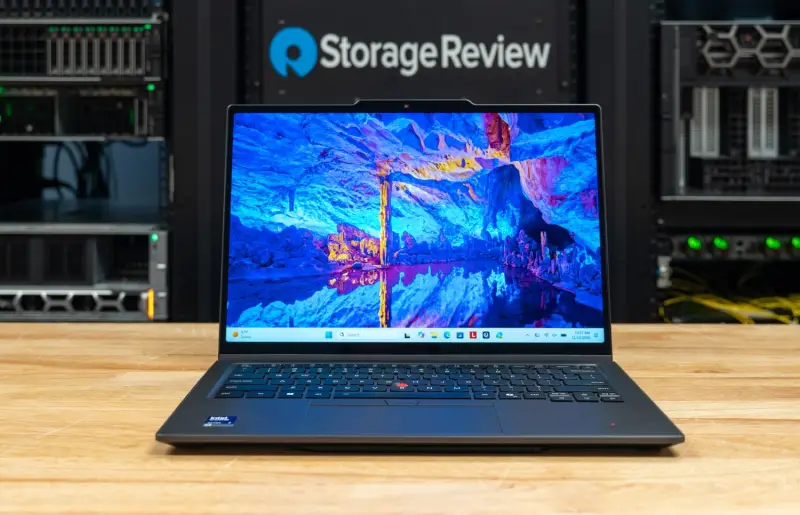
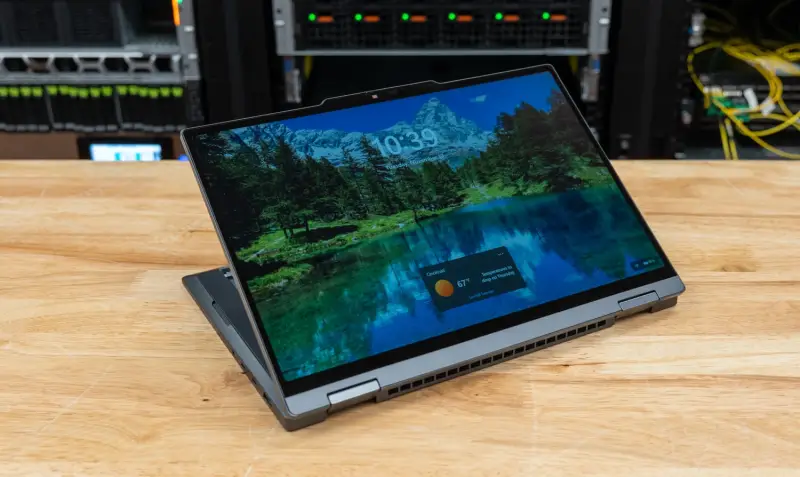
If you manage a fleet of mobile executives and field staff, the question with this ThinkPad is simple: does the lightest X1 with a pen and tablet mode still do real work? The X1 2-in-1 Gen 11 Aura Edition is a 14-inch business convertible that weighs 1.14kg (2.52lb) and folds through laptop, tent, stand, and tablet modes on a 360-degree hinge. Our review unit runs the 8-core Core Ultra 7 355 with 32GB of LPDDR5X memory, a 512GB SSD, and a 500-nit WUXGA touch display. My read is that it's a sound business machine with one clear performance ceiling, and that ceiling is set by the chip Lenovo chooses to sell in North America.
What Changed in Gen 11
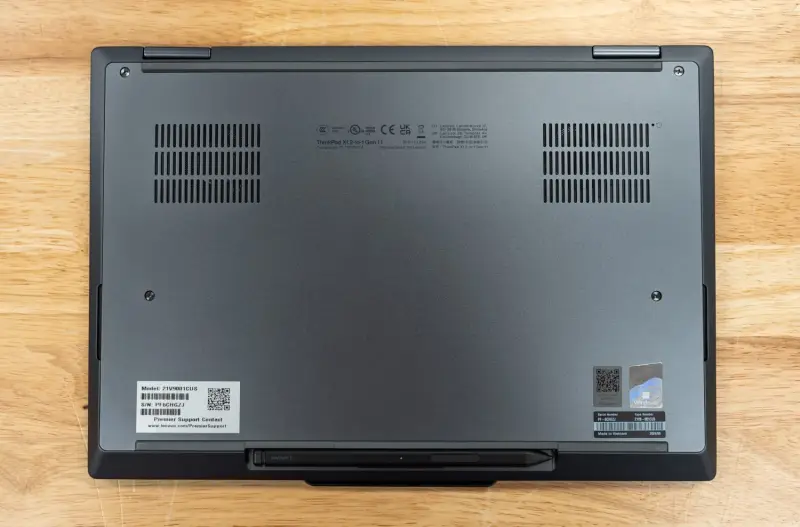
The X1 2-in-1 is the convertible member of Lenovo's flagship X1 family. Gen 11 is built around what Lenovo calls the Space Frame. A double-sided system board cuts the board footprint by 20 percent, and Lenovo says the space it frees holds a fan that is 70 percent larger and supports up to 30W TDP performance. That same redesign makes room for a pen storage slot on the underside of the chassis.
Lenovo's North American lineup is limited to 8-core parts with four P-cores and four low-power E-cores: the Core Ultra 5 325 and 335, and the Core Ultra 7 355 and 365. Other regions get three 16-core H-series options, the Core Ultra 7 356H and 366H, which keep the same Intel Graphics, and the Core Ultra X7 368H, which adds Arc B390 graphics. That regional split matters. The CPU gap between this laptop and the H-series ThinkPad X9-15p in our comparison follows directly from it. The 335 and 365 are the vPro parts, and the 355 in our unit ships without vPro.
Configuration and Buying Options
Our configuration, model 21V9001CUS, sells for $2,884.99 at CDW against a $3,229 list price, and it was in stock at the time of writing. It pairs the Core Ultra 7 355 with 32GB of memory, a 512GB SSD, and the anti-reflective WUXGA touch panel. Memory is soldered and comes in 16GB, 24GB, 32GB, or 64GB, so the capacity decision happens at purchase. Lenovo also offers a 2.8K OLED panel at 120Hz for buyers who want more than the 1920×1200 IPS display.
Lenovo.com doesn't list our exact model. The closest match is 21V9001AUS, which carries the Core Ultra 7 365 vPro, 32GB of LPDDR5X-8533, a 1TB SSD, and the same touch panel. At the time of writing it cost $2,229 with a coupon applied, which is about $656 less than our configuration. Build-to-order models with the Core Ultra 5 335 vPro start at $2,204.90, and the X9-15p configuration we reviewed lists at $2,629 at the same store.
That price gap is the first thing a purchasing team should check. If the 365 vPro model's extra SSD capacity and vPro support fit your requirements, the configuration we tested is hard to justify at list-plus-reseller pricing.
Build and Chassis
The chassis uses aluminum on the top and bottom. Lenovo says 75 percent of the lid is recycled material and 90 percent of the keyboard frame is recycled magnesium. The body measures 313.5 x 219.25mm and tapers from 9.24mm at the front to 16.4mm at the rear, with a 17.9mm maximum. Lenovo tests the design against 12 MIL-STD-810H methods and more than 26 procedures.
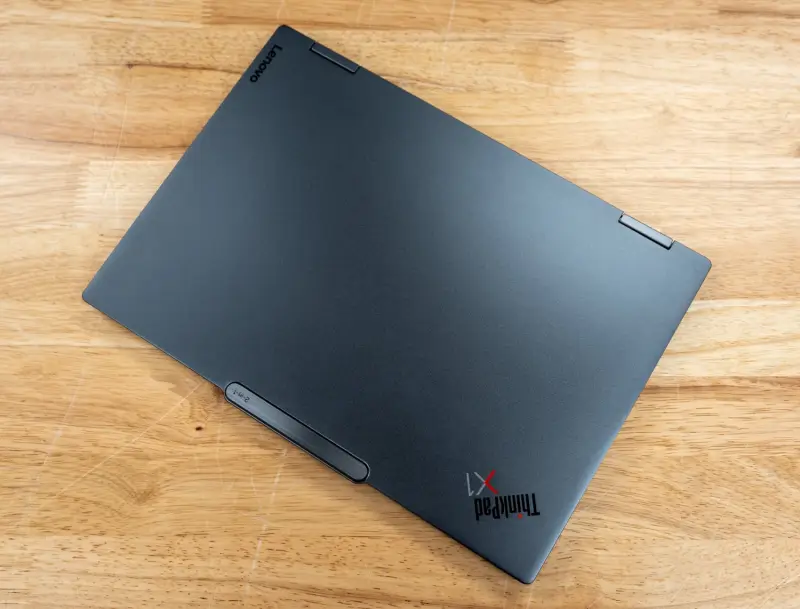
The 360-degree hinge supports laptop, tent, stand, and tablet modes. The pen is the Lenovo Slim Pen 2, which attaches magnetically and charges through pogo pins when stored in the base. Lenovo sells the X1 2-in-1 with or without a pen in the box. Our unit shipped with the pen docked in a slot along the front edge of the base. The pen supports tilt detection, and its body uses 90 percent recycled aluminum.
The hinge is the design's weak point. It's loose enough that, with the laptop resting on a lap, a slight bounce of the leg pushes the display back, and it can keep going until the screen lies flat. Tent mode holds up better than I expected given the camera bump at the top of the display, though tapping with the pen nudges the screen. The pen itself stays firmly seated in its slot. If your users work in tablet mode on a desk or a stand, expect the hinge to be a daily annoyance rather than a deal-breaker.
Ports, Wireless, and Serviceability
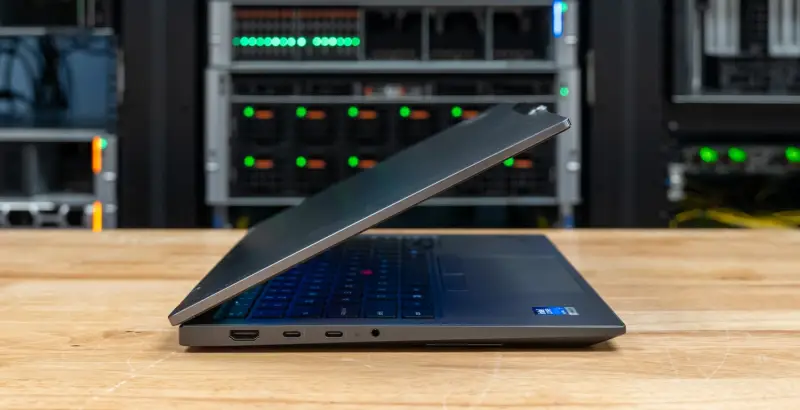
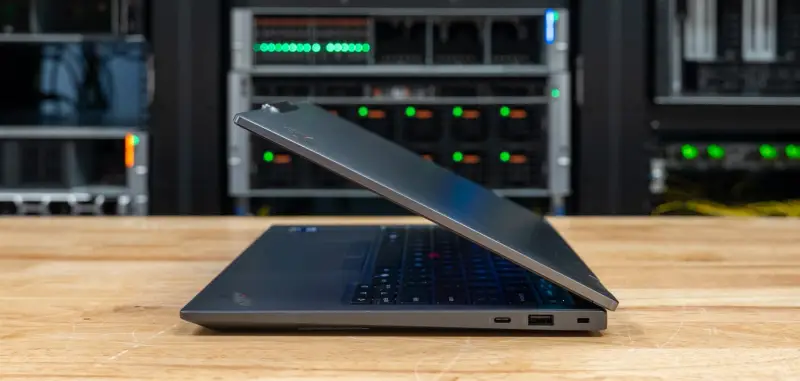
The port set covers most business docking needs without an adapter. There are three Thunderbolt 4 connections with DisplayPort 2.1 and USB Power Delivery up to 65W, one USB-A port at 5Gbps with always-on charging, an HDMI 2.1 port that supports 4K at 60Hz, and a 3.5mm combo jack. HDMI, two Thunderbolt 4 ports, and the audio jack sit on the left side. The third Thunderbolt 4 port, the USB-A port, and a Kensington Nano lock slot sit on the right. Because the system charges from either side, you can route the cable to whichever side suits the desk.
Wireless is Intel Wi-Fi 7 BE211 with Bluetooth 5.4. Lenovo offers 5G on other configurations. There is no Ethernet port and no card reader, so any wired network or media workflow will need a Thunderbolt or USB adapter. Plan for that in your accessory kit.
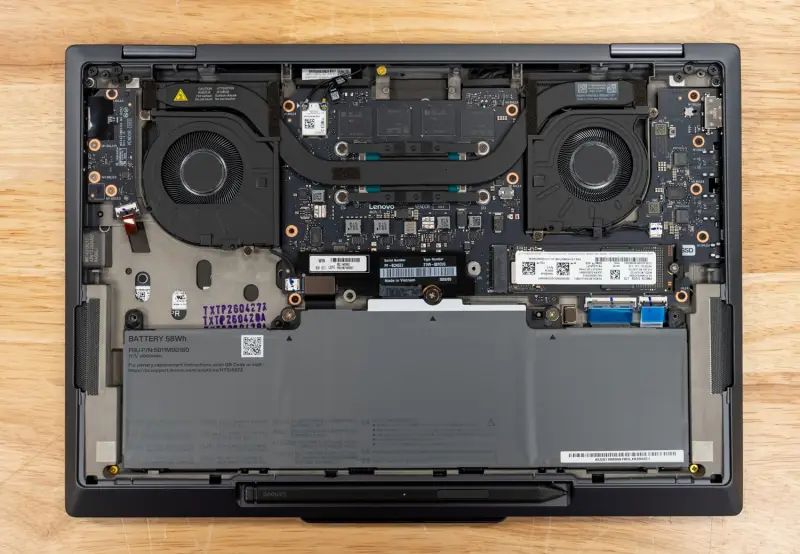
Servicing is easier than on most thin notebooks. Four captive screws hold the bottom cover, and a Phillips screwdriver and a pry tool are all you need. The cover is a flat plate rather than a panel that wraps up to the palm rest. The palm rest and keyboard sit in a separate midframe, so the cover comes off quickly. Under it, two fans sit in the rear corners and are linked by a heat pipe that crosses the processor. The M.2 2280 SSD sits on the right side of the board, clear of the cooling assembly. The 58Wh battery spans the front half of the chassis, with the pen garage running along the front edge in front of it.
Keyboard, Display, and Camera
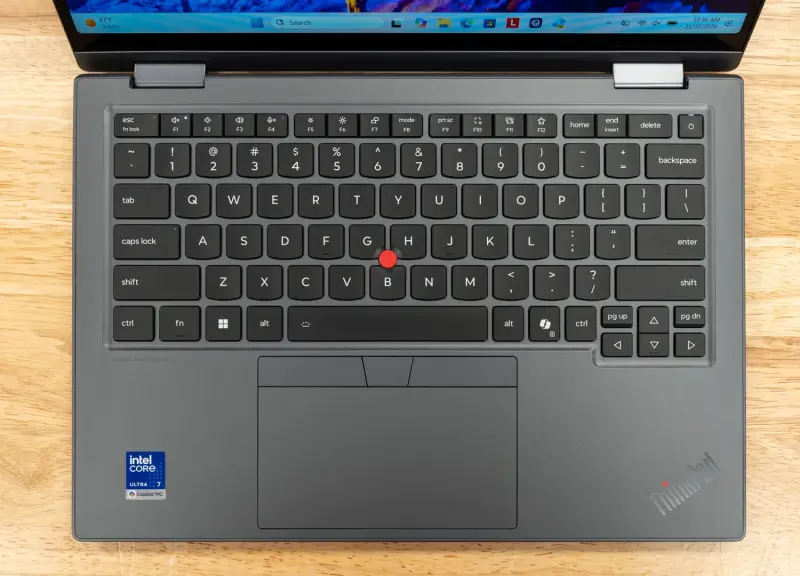
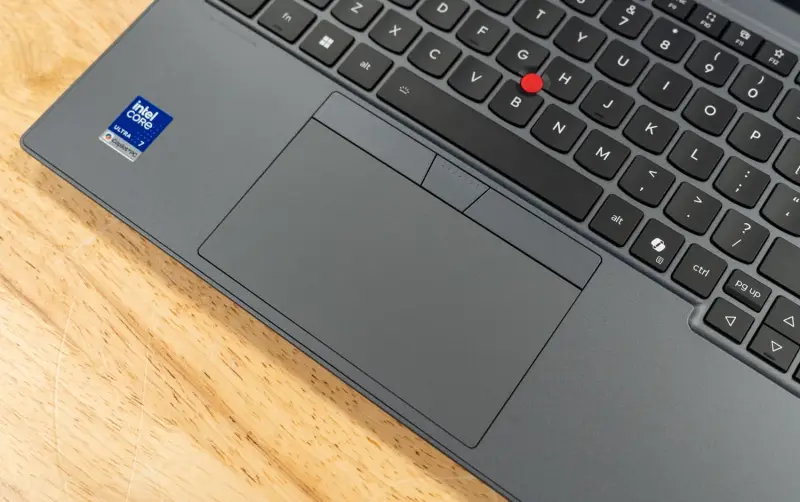
The keyboard is the six-row, spill-resistant ThinkPad layout with 1.5mm of key travel and an LED backlight. It includes a Copilot key and a TrackPoint with three buttons above an 80 x 120mm trackpad. Lenovo draws cooling air through sealed openings under the keys and pushes the two 2W speakers' sound out through the same path. The fingerprint reader sits in the power button. The Ctrl and Fn keys have swapped positions compared with earlier ThinkPads, which will take some retraining for long-time users. Several keys also carry tactile markings for users with low vision.
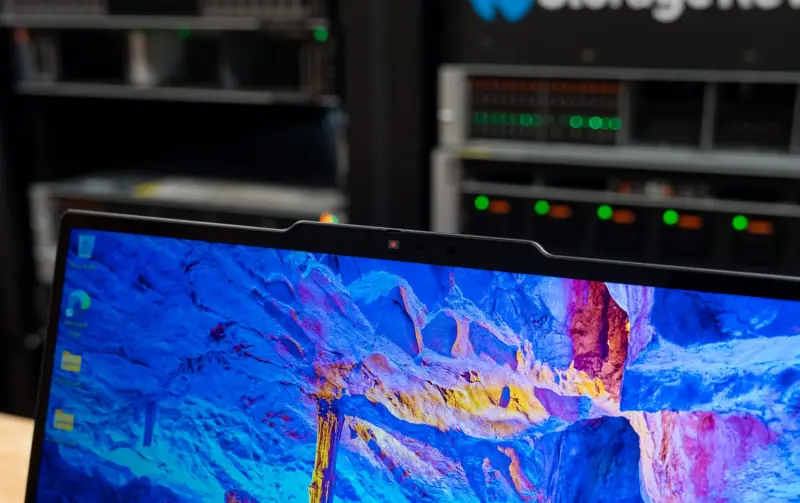
Our unit's display is a 14-inch, 16:10 low-power IPS panel at 1920×1200 with touch. It's rated at 500 nits and 100 percent sRGB, with an anti-reflective, anti-smudge surface and a 60Hz refresh rate. The camera above it is 5MP with an IR sensor for Windows Hello, and it sits behind a physical privacy shutter. Lenovo offers a 10MP camera as an upgrade. If your users need a sharper panel for presentations, the OLED option is the reason to look beyond the standard configuration.
Memory, Storage Slot, Battery, and Software
Memory is soldered LPDDR5X. Our unit has 32GB running at 7467MT/s. Storage is a single M.2 2280 slot wired for PCIe Gen5 x4 that accepts drives up to 2TB, although our unit shipped with a 512GB Samsung PCIe Gen4 drive. The battery is a 58Wh pack that charges from a 65W USB-C GaN adapter. Rapid Charge brings it to 80 percent in one hour while the system is off or asleep. Lenovo quotes up to 17.2 hours in MobileMark 30 for a Core Ultra 5 335 configuration. Battery life testing for our unit will follow in a later update.
The Aura Edition name refers to a set of Lenovo software features. Smart Modes switches system settings across six profiles: working, gaming, creating, entertainment, meetings, and learning. You can trigger it from a widget or from inside Lenovo Vantage. Smart Share covers Tap to Launch, which moves photos between a phone and the notebook, and Tap to Pair for Bluetooth accessories. Smart Care connects users to Lenovo support technicians by chat or phone. Whether those features matter depends on how much your users rely on Lenovo's own tooling versus your existing management stack.
Test Setup and Methodology
The review unit runs the Core Ultra 7 355 with integrated Intel Graphics, 32GB of LPDDR5X-7467, and a 512GB Gen4 SSD on Windows 11 Pro. Benchmarks ran in Best Performance power mode. The suite ran while plugged in, on BIOS 1.16 and Intel graphics driver 32.0.101.8826.
Results come from full, Peak-profile runs of sr-client, a scripted client benchmark suite. The three ThinkPads ran sr-client version 1.13, the Dell ran version 1.12, and the Yoga ran version 1.11. The benchmark applications match across those releases, including Cinebench 2026, 7-Zip 24.09, Blender 4.5, Stockfish 19, GROMACS 2025.3, and MLPerf Client v2.0.
The suite applies the same settings to every system: Windows power mode at Best performance, display at 50 percent brightness, all sleep and display timers off, and Windows Firewall and UAC prompts off. VBS and Memory Integrity stayed as shipped. Each result is the median of repeated passes, and the suite reruns a test when its spread exceeds 2 percent before accepting it.
The comparison set brackets the X1 2-in-1 inside Lenovo's own lineup. The ThinkPad T14 Gen 7 runs the 6-core Core Ultra 5 332 with the same 32GB and the same Samsung SSD model. The ThinkPad X9-15p Gen 1 runs the 16-core Core Ultra X7 358H with Arc B390 graphics. That shows what the H-series chips Lenovo withholds from this chassis in North America would add in CPU cores, and what the Arc B390 in the top X7 368H option would add in graphics. Two systems from outside that range round out the group. The Dell Pro 7 14 is a 14-inch business notebook with the 12-core Ryzen AI 9 HX PRO 470 and Radeon 890M graphics. The Lenovo Yoga 9n 2-in-1 16 is a 16-inch convertible built on NVIDIA's 20-core RTX Spark N1X with 64GB of unified memory.
| Configuration | CPU | Memory | GPU | Boot Drive | sr-client |
|---|---|---|---|---|---|
| Lenovo ThinkPad X1 2-in-1 Gen 11 (21V9001CUS) | Core Ultra 7 355, 8 cores | 32GB LPDDR5X-7467 | Intel Graphics (integrated), 18.1GB usable | 512GB Samsung, PCIe Gen4 | 1.13 |
| Lenovo ThinkPad T14 Gen 7 (21WN00C9US) | Core Ultra 5 332, 6 cores | 32GB at 6800MT/s | Intel Graphics (integrated), 18.1GB usable | 512GB Samsung, PCIe Gen4 | 1.13 |
| Lenovo ThinkPad X9-15p Gen 1 (21VV002AUS) | Core Ultra X7 358H, 16 cores | 32GB LPDDR5X-9600 | Arc B390 (integrated), 18.1GB usable | 1TB UMIS, PCIe Gen4 | 1.13 |
| Dell Pro 7 14 (P714265) | Ryzen AI 9 HX PRO 470, 12 cores | 64GB LPDDR5X-8000 | Radeon 890M (integrated), 47.8GB usable | 1TB Samsung, PCIe Gen4 | 1.12 |
| Lenovo Yoga 9n 2-in-1 16 (83N7) | RTX Spark N1X, 20 cores | 64GB LPDDR5X-9400 | N1X integrated RTX, 32GB usable | 1TB Sandisk, PCIe Gen4 | 1.11 |
Local AI Performance
The X1 2-in-1 has no discrete GPU, so local AI work runs on the processor's integrated Intel Graphics and shared system memory. On our 32GB unit, the suite measured 18.1GB of GPU-usable memory. That clears the 16GB floor for our tiered tests, so model loading and the coding agent test both ran. This graphics core is the smaller of Intel's two integrated designs this generation, and the results below sit well under the Arc B390 in the X9-15p.
MLPerf Client v2.0
| MLPerf Client v2.0 | Lenovo ThinkPad X1 2-in-1 Gen 11 (Ultra 7 355, 32GB) | Lenovo ThinkPad T14 Gen 7 (Ultra 5 332, 32GB) | Lenovo ThinkPad X9-15p Gen 1 (X7 358H, Arc B390, 32GB) | Dell Pro 7 14 (Ryzen AI 9 HX PRO 470, Radeon 890M) | Lenovo Yoga 9n 2-in-1 16 (N1X, 64GB) |
|---|---|---|---|---|---|
| Llama 3.1 8B, time to first token (s, lower is better) | 0.53 | 1.13 | 0.20 | 3.15 | 0.35 |
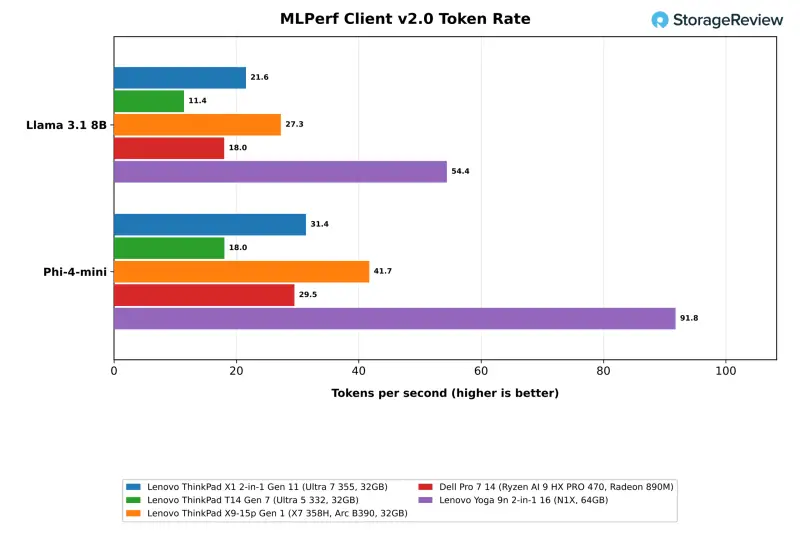
| Llama 3.1 8B, token rate (tokens/s) | 21.6 | 11.4 | 27.3 | 18.0 | 54.4 |
| Phi-4-mini, time to first token (s, lower is better) | 0.43 | 0.91 | 0.18 | 1.90 | 0.15 |
| Phi-4-mini, token rate (tokens/s) | 31.4 | 18.0 | 41.7 | 29.5 | 91.8 |
MLPerf Client runs through OpenVINO on the three ThinkPads, through Windows ML with DirectML on the Dell, and through llama.cpp with CUDA on the Yoga. The columns therefore compare inference engines as well as hardware. The X1 2-in-1 generated 21.6 tokens per second on Llama 3.1 8B and 31.4 on Phi-4-mini. On Llama 3.1 8B, that's 21 percent behind the X9-15p's Arc B390, 20 percent ahead of the Radeon 890M in the Dell, and close to double the T14's 11.4. The N1X in the Yoga reached 54.4 tokens per second, about 2.5 times the X1 2-in-1's rate.
Model Loading and the Coding Agent
| gpt-oss:20b (Ollama 0.40.3) | Lenovo ThinkPad X1 2-in-1 Gen 11 (Ultra 7 355, 32GB) | Lenovo ThinkPad T14 Gen 7 (Ultra 5 332, 32GB) | Lenovo ThinkPad X9-15p Gen 1 (X7 358H, Arc B390, 32GB) | Dell Pro 7 14 (Ryzen AI 9 HX PRO 470, Radeon 890M) | Lenovo Yoga 9n 2-in-1 16 (N1X, 64GB) |
|---|---|---|---|---|---|
| gpt-oss:20b cold load to first token (s, lower is better) | 10.40 | 11.03 | 8.63 | 10.94 | 7.55 |
| gpt-oss:20b warm load to first token (s, lower is better) | 9.80 | 10.54 | 8.01 | 5.14 | 3.70 |
| Coding agent, successful runs (of 3) | 2 | 0 | 3 | 2 | 2 |
| Coding agent, tests passing (of 11) | 11 | Failed | 11 | 11 | 11 |
| Coding agent, wall time (s, lower is better) | 392 | Failed | 374 | 1328 | 311 |
| Coding agent, generation rate (tokens/s) | 12.5 | 7.3 | 18.3 | 20.2 | 56.0 |
| Speedometer slowdown beside the agent (x, lower is better) | 1.18 | 1.11 | 1.26 | 1.91 | 2.35 |
The model-load test times Ollama from launch to first token on gpt-oss:20b, a 12.8GB model, both cold from the SSD and warm from the page cache. The X1 2-in-1 took 10.40 seconds cold and 9.80 seconds warm. The three 32GB ThinkPads each gained less than a second from a warm cache. The 64GB Dell and Yoga dropped to 5.14 and 3.70 seconds warm. That pattern suggests 32GB leaves little page cache free once the model sits in shared memory.
The coding agent test runs Crush against gpt-oss:20b with a 64K context through a fixed programming task. It runs three times, with up to three rounds each. The X1 2-in-1 succeeded on two of three runs, passing 11 of 11 tests on both, at a median of 392 seconds and 12.5 tokens per second. Its third run ended with 1 of 11 tests passing, and individual runs ranged from 151 to 991 seconds. The T14 failed all three attempts, and the X9-15p passed all three.
With Speedometer running beside the agent, the browser score fell from 38.6 to 32.8, a 1.18x slowdown. The agent's generation rate dropped from 12.5 to 11.4 tokens per second. Larger models are out of reach on this configuration. The 27B serving model needs 30GB of GPU-usable memory, and the 35B agent model needs about 40GB. Lenovo lists a 64GB memory option for the X1 2-in-1, and because the memory is soldered, that choice has to be made at purchase.
RAG and LLM Serving
| RAG (Ollama 0.40.3) | Lenovo ThinkPad X1 2-in-1 Gen 11 (Ultra 7 355, 32GB) | Lenovo ThinkPad T14 Gen 7 (Ultra 5 332, 32GB) | Lenovo ThinkPad X9-15p Gen 1 (X7 358H, Arc B390, 32GB) | Dell Pro 7 14 (Ryzen AI 9 HX PRO 470, Radeon 890M) | Lenovo Yoga 9n 2-in-1 16 (N1X, 64GB) |
|---|---|---|---|---|---|
| Ingest, passages per second | 43.1 | 22.9 | 83.6 | 52.3 | 114.5 |
| Ingest, embedding rate (tokens/s) | 6,980 | 3,703 | 13,543 | 8,465 | 18,538 |
| Answer, generation rate (tokens/s) | 34.9 | 17.1 | 48.7 | 42.2 | 91.1 |
| Answer, time to first token p50 (s, lower is better) | 1.52 | 2.81 | 0.84 | 1.43 | 0.18 |
| Question to answer p50 (s, lower is better) | 1.69 | 3.14 | 0.98 | 1.58 | 0.27 |
The RAG test embeds 20,963 SQuAD passages, retrieves the top five for each question, and answers with Phi-4-mini through Ollama. The X1 2-in-1 ingested 43.1 passages per second and generated answers at 34.9 tokens per second. Its median time from question to answer was 1.69 seconds. The X9-15p is roughly twice as fast on ingest at 83.6 passages per second. The Dell is 21 percent ahead of the X1 2-in-1 at 52.3, and the Yoga answers in a median of 0.27 seconds.
| llama.cpp server, Ministral 3 | Lenovo ThinkPad X1 2-in-1 Gen 11 (Ultra 7 355, 32GB) | Lenovo ThinkPad T14 Gen 7 (Ultra 5 332, 32GB) | Lenovo ThinkPad X9-15p Gen 1 (X7 358H, Arc B390, 32GB) | Dell Pro 7 14 (Ryzen AI 9 HX PRO 470, Radeon 890M) | Lenovo Yoga 9n 2-in-1 16 (N1X, 64GB) |
|---|---|---|---|---|---|
| Ministral 3 3B, 1 request, output (tokens/s) | 14.0 | 6.6 | 22.8 | 18.3 | 56.8 |
| Ministral 3 3B, 4 requests, output (tokens/s) | 25.2 | 11.8 | 39.1 | 45.3 | 143.2 |
| Ministral 3 3B, 1 request, time to first token (ms, lower is better) | 15,248 | 35,384 | 4,349 | 4,595 | 765 |
| Ministral 3 8B, 1 request, output (tokens/s) | 9.7 | 4.4 | 16.5 | 13.4 | 39.7 |
| Ministral 3 8B, 4 requests, output (tokens/s) | 14.3 | 6.7 | 25.6 | 29.0 | 96.9 |
| Ministral 3 8B, 1 request, time to first token (ms, lower is better) | 23,718 | 53,131 | 7,168 | 9,154 | 1,731 |
LLM serving runs the llama.cpp server with Ministral 3 models at 4,096 prompt tokens and 1,024 output tokens per request. The X1 2-in-1 delivered 14.0 tokens per second to a single user on the 3B model and 25.2 across four concurrent requests. On the 8B model it managed 9.7 and 14.3. Prompt processing is the real pain point on this graphics core. The median time to first token was 15.2 seconds on the 3B model and 23.7 seconds on the 8B model, against 4.3 and 7.2 seconds on the X9-15p and under two seconds on the Yoga. If your users plan to chat with a local model that reads long documents, expect to wait.
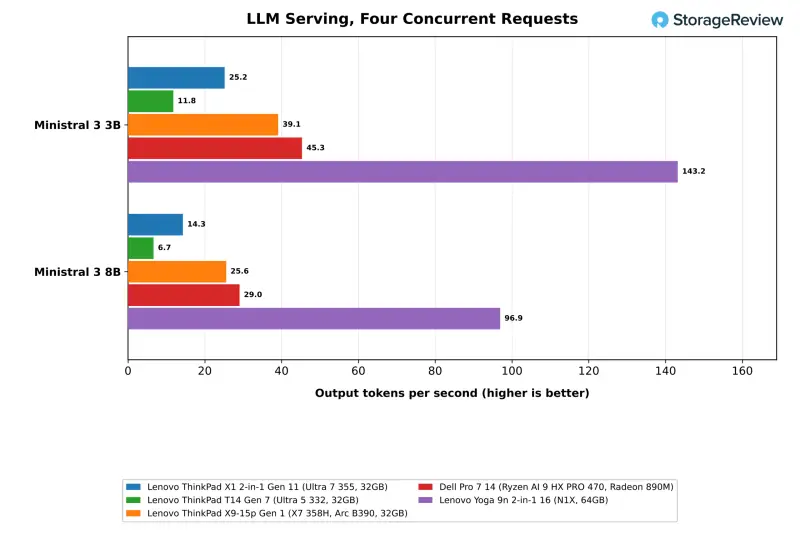
Image Generation
| stable-diffusion.cpp, 1024×1024 | Lenovo ThinkPad X1 2-in-1 Gen 11 (Ultra 7 355, 32GB) | Lenovo ThinkPad T14 Gen 7 (Ultra 5 332, 32GB) | Lenovo ThinkPad X9-15p Gen 1 (X7 358H, Arc B390, 32GB) | Dell Pro 7 14 (Ryzen AI 9 HX PRO 470, Radeon 890M) | Lenovo Yoga 9n 2-in-1 16 (N1X, 64GB) |
|---|---|---|---|---|---|
| FLUX.2 klein 4B Q4_0, images per minute | 0.14 | 0.10 | 0.20 | 1.79 | 9.89 |
| FLUX.2 klein 4B Q4_0, time per image (s, lower is better) | 445.29 | 612.38 | 302.39 | 33.51 | 6.07 |
Image generation with stable-diffusion.cpp doesn't suit the integrated Intel graphics in this group. The X1 2-in-1 completed FLUX.2 klein 4B at Q4_0 in 445 seconds per image, or 0.14 images per minute. It took close to 16 minutes per image on Z-Image Turbo. The Radeon 890M in the Dell produced 1.79 images per minute on the same FLUX.2 model, and the N1X in the Yoga produced 9.89. Unless image generation is a stated requirement, this isn't a reason to choose this laptop.
CPU Performance
Cinebench 2026 and Sustained Load
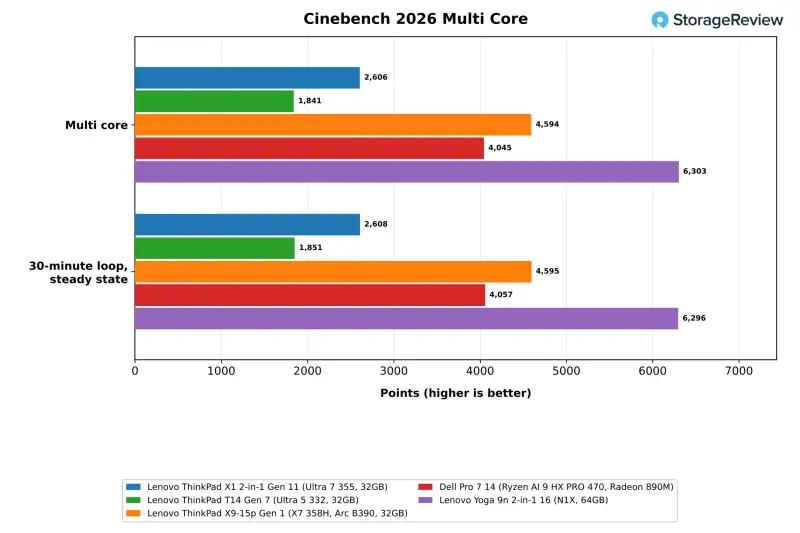
| Cinebench 2026 (points, higher is better) | Lenovo ThinkPad X1 2-in-1 Gen 11 (Ultra 7 355, 32GB) | Lenovo ThinkPad T14 Gen 7 (Ultra 5 332, 32GB) | Lenovo ThinkPad X9-15p Gen 1 (X7 358H, Arc B390, 32GB) | Dell Pro 7 14 (Ryzen AI 9 HX PRO 470, Radeon 890M) | Lenovo Yoga 9n 2-in-1 16 (N1X, 64GB) |
|---|---|---|---|---|---|
| Single core | 475 | 457 | 511 | 465 | 552 |
| Multi core | 2,606 | 1,841 | 4,594 | 4,045 | 6,303 |
| 30-minute loop, first pass | 2,602 | 1,845 | 4,614 | 4,029 | 6,269 |
| 30-minute loop, steady state | 2,608 | 1,851 | 4,595 | 4,057 | 6,296 |
| Steady state / first pass | 1.002 | 1.003 | 0.996 | 1.007 | 1.004 |
The Core Ultra 7 355 scored 2,606 in Cinebench 2026 multi-core and 475 single-core. That's 42 percent ahead of the 6-core Core Ultra 5 332 in the T14 on multi-core and 4 percent ahead on single-core. The 16-core X7 358H in the X9-15p is 76 percent faster on multi-core, at 4,594. The Ryzen AI 9 HX PRO 470 in the Dell is 55 percent faster at 4,045, and the N1X in the Yoga is 2.4 times faster at 6,303. Single-core results are much closer, with the X1 2-in-1 7 percent behind the X9-15p.
The 30-minute loop is the result I'd point to first. The X1 2-in-1 opened at 2,602 and settled at 2,608, so it held its first-pass score. The CPU averaged 90.6C with a mean clock of 3,705MHz. That clock is higher than the X9-15p's 3,255MHz in the same test. It fits a chip with half as many cores running under the same 30W figure Lenovo cites for both designs. Lenovo's larger fan keeps this processor at full output for the length of the test.
7-Zip, Blender, HandBrake, and LLVM
| Test | Lenovo ThinkPad X1 2-in-1 Gen 11 (Ultra 7 355, 32GB) | Lenovo ThinkPad T14 Gen 7 (Ultra 5 332, 32GB) | Lenovo ThinkPad X9-15p Gen 1 (X7 358H, Arc B390, 32GB) | Dell Pro 7 14 (Ryzen AI 9 HX PRO 470, Radeon 890M) | Lenovo Yoga 9n 2-in-1 16 (N1X, 64GB) |
|---|---|---|---|---|---|
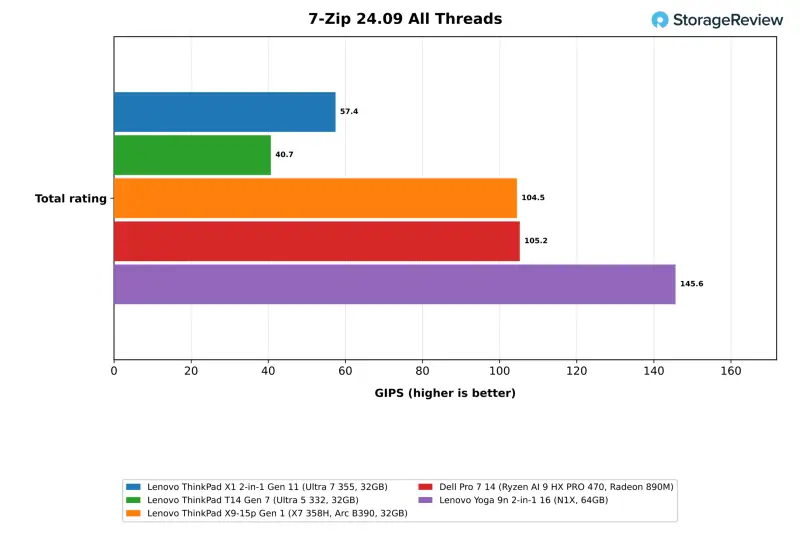
| 7-Zip, all threads, total (GIPS) | 57.4 | 40.7 | 104.5 | 105.2 | 145.6 |
| 7-Zip, one thread, total (GIPS) | 8.63 | 8.15 | 9.44 | 8.99 | 9.12 |
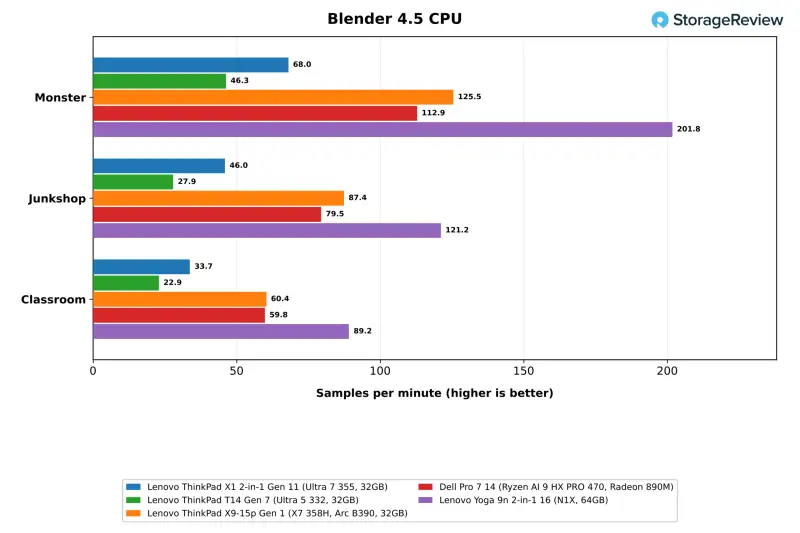
| Blender 4.5 Monster (samples/min) | 68.0 | 46.3 | 125.5 | 112.9 | 201.8 |
| Blender 4.5 Junkshop (samples/min) | 46.0 | 27.9 | 87.4 | 79.5 | 121.2 |
| Blender 4.5 Classroom (samples/min) | 33.7 | 22.9 | 60.4 | 59.8 | 89.2 |
| HandBrake x265 (fps) | 20.0 | 15.6 | 28.6 | 26.8 | 38.7 |
| HandBrake SVT-AV1 (fps) | 50.4 | 38.6 | 80.1 | 68.5 | 15.1 |
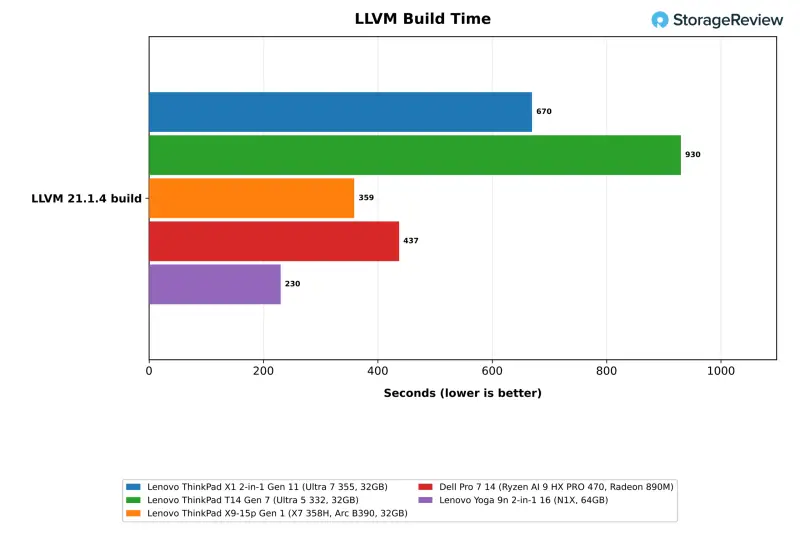
| LLVM build (s, lower is better) | 670 | 930 | 359 | 437 | 230 |
The content creation tests follow the Cinebench pattern. The X1 2-in-1 leads the T14 by 41 percent in 7-Zip, 47 percent in Blender Monster, and 28 percent in x265. It finishes the LLVM build in 670 seconds, against 930 on the T14. The X9-15p is 82 percent faster than the X1 2-in-1 in 7-Zip at 104.5 GIPS and 85 percent faster in Blender Monster, and its LLVM build takes 359 seconds. The Dell's 12-core Ryzen matches the X9-15p in 7-Zip and trails it in Blender and the LLVM build.
The Yoga's N1X leads every multi-threaded row except SVT-AV1, where the X1 2-in-1 encoded at 50.4 fps against 15.1 fps on the Arm system. For compiling or rendering, the Yoga offers more throughput, but at the cost of extra weight. Its LLVM build finishes in 230 seconds, just over a third of the X1 2-in-1's time, and the laptop weighs 0.8kg more.
Stockfish, primesieve, Python, and the Browser
| Test | Lenovo ThinkPad X1 2-in-1 Gen 11 (Ultra 7 355, 32GB) | Lenovo ThinkPad T14 Gen 7 (Ultra 5 332, 32GB) | Lenovo ThinkPad X9-15p Gen 1 (X7 358H, Arc B390, 32GB) | Dell Pro 7 14 (Ryzen AI 9 HX PRO 470, Radeon 890M) | Lenovo Yoga 9n 2-in-1 16 (N1X, 64GB) |
|---|---|---|---|---|---|
| Stockfish, one thread (Mnps) | 1.65 | 1.54 | 1.74 | 1.96 | 1.73 |
| Stockfish, all threads (Mnps) | 7.73 | 5.43 | 13.84 | 14.74 | 12.98 |
| primesieve to 10^12, all threads (s, lower is better) | 22.20 | 30.20 | 12.04 | 14.95 | 10.71 |
| primesieve to 10^11, one thread (s, lower is better) | 10.60 | 11.28 | 10.15 | 6.67 | 12.02 |
| PyPerformance go (ms, lower is better) | 76.9 | 81.2 | 73.2 | 76.5 | 110.6 |
| PyPerformance nbody (ms, lower is better) | 59.5 | 63.5 | 55.3 | 61.8 | 80.3 |
| Speedometer 3.1 (score) | 38.6 | 35.5 | 40.8 | 36.9 | 34.5 |
Lightly threaded work is where the X1 2-in-1 gives up the least. It scored 38.6 in Speedometer 3.1, 5 percent behind the X9-15p and ahead of the T14, the Dell, and the Yoga. It ran PyPerformance go in 76.9ms, level with the Dell, where the N1X takes 44 percent longer. One-thread Stockfish reached 1.65 Mnps, against 1.74 on the X9-15p. All-thread Stockfish at 7.73 Mnps is 42 percent ahead of the T14 but only a little over half of the X9-15p's 13.84.
GROMACS, OpenBLAS, and Memory
| Test | Lenovo ThinkPad X1 2-in-1 Gen 11 (Ultra 7 355, 32GB) | Lenovo ThinkPad T14 Gen 7 (Ultra 5 332, 32GB) | Lenovo ThinkPad X9-15p Gen 1 (X7 358H, Arc B390, 32GB) | Dell Pro 7 14 (Ryzen AI 9 HX PRO 470, Radeon 890M) | Lenovo Yoga 9n 2-in-1 16 (N1X, 64GB) |
|---|---|---|---|---|---|
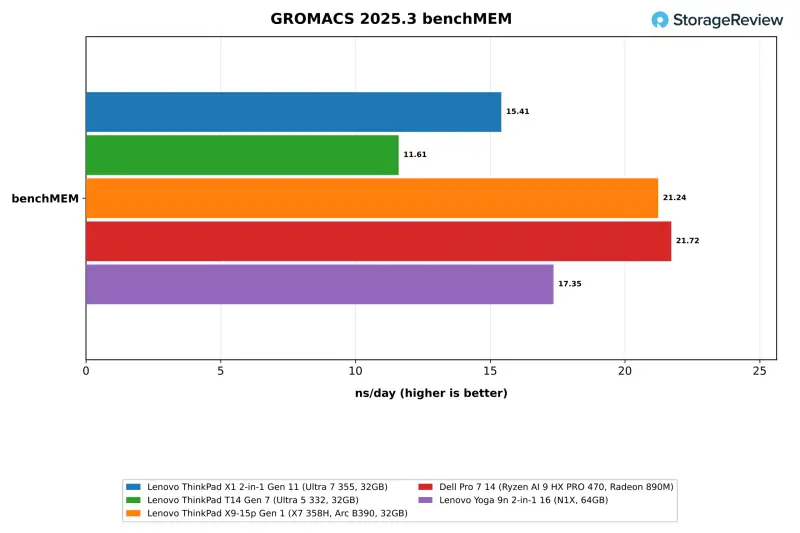
| GROMACS benchMEM (ns/day) | 15.41 | 11.61 | 21.24 | 21.72 | 17.35 |
| OpenBLAS DGEMM, all cores (GFLOPS) | 272.0 | 201.6 | 469.2 | 390.2 | 304.9 |
| OpenBLAS LU solve N=20000, all cores (GFLOPS) | 262.3 | 198.0 | 444.1 | 377.8 | 292.5 |
| STREAM Triad (MB/s) | 63,620 | 53,165 | 91,270 | 45,108 | 112,952 |
| Memory latency, 4KiB pages (ns, lower is better) | 142.8 | 155.4 | 109.9 | 148.3 | 141.2 |
GROMACS benchMEM ran at 15.41 ns/day, 33 percent ahead of the T14. The X9-15p and the Dell were 38 and 41 percent faster, at 21.24 and 21.72. OpenBLAS DGEMM reached 272.0 GFLOPS, compared with 469.2 on the X9-15p. Memory bandwidth in STREAM Triad was 63.6GB/s on the X1 2-in-1's LPDDR5X-7467. That's 20 percent above the T14 and 41 percent above the Dell, and below the 91.3GB/s of the X9-15p's LPDDR5X-9600.
Graphics and GPU Encoding
| SuperTuxKart 1.5 and FFmpeg (higher is better) | Lenovo ThinkPad X1 2-in-1 Gen 11 (Ultra 7 355, 32GB) | Lenovo ThinkPad T14 Gen 7 (Ultra 5 332, 32GB) | Lenovo ThinkPad X9-15p Gen 1 (X7 358H, Arc B390, 32GB) | Dell Pro 7 14 (Ryzen AI 9 HX PRO 470, Radeon 890M) | Lenovo Yoga 9n 2-in-1 16 (N1X, 64GB) |
|---|---|---|---|---|---|
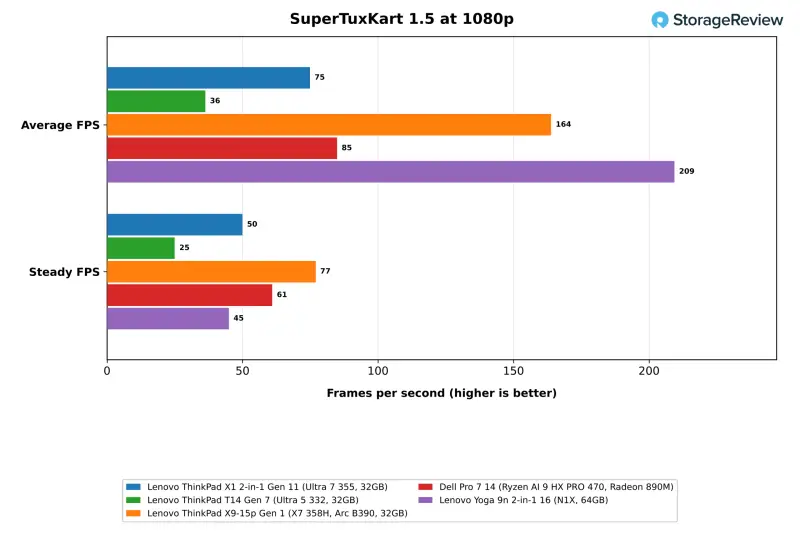
| SuperTuxKart 1080p, average FPS | 74.9 | 36.3 | 163.9 | 84.9 | 209.4 |
| SuperTuxKart 1080p, typical FPS | 73 | 35 | 161 | 84 | 208 |
| SuperTuxKart 1080p, mostly stable FPS | 61 | 29 | 132 | 70 | 164 |
| SuperTuxKart 1080p, steady FPS | 50 | 25 | 77 | 61 | 45 |
| FFmpeg HEVC Quick Sync (fps) | 128 | 126 | 128 | Not run | Not run |
SuperTuxKart at 1080p with the highest preset is the suite's only game test. The X1 2-in-1 averaged 74.9 fps, about double the T14's 36.3 fps and 12 percent behind the Radeon 890M in the Dell at 84.9. The Arc B390 in the X9-15p is 2.2 times faster at 163.9 fps, which is the clearest measure of what the smaller integrated graphics core gives up. The panel tops out at 1920×1200, so the suite's 4K pass didn't run.
For GPU encoding, FFmpeg with HEVC Quick Sync ran at 128 fps on the suite's Big Buck Bunny clip, matching the X9-15p. Hardware video encoding isn't held back by the smaller graphics core the way 3D rendering and local AI inference are. That covers the conferencing and screen-recording work a business convertible is most likely to handle.
Thermals and Clocks Under Load
| Lenovo ThinkPad X1 2-in-1 Gen 11 | CPU Max (C) | CPU Mean (C) | Mean CPU Clock (MHz) |
|---|---|---|---|
| Cinebench 2026 | 94.1 | 86.7 | 3,828 |
| 7-Zip | 94.1 | 85.8 | 3,862 |
| Blender | 94.1 | 92.1 | 3,787 |
| GROMACS | 95.1 | 89.6 | 3,674 |
| 30-minute Cinebench loop | 94.1 | 90.6 | 3,705 |
| MLPerf Client | 91.1 | 68.0 | 2,486 |
| LLM serving | 87.1 | 71.3 | 3,606 |
| SuperTuxKart | 89.1 | 75.8 | 3,687 |
| Storage | 94.1 | 65.0 | 3,048 |
The 355 reached 94C to 95C in every sustained CPU test and held there. Mean clocks stayed between 3,674 and 3,862MHz under those loads, with no decline across the 30-minute loop. GPU-led work ran cooler on the processor side, at a 68C mean during MLPerf Client and 71C during LLM serving. The SSD peaked at 66C during the 67-minute storage run, with a 57C mean. Thermal headroom is not the limiting factor here. The chip's core count and the graphics block are.
Storage Performance
| fio, 25GiB footprint (higher is better) | Lenovo ThinkPad X1 2-in-1 Gen 11 (Ultra 7 355, 32GB) | Lenovo ThinkPad T14 Gen 7 (Ultra 5 332, 32GB) | Lenovo ThinkPad X9-15p Gen 1 (X7 358H, Arc B390, 32GB) | Dell Pro 7 14 (Ryzen AI 9 HX PRO 470, Radeon 890M) | Lenovo Yoga 9n 2-in-1 16 (N1X, 64GB) |
|---|---|---|---|---|---|
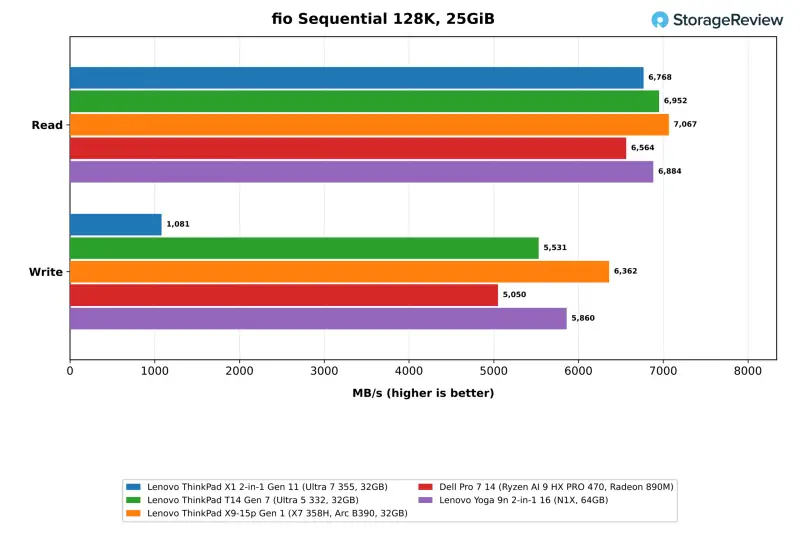
| Sequential read 128K (MB/s) | 6,768 | 6,952 | 7,067 | 6,564 | 6,884 |
| Sequential write 128K (MB/s) | 1,081* | 5,531* | 6,362 | 5,050 | 5,860 |
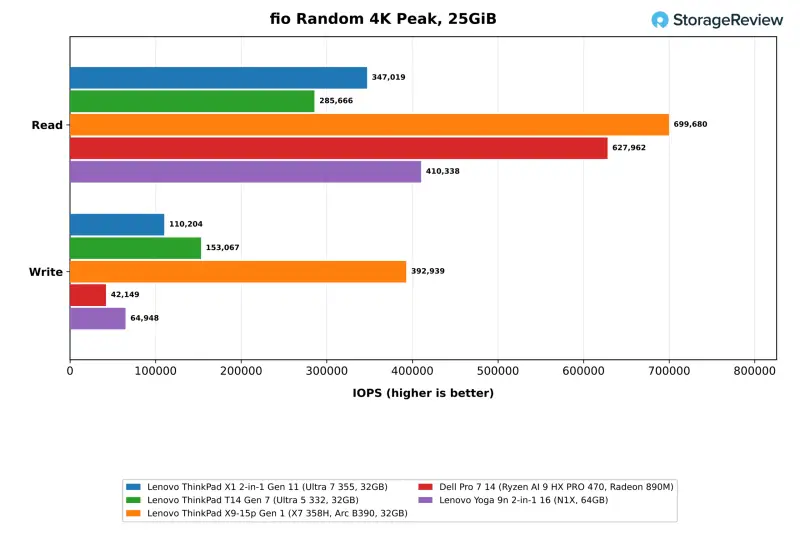
| Random read 4K, peak (IOPS) | 347,019 | 285,666 | 699,680 | 627,962 | 410,338 |
| Random write 4K, peak (IOPS) | 110,204 | 153,067* | 392,939* | 42,149* | 64,948* |
| Random read 4K, QD32 x 4 jobs (IOPS) | 266,188 | 233,143 | 364,397 | 274,615 | 410,338 |
| Random write 4K, QD32 x 4 jobs (IOPS) | 110,204 | 153,067* | 222,188* | 21,275* | 64,948* |
*Flagged by the suite for run-to-run variance after a rerun.
The 512GB drive in our unit is a Samsung PCIe Gen4 SSD, installed in a slot that supports Gen5. Sequential read measured 6,768MB/s on the 25GiB footprint, in line with the other Gen4 drives in this group. Sequential write behaved differently. The drive reached 5,787MB/s on the suite's 5GiB footprint, but it fell to 1,081MB/s on the 25GiB test, with individual passes ranging from 956 to 1,254MB/s. That pattern is consistent with a small-capacity SSD running out of its fast write cache.
The T14 carries the same Samsung model and held 5,531MB/s on the 25GiB write. The drop may reflect how full the X1 2-in-1's drive was, or how recently it had been written. We're treating the 25GiB figure as specific to this unit rather than as a configuration-wide problem. Peak 4K random read reached 347K IOPS, about half of what the 1TB drive in the X9-15p delivered, and random write peaked at 110K IOPS. Lenovo lists 1TB Gen4 and Gen5 Performance drives, up to 2TB, as options. If sustained large writes matter to your workload, it's worth testing the drive you actually receive.
Verdict and Who Should Buy It
The ThinkPad X1 2-in-1 Gen 11 Aura Edition gets everything its 8-core processor can deliver in a 1.14kg convertible. The Core Ultra 7 355 held its full Cinebench score through a 30-minute loop. It stayed within 5 to 7 percent of the 16-core X9-15p in Speedometer and in Cinebench single-core, and it ran 41 to 47 percent ahead of the 6-core T14 in 7-Zip and Blender Monster. Its 18.1GB of GPU-usable memory was enough to finish our 20B coding agent task on two of three attempts.
The pricing is where I'd push back on the configuration we tested. Our unit is $2,884.99 at CDW. Lenovo.com sells a Core Ultra 7 365 vPro model with a 1TB SSD for $2,229, which is about $400 less than the X9-15p configuration we priced on the same store. The 365 shares the 355's eight-core layout, so our results are a close guide to that model. Based on those numbers, it's the better value of the two. The 365 vPro model also adds the vPro support the 355 lacks, which matters if your fleet is managed that way.
The X9-15p was 76 percent faster in multi-core work and 2.2 times faster in our graphics test. Lenovo doesn't sell H-series processors for this chassis in North America, so that gap can't be closed with a different configuration. If your users need that headroom, you'll need to buy a different ThinkPad.
Two other items deserve a line in your evaluation notes. Integrated graphics took 15 seconds to return a first token when serving a 3B model. And the hinge is loose enough that a small bounce on a lap can tip the display back flat. Our unit's 512GB SSD also slowed to 1,081MB/s during large sequential writes, but the same drive model in the T14 showed no comparable drop. We treat that result as specific to our review unit, not representative of the configuration.
That makes the X1 2-in-1 a good fit for executives, consultants, and field staff who want the lightest X1 with a pen, a TrackPoint, and tablet modes, and whose heaviest work is office, browser, and conferencing software. Buyers who don't need the hinge will get more performance from the X9-15p. Buyers who want a convertible for creative or local AI work should look at the Yoga 9n 2-in-1 16 instead. The first thing I'd check on any order is whether 32GB of soldered memory and the 512GB drive match your users' workload, because neither can be changed after purchase.


