QNAP ES1686Adc Lets Every Bay in a 3U Array Take SAS or Dual-Port NVMe
- Harold Fritts
- 623 views
QNAP's 3U ES1686Adc accepts SAS or dual-port U.3 NVMe in all 16 bays, with active-active ZFS controllers. Pricing and availability are not yet stated.
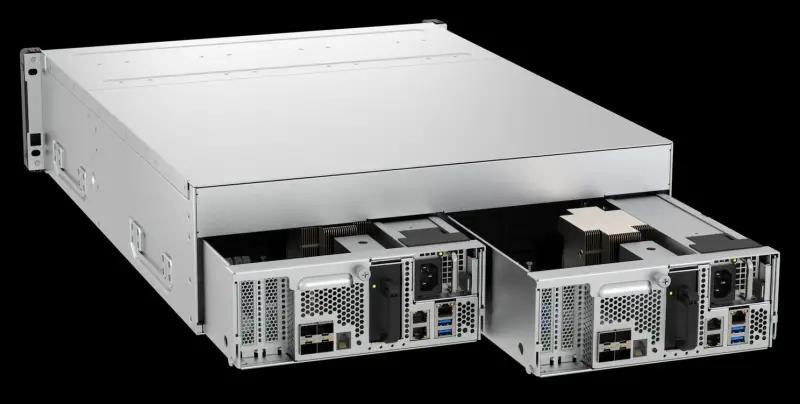
QNAP's ES1686Adc is a 3U, 16-bay dual-controller array where every bay accepts either a SAS 12Gb/s drive or a dual-port U.3 NVMe SSD. That's the detail to focus on. Most mixed-media arrays force you to choose a tier at purchase and live with it. This one is pitched as a chassis you fill with high-capacity SAS today and convert to NVMe later without changing platforms. QNAP hasn't said what it costs or when it ships.
How the NVMe and SAS tiers fit together
All 16 bays take 3.5-inch SAS HDDs, 2.5-inch SAS SSDs, or dual-port U.3 NVMe SSDs. That NVMe support is the main change from the earlier ES1686dc, which offered SAS bays only. QNAP says that filling the first four slots with U.3 NVMe or SAS SSDs creates a System Pool. QES reserves a small portion of that pool for a hidden four-disk mirror, which keeps system operations off the hard drives. The rest of the SSD capacity can serve as L2ARC read cache and ZIL write cache for the SAS HDD pools behind it.
Here's the practical read: a SAS-heavy build gets bulk capacity, while a few SSDs in the front bays absorb metadata-style and cache traffic. That's a familiar ZFS pattern. The hard part is sizing the cache correctly for your workload, and QNAP hasn't published guidance on how a given HDD pool should be paired with a given amount of SSD cache.
Active-active controllers and failover
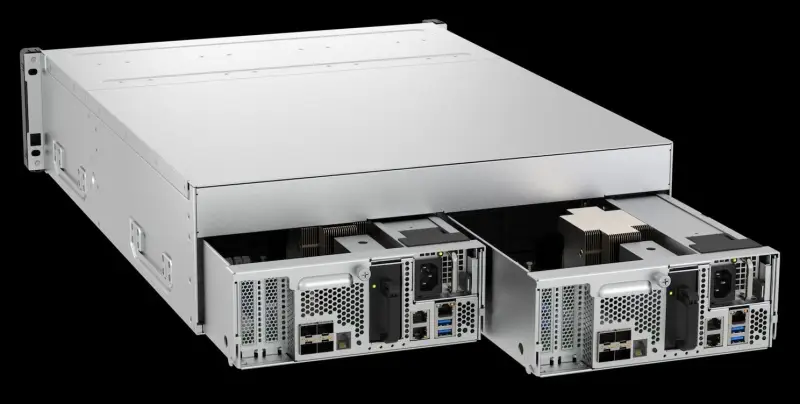
Each controller carries an eight-core Intel Xeon D-2142IT, 64GB of DDR4 ECC memory that expands to 512GB, four 10GbE SFP+ ports, and three 2.5GbE ports, one of which can be assigned to management. Each also has two PCIe Gen3 x8 slots. Both controllers process I/O at the same time and are joined by a PCIe non-transparent bridge.
QNAP says that if one controller fails, the other takes over its drives and network addresses with no interruption or reconnection for front-end applications. That claim matters most for iSCSI and Fibre Channel hosts, which are less forgiving of path changes than SMB clients. Treat it as the vendor's stated behaviour until you've proven it in your own environment with your own host stack and multipath settings. The controller specification matches QNAP's 24-bay all-flash ES2486AFdc.
Reading the performance figures
QNAP lists 579,502 4K random read IOPS and 257,701 write IOPS over iSCSI. Its SMB sequential throughput is 8,352MB/s read and 3,557MB/s write. These are QNAP's own lab results, not independent measurements. The test used eight 10GbE ports, QES 2.2.1, and a RAID 5 group of 16 SAS SSDs, eight from Seagate and eight from Samsung.
That setup tells you two things. The numbers describe an all-SAS-SSD configuration with no NVMe installed. And the network, not the array, is probably the limit for sequential throughput. Eight 10GbE ports top out well below what NVMe drives could deliver, so QNAP's figures say little about what the U.3 bays will do. QNAP hasn't published results for U.3 drives, or for hard drive pools using SSD cache. Until it does, any NVMe tier performance is an estimate.
The PCIe question for NVMe bays
QNAP's product page pitches the U.3 bays as a route to PCIe Gen4 performance. The hardware specifications, though, list both expansion slots as PCIe Gen3 x8 and give no link speed for the drive bays. On the ES2486AFdc, which uses the same processor, QNAP does state a PCIe Gen4 x4 link for every bay. The ES1686Adc may well be the same, but the documentation I'd want to see doesn't say so for this model.
If you're planning an NVMe tier, get the bay link speed in writing from QNAP before you size the pool. A Gen3 link and a Gen4 link give very different ceilings per drive, and that changes how many U.3 SSDs you need to saturate two 10GbE ports, let alone a Fibre Channel card.
Positioning and the buyer's pitch
QNAP's product manager, Sean Teng, framed the design this way: "Not all data requires extremely expensive all-flash space." Teng said that mixing U.3 NVMe SSDs with high-capacity SAS drives lets a business balance performance and return on investment in one chassis while keeping services online.
That's a sensible argument for a hybrid array, and the pitch is aimed at shops that don't want to split workloads across two platforms. The catch is that the balance only works if the NVMe bays deliver what the tier is supposed to provide. Until QNAP documents that, the value of the hybrid design rests on the architecture, not on measured results.
Data protection and expansion
QES is QNAP's FreeBSD and ZFS-based operating system for its dual-controller arrays. End-to-end checksums detect and repair silent data corruption. Inline deduplication and compression reduce how much data lands on the SSDs, and QNAP describes snapshot capacity as nearly unlimited. Write cache sits in DRAM, and each controller pairs a battery backup unit with a 64GB M.2 SATA SSD. On power loss, the battery keeps the controller running long enough to copy cached writes to that drive. Dedup and compression ratios depend heavily on the data, so budget for raw capacity rather than the best-case figure.
On the host side, QES serves SMB and NFS file shares alongside iSCSI and Fibre Channel block storage. It offers VAAI and ODX offload for VMware and Hyper-V, and iSER to reduce host CPU load. Each controller's two PCIe slots take optional Fibre Channel cards up to 32Gb/s or 25GbE adapters. With optional SAS expansion cards and dual-path cabling, the array connects to as many as seven QNAP SAS expansion units, which QNAP says brings capacity into the petabyte range. The system carries a five-year warranty, with one year on the battery backup unit.
Key specifications at a glance
| Specification | QNAP ES1686Adc |
|---|---|
| Model | ES1686Adc-2142IT-128G |
| Controllers | 2, active-active |
| System memory | 64GB DDR4 ECC RDIMM per controller, up to 512GB per controller |
| Drive bays | 16 x 3.5-inch hot-swappable, SAS 12Gb/s, backward compatible with SAS 6Gb/s |
| Drive compatibility | 3.5-inch SAS HDDs, 2.5-inch SAS SSDs, 2.5-inch dual-port U.3 NVMe SSDs |
| Networking | 4 x 10GbE SFP+ and 3 x 2.5GbE per controller |
| Power | Redundant hot-swappable 700W, typical draw 588.33W with all bays populated |
| Warranty | 5 years, 1 year on the battery backup unit |
What to check before you buy
If you're evaluating this array, three things matter most. First, confirm the U.3 bay link speed with QNAP. Second, ask for NVMe and hybrid-pool benchmarks, since the published figures cover SAS SSDs only. Third, test controller failover with your actual hosts and multipath configuration, not just the vendor's description of it. Pricing and availability are still unannounced, so there's no cost comparison to make yet.
My read is that the hybrid design is the real story here. A 3U box that can grow from SAS capacity into NVMe performance without a forklift upgrade is useful, provided QNAP backs up the NVMe side with measurements. Watch for those numbers, a price, and a ship date. Those three will tell you whether this belongs on your shortlist.