SSSTC PQ2 Brings KIOXIA QLC Flash to Industrial M.2 SSDs
- Harold Fritts
- 693 views
SSSTC's PQ2 pairs KIOXIA BiCS FLASH 8 QLC with PCIe Gen4 in industrial M.2 2280 and 2230 drives rated up to 7,000MB/s reads. Pricing isn't stated yet.
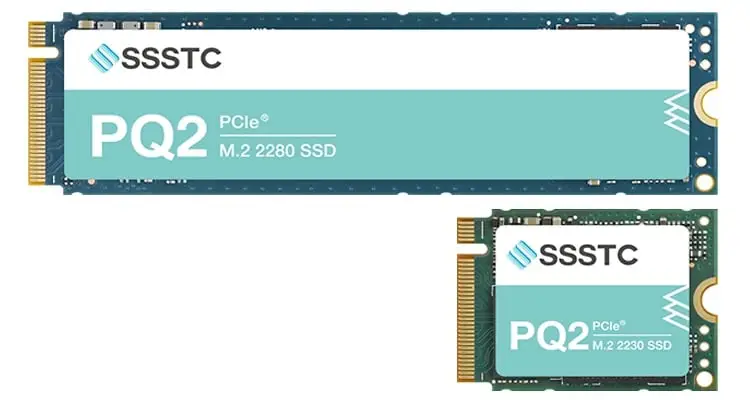
Solid State Storage Technology Corporation (SSSTC), the KIOXIA subsidiary, has launched the PQ2 series, its first industrial-grade QLC SSD. The headline number is 7,000MB/s sequential reads over PCIe Gen4 x4, but the more useful detail for anyone specifying hardware is the combination of QLC flash, a DRAM-less design, and read-oriented endurance. That's a profile you'd expect in AI PCs, point-of-sale terminals and embedded boot drives, not in write-heavy caching tiers. SSSTC hasn't said what the drives will cost or when they'll ship.
Flash and Controller Design
The PQ2 uses KIOXIA's 4-bit-per-cell QLC NAND, built on BiCS FLASH generation 8 with CMOS directly Bonded to Array (CBA) technology. SSSTC says CBA improves memory density, performance and power efficiency. QLC trades write endurance and write speed for capacity per cell, so the design choice here is clear: SSSTC is aiming at reads.
The drives are DRAM-less and rely on Host Memory Buffer (HMB), which uses a slice of system memory to handle mapping work that an onboard DRAM chip would normally do. That keeps the bill of materials and board footprint down, which matters in compact hardware. It also means performance depends partly on the host platform. If you're qualifying the PQ2 for a board design, confirm that the host firmware and OS support HMB properly and test on your actual platform rather than assuming the datasheet number will carry over.
Form Factors and Capacities
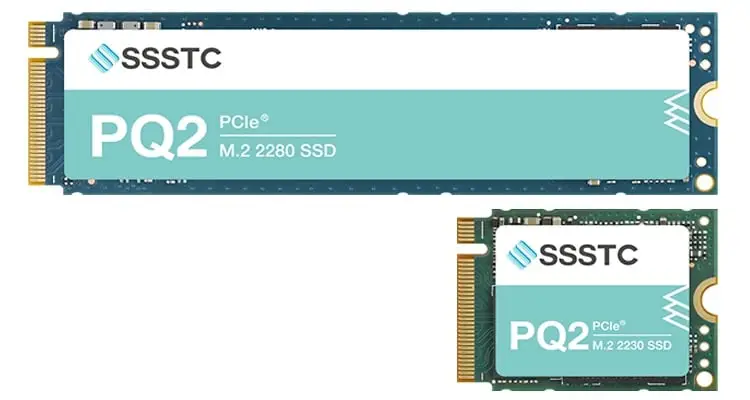
The series comes in two lengths. The M.2 2280 measures 80mm by 22mm and weighs up to 6g. The M.2 2230 is 30mm long, also 22mm wide, and weighs up to 3g. Both are offered at 512GB, 1TB and 2TB. The 2230 is the one that matters for embedded boards and thin devices with little room, while the 2280 fits standard client and industrial motherboards.
| Specification | SSSTC PQ2 Series |
|---|---|
| Models | M.2 2280: PQ2-8H512G, PQ2-8H1T02, PQ2-8H2T04 M.2 2230: PQ2-3H512G, PQ2-3H1T02, PQ2-3H2T04 |
| Interface | PCIe Gen4 x4, NVMe 2.0d |
| Flash | KIOXIA BiCS FLASH generation 8 QLC (4 bits per cell) |
| Design | DRAM-less with Host Memory Buffer (HMB) |
| Form factors | M.2 2280: 80 x 22mm, up to 6g M.2 2230: 30 x 22mm, up to 3g |
| Sequential read / write | Up to 7,000MB/s / up to 6,200MB/s |
| 4KiB random read / write | Up to 1,000K IOPS each |
| Endurance | Above 1 DWPD over 3 years |
| MTBF | Above 3 million hours |
| Operating / storage temperature | 0C to 85C / -40C to 85C |
| Security | AES 256-bit hardware encryption; TCG Opal or TCG Pyrite (optional) |
| Data protection | LDPC ECC, end-to-end data protection, firmware power-loss protection |
Reading the Performance Ratings
SSSTC rates the PQ2 at up to 7,000MB/s sequential read, up to 6,200MB/s sequential write, and up to 1,000K IOPS for both 4KiB random reads and random writes. Those are maximums. SSSTC doesn't split them out by capacity, doesn't publish the test platform, and says speeds vary with the host and workload. Treat the figures as a ceiling you'll see under specific conditions, and build your sizing around sustained, measured behaviour on the hardware you actually deploy.
The ratings line up with KIOXIA's EG7 Series, a client QLC drive that uses the same flash generation, the same DRAM-less design, and the same three capacities. That's a useful reference point. If you already have test data on EG7-class drives, it gives you a reasonable baseline for what to expect from the PQ2 before your own qualification starts. It doesn't replace that qualification, though.
Where the Read-Heavy Positioning Fits
SSSTC built the series for read-intensive work. In an AI PC, that means loading locally stored models and pulling application data. In embedded gear, it means boot storage, configuration and logging that gets written rarely. The company's list also covers point-of-sale terminals, thin clients and networking devices.
The write side is where QLC needs careful planning. SSSTC rates endurance above one drive write per day over three years but doesn't publish total bytes written for each capacity. If your workload involves frequent logging, database journaling or swap-heavy operation, you'll want that figure before committing. Ask for it directly, and model your write profile against the DWPD rating rather than the headline speed numbers. Teams in this position typically find that the endurance spec, not the throughput spec, decides whether a QLC drive is viable.
KIOXIA uses the same BiCS FLASH generation 8 QLC in data center products such as the LD4 Series, where it also targets read-heavy storage. That shared flash platform suggests the PQ2 is part of a consistent QLC strategy across client, embedded and server products, rather than a one-off industrial variant.
Industrial Ratings and Reliability
The industrial angle is the operating range. The drives run from 0C to 85C and store from -40C to 85C. SSSTC lists every model at that single grade and doesn't offer a separate wide-temperature version. Teams building in harsh environments should check whether the thermal headroom in their enclosure stays inside those limits under load, not just at idle.
SSSTC cites MTBF above 3 million hours and mentions vibration and shock resistance, but it doesn't publish numeric figures for either. Data protection includes AES 256-bit hardware encryption, LDPC error correction, end-to-end data protection and firmware power-loss protection. TCG Opal or TCG Pyrite support is available as an option, which matters if your deployment needs self-encrypting drive behaviour for managed endpoints.
What to Watch Next
Three things will decide whether the PQ2 earns a place in an industrial bill of materials: pricing, which SSSTC hasn't disclosed, availability, which it also hasn't stated, and the independent sustained-performance and endurance data that will eventually follow the launch. Until then, the datasheet gives you a clear target profile, not a validated result. My read is that the drive is aimed squarely at read-dominant embedded and AI PC designs, and that buyers should qualify it against their own write patterns before treating it as a general-purpose industrial SSD.
The full specifications are on the SSSTC PQ2 Series product page.