Multi-Agent AI Needs a Named Owner Before It Ships
- Ali Alkhafaji
- 343 views
Gartner expects agent counts to climb sharply, but only 13% of surveyed organizations feel their governance is ready. Here's where accountability breaks down.
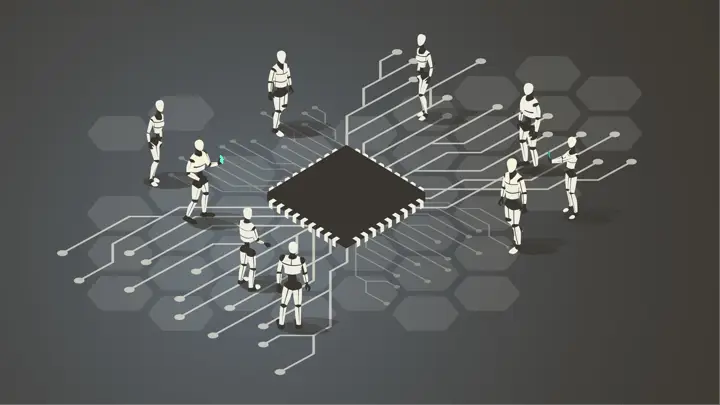
Most enterprises still can't say who answers for a decision that several AI agents made together. That gap matters more each quarter, because the number of agents in production is climbing fast.
The scale problem
Gartner projects that by 2028 the average global Fortune 500 enterprise will run more than 150,000 AI agents, up from fewer than 15 in 2025. In its April 2026 report on agent sprawl, the firm also found that only 13% of 360 survey respondents believe they have the right governance in place. Most of those organizations haven't settled a basic question: when multiple agents collaborate to produce an output that causes a problem, who owns it?
That's a different problem from the one most governance programs were built for. For the past two years, the conversation has centred on a single question: who is responsible for what a model produces? That was already hard. Once the unit of work becomes a chain of agents, each reasoning, deciding and acting across a different part of a workflow, the question multiplies. A single model's output has one visible origin. A collaborative output has several, and they can interact in ways nobody designed.
Why the chain breaks accountability
Here's the thing: the organizations running into this aren't the reckless ones. They adopted agents carefully, applied the standards they already had, and didn't update those standards for a new class of system. When one agent produces a flawed result, the chain of responsibility is easy to see. When three agents produce the same error together, the trail gets blurry fast, and most enterprise frameworks don't say who holds the result.
The stakes are also rising in a more concrete way. A California law that took effect Jan. 1 prevents defendants from arguing that an AI agent's autonomous operation was itself a defense against a liability claim. For IT and risk teams, the practical reading is simple: "the agent did it" won't work as an explanation, so someone in the organization has to be able to account for the output.
Naming one person before deployment
Ali Alkhafaji, CEO of Apply Digital, describes a working model that tests this idea directly. His firm starts every new client engagement with a minimum of 50% agents working alongside human practitioners in what it calls matrix teams. He says the arrangement forced the accountability question into daily operations rather than leaving it in a policy document.
His first conclusion is that accountability can't be attached to a system. It has to sit with a named human who owns every output before it reaches a client or customer, no matter how many agents contributed. Not a team, not a committee, not a review process. And that person should exist before deployment begins. If you can't name them yet, you aren't ready to deploy.
I think that standard is blunt in a useful way. Many teams will discover they've been treating "the operations group" as the owner, which in practice means nobody. Forcing a single name onto each workflow exposes that gap early, when it's cheap to fix.
Handoffs are design work
The second lesson concerns the seams between agents. In a multi-agent workflow, each agent's decision narrows what the next agent can see and do. If Agent One makes a poor call, Agent Two may not have enough information to catch it. By the time a human reviewer sees the output, the error may have passed through several more steps and picked up consequences along the way.
Alkhafaji's team focuses on what it calls the graceful handoff, the moment when a component recognizes it needs to pass context cleanly rather than simply pass the task along. A useful handoff record carries enough context for the receiving party to act, which is the difference between a handoff that supports a fast human decision and one that forces a full reconstruction before anyone can move. The handoff between agents deserves the same design attention as a handoff from an agent to a person, and many teams haven't given it that.
Logs should capture reasoning, not just results
The governance component most organizations underinvest in is the audit trail, and the trail that matters is a record of reasoning rather than a list of final outputs. When something goes wrong in a multi-agent system, you need to trace it back through every decision point. An output log shows what happened. A reasoning trace shows where the accountability chain broke.
In the engagements Alkhafaji describes, the team defines what gets logged at every agent boundary before deployment: inputs, confidence signals, actions taken and handoffs initiated. Without that structure, post-incident reviews turn into guesswork. Teams that skip this step rarely see a dramatic failure. They see outputs that slowly erode trust, compliance gaps that surface months later, and decisions nobody can trace to an owner.
What to check before the next change window
If you run agentic workflows, three actions are worth scheduling now rather than after an incident:
Map every active agentic workflow and assign a named owner. Identify which workflows have a single accountable person for each output. If the answer is a team or a process, assign one person before that workflow runs again.
Document the handoff protocols at each agent boundary. If they exist only in someone's head, write them down now. Don't wait for a production failure to expose the gap.
Check what your logging captures at each boundary. If you record final outputs but not inputs, confidence signals and reasoning steps, redesign the logging before you scale. Retrofitting audit infrastructure after an incident costs considerably more than building it in from the start.
Agent counts are heading toward the levels Gartner describes, and the organizations that handle this well will be the ones that treat ownership and traceability as launch requirements. The question to bring to your next deployment review is simple: if this workflow produces a bad result tomorrow, which named person can explain exactly how it happened?


