M365 outage, SCKit worm and N-central patching dominate this week's MSP news
- Matt Whitlock
- 609 views
A Microsoft 365 outage, a ScreenConnect worm and urgent N-central patches top the week's MSP agenda. Here's what to check in your own environment.
Three stories this week should be on every MSP's change board: a multi-day Microsoft 365 disruption, a worm-like campaign riding on compromised ScreenConnect environments, and an urgent N-central patch. Around them sit vendor launches for AI agent recovery, MCP-based data access and partner programs, plus fresh survey data on cybersecurity spend and infrastructure costs.
Microsoft 365 disruption ran into a second day
 Microsoft reported service degradation affecting Exchange Online and several other Microsoft 365 features beginning Nov. 12. The affected list was wide: Outlook access and mail delivery, Teams features that depend on Exchange Online, Microsoft 365 Copilot, administrative portals and parts of Microsoft Defender for Office 365. That combination hits email, collaboration, admin work and security tooling at the same time, which is why MSPs ended up on continuity duty.
Microsoft said availability was improving and email queues were shrinking on Nov. 13. Some users still reported intermittent access problems and delayed mail, so recovery was uneven rather than complete. If you manage tenants, the practical move is to keep the Microsoft 365 service health page open and check each client's mail flow and admin portal access individually instead of assuming a single green status covers everyone.
ScreenConnect worm and the N-central patch
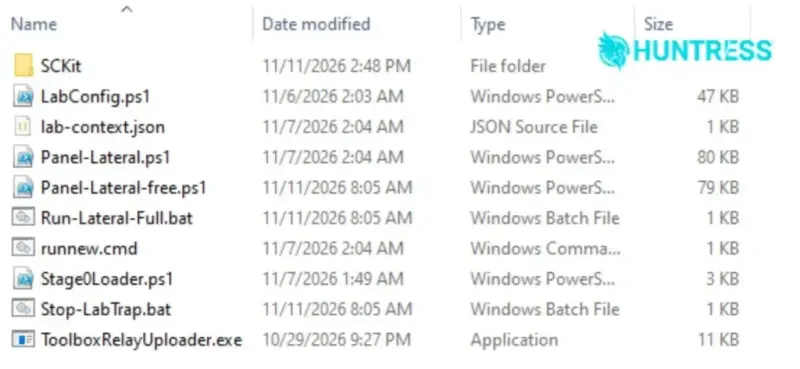
Huntress reported that attackers used compromised cloud-hosted ScreenConnect panels to run commands that installed rogue clients on at least 288 endpoints across 48 organizations. The activity appears tied to vulnerable versions of the third-party RMM+ extension, which could accept a blank access key if an administrator had never set one. That's an uncomfortable detail for anyone who deployed extensions and never reviewed their configuration.
ConnectWise disabled five potentially associated third-party extensions across more than 400 partner environments as a precaution. Per Huntress, the SCKit toolkit installs a second attacker-controlled ScreenConnect client, sets up persistence and tries to intercept technician session cookies. Stolen session cookies are the part that worries me most. They can let an attacker ride an authenticated session without ever needing a password, so a clean-up of rogue clients alone isn't enough. Review which extensions are installed in each ScreenConnect instance, confirm access keys are set, and check technician session activity. Huntress also reported a separate campaign in which attackers left persistent webshells and cryptominers after compromising AhsayCBS, so it's worth reviewing that exposure too if you run it. The Huntress write-up is at huntress.com.
N-able is pushing customers to act on N-central. Its guidance is to install N-central 2026.4 HF2 as soon as possible and keep on-premises servers off the internet until the upgrade finishes. Hosted N-central servers have already been upgraded and returned to service, but hosted and on-premises customers both still need to update their Agents and Probes. N-able says every vulnerability that an unauthenticated user could exploit has been addressed. The remaining issues need an authenticated N-central account, often with elevated privileges, or other conditions that limit exploitability, and they'll land in later hotfixes. That's a sequencing decision you'll need to plan around: the unauthenticated risk is closed, but the authenticated-user issues are still open until those follow-up hotfixes arrive. Details are in N-able's security update.
Barracuda also disclosed an incident with a different supply-chain angle. It said an attacker got in through a cloud access key stored in a configuration file in a third party's GitHub repository, after that party's development environment was compromised. The attacker had access to a system holding credentials that Barracuda XDR uses to collect data from connected services such as Microsoft 365, Google Workspace and endpoint security platforms, active between Nov. 1 and Nov. 2. Barracuda says it found no direct evidence that customer integration credentials were viewed or accessed, but it notified potentially affected customers and advised them to revoke and recreate those credentials. If you run Barracuda XDR, treat that revocation advice as a task for this week rather than a someday item. The full advisory is on Barracuda's trust portal.
Agents need recovery plans and controlled data access
Commvault's AgentRecover capabilities target a problem most enterprises haven't solved yet. The vendor says the new features help enterprises audit AI agent activity, restore agents and recover affected data and systems across Amazon Bedrock AgentCore and Microsoft Foundry. Pranay Ahlawat, chief technology and AI officer at Commvault, put the issue plainly in the company's announcement: "Business logic is moving out of applications and into agents, and agents don't behave deterministically. A single agent decision can trigger changes across data, applications, and infrastructure on multiple platforms."
That's the right frame. Backup has always assumed you can work out what changed and roll it back. An agent that makes a chain of decisions across several platforms makes the question "what did it do?" much harder to answer. My read is that the audit trail will matter as much as the restore function, and buyers should ask vendors exactly what activity gets logged and how far a recovery can reach across the platforms they use.
Sherweb is taking a different route to the same agent problem. Its read-only MCP server connects approved AI tools to cloud subscription, usage, pricing and billing data. Rick Stern, senior director of platform at Sherweb, said MSPs' AI value depends on access to the right business data at the right time, and that MCP gives the company a standardized way to make its capabilities available wherever partners choose to work. Read-only is the detail to note. Before you connect any assistant to billing or subscription data, confirm the scope, which tools are approved and who can see the output.
Cowbell is also moving on AI risk, with standalone AI liability coverage for U.S. small and midsize businesses scheduled to become available Jan. 1, 2027. The non-admitted policy is aimed at brokers. Simon Hughes, chief commercial officer at Cowbell, argued that the exposure has shifted: "When an agent goes rogue, a business can face its own losses and claims from customers and others at the same time." If you're advising clients on AI use, that's a conversation to start now, well before the policy's launch date.
Channel programs and the partner business
Coro launched two global channel programs. One is a services certification, CCISP, which Coro positions as a path for partners to implement and manage the platform over time through training and deployment experience. The other is SLED Miner, which identifies U.S. public-sector opportunities. Heather Harlos, global VP of marketing, programs and enablement at Coro, said services are where partners build real margin, and that resale alone only takes them so far.
T-Mobile Business is also making itself easier for technology advisers to buy. CableFinder is adding T-Mobile Business Internet and SuperBroadband to marketplaces used by major technology services distributors, with connectivity qualification and pricing built in. Chris Jones, VP of ecosystems and partner alliances at T-Mobile Business Group, framed connectivity as the starting point for a partner conversation that can grow into long-term customer value. For MSPs, that kind of marketplace access reduces the friction of quoting connectivity alongside the rest of a managed package.
GTIA's research shows the demand behind those programs. North American service providers report rising cybersecurity demand, with 76% planning to add cybersecurity solutions in the next 12 months, compared with 65% in 2025. Fifty-one percent named AI-generated attacks as a leading concern. Yet the controls gap is hard to ignore: only 42% said more than half their customers had MFA on all critical systems, and 35% reported immutable, air-gapped backups. That's the number I'd bring to a client review. Demand is growing faster than the baseline controls it depends on.
Infrastructure costs and the price of downtime
 The 2027 State of IT Infrastructure Resilience study from 11:11 Systems found that infrastructure cost is now a board-level concern. Ninety percent of respondents said total data center infrastructure costs rose over the past 12 months, with an average year-over-year increase of 13%. Forty-three percent named cyberattacks as their top data center concern, and 73% expect data protection, backup and recovery budgets to grow in 2027. Sixty-nine percent of IT leaders had at least one cyberattack in the past 12 months, and 24% had three or more. Sixty-two percent said the average cost of one hour of downtime exceeds $250,000.
Those downtime figures are worth holding up against this week's Microsoft 365 incident. A degraded mail and collaboration platform for a day or two is exactly the scenario where that hourly cost becomes real, and it's a fair test for whether your continuity plan covers cloud SaaS dependencies as well as your own racks.
Tools for triage and validation
 ESET launched its Threat Intelligence Investigation Lab, which combines IOC search with sample submission to help SOCs, public-sector organizations, CERTs and MSSPs validate threats and speed up triage. Roman Kováč, chief research officer at ESET, said the goal is to answer three questions: whether a file is dangerous, where it has been seen and what to do next. For MSSPs handling a steady stream of suspicious indicators, a faster validation step should reduce the time spent deciding whether to block, investigate or close an alert.
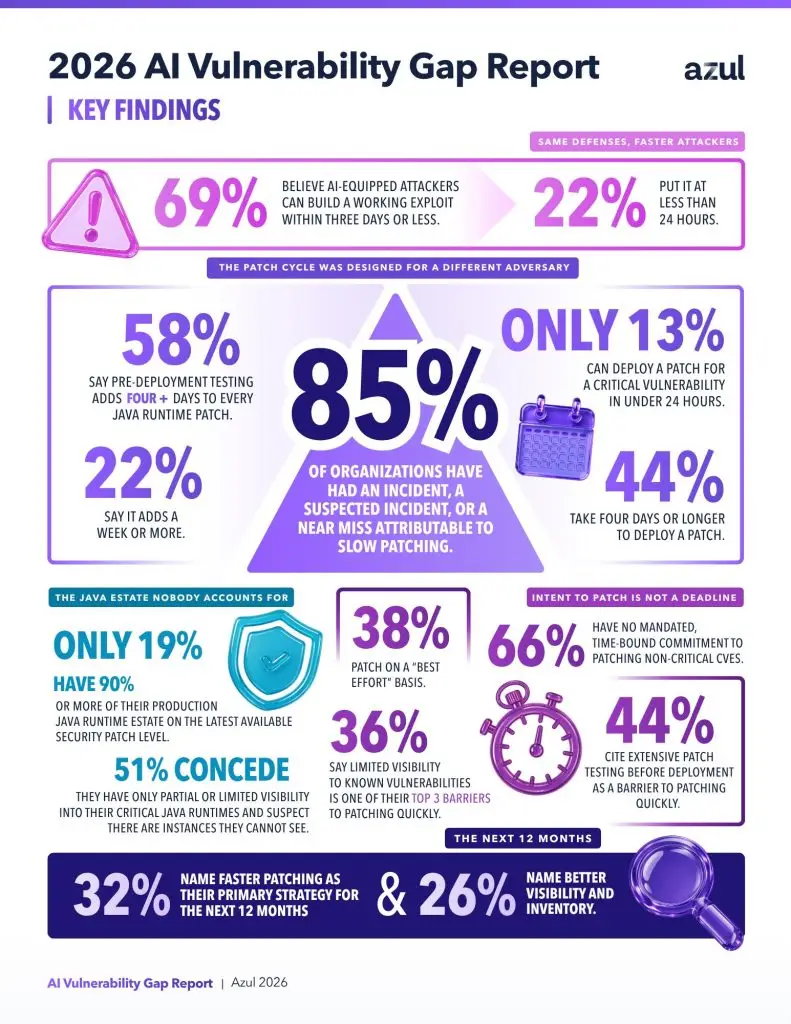
Azul's survey points to a gap that's hard to dismiss. Sixty-nine percent of respondents expect AI-enabled attackers to exploit a new vulnerability within three days or less. Only 56% say they can deploy a critical patch within three days. And 85% reported an incident, suspected incident or near miss tied to slow patching. Read those numbers next to the N-central and ScreenConnect stories and the pattern is clear: the exposure window is closing faster than many patch cycles can follow. Check your critical patch SLAs against a three-day target and see where the shortfall sits.


