Data Centers Need to Explain What They Enable, Not Just What They Draw
- Dan Snyder
- 861 views
A CloudFest Americas panel argued that megawatts and GPU counts don't reach communities. Providers need to explain the services their facilities support.
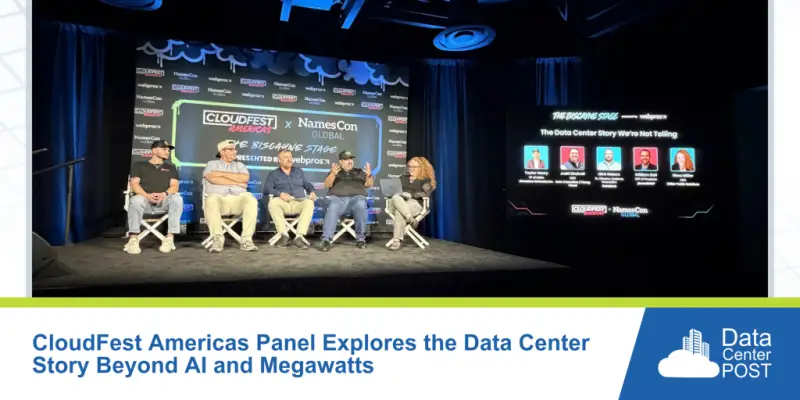
The industry is good at describing itself to investors and to itself. It's much worse at talking to the people who live near its buildings. That was the core argument of a session called "The Data Center Story We're Not Telling," held on the Biscayne Stage at CloudFest Americas in November 2026. The panel treated the communications problem as a real operational risk, not a public-relations footnote.
Why the story keeps missing its audience
Moderator Ilissa Miller, CEO of iMiller Public Relations, opened with a distinction that shaped the rest of the hour. Announcements about megawatts, GPUs and capital spend make sense inside the sector. They don't tell a neighbor why a community needs a data center, or how that facility touches daily life.
Here's the thing: most of the debate now runs through AI, power demand and water use. Those are legitimate concerns, but they're framed around the building's inputs. The panel's point was that the outputs, the services people actually rely on, rarely get a comparable airing.
Start with what the facility makes possible
Taylor Henry, VP of Sales at Limestone Networks Inc., argued that providers should change how they define projects. Instead of leading with capital investment, power capacity or square footage, they should describe the technologies and services a facility enables. He pointed to education, financial services and the wider systems that keep modern life running.
Henry also refused to frame innovation and environmental responsibility as a trade-off. In his view, both belong in the same message, and a provider that talks about only one will lose the other audience.
Nick Nelson, Sr. Director, Systems Innovation at DataBank, made a related point from the operator side. Public attention tends to fixate on large AI campuses, yet he described an industry still rooted in enterprise hosting and the day-to-day needs of businesses. Medical research, communications and the digital services people use every day give a more concrete picture of that role.
Nelson's sharpest observation was about the gap itself. The missing link is often between the app a person recognizes and the data center quietly supporting it. If people can't connect the two, they have no reason to care where the servers sit.
Not every data center is the same thing
Another problem the panel identified is that public discussion treats all data centers as interchangeable. The speakers distinguished between hosting environments, interconnection facilities, enterprise infrastructure, AI campuses and cryptocurrency mining operations. Each has different purposes, power profiles and operating requirements.
That matters for anyone writing rules or running public meetings. A single broad label sets expectations before anyone has seen the actual facility. Explaining what a specific site does, and what it needs to run, gives residents and officials a much better basis for a discussion.
Opposition has a cost beyond one project
The panel also looked at how AI's visibility has changed perceptions. Miller contrasted the enthusiasm that once greeted expanded internet access with the resistance some infrastructure projects face today. William Bell, EVP Products at phoenixNAP, warned that opposition to new development can have effects well beyond a single construction schedule. It can slow the pipeline of facilities needed to meet future demand.
My read is that this turns community relations from a nice-to-have into a planning input. Teams in this position typically treat local understanding as something to build before a site is announced, not as damage control once shovels are in the ground.
Trust comes from relationships and substance
Trust ran through the whole conversation. Henry described long-standing provider relationships as foundational to infrastructure decisions, sitting alongside connectivity, redundancy, power and cooling. Judd Lindvall, CRO at Core 4 Solutions, stressed that operators should communicate both the economic and societal returns of building infrastructure.
The panel's position was that a clear account of benefits carries more weight when it's backed by dependable relationships and responsible execution. Promises of jobs and tax revenue alone won't settle a community's questions about power, water or the impact on nearby development. Those questions need specific, substantive answers.
The speakers also urged the industry to share positive stories more often. Examples included cooling innovations and healthcare advances that have come out of infrastructure work. These are concrete results people can verify, which makes them more persuasive than general claims about innovation.
A community-centered approach
Miller closed by encouraging providers to approach public engagement with compassion and empathy. Project announcements shouldn't be the only point of contact with the public. The panel's suggested alternative had three parts: stay involved in local civic life over the long term, address concerns with transparency and real information, and explain what the infrastructure makes possible for everyone, not just for the company.
If you work at a provider, colocation customer or managed service firm, the practical takeaway is to get specific about your own dependencies. Map which services your organization runs in which facilities, and be ready to describe them in plain language. That's the connection the panel said most people never see, and it's the one that makes the rest of the conversation easier.