Dell's AI Factory Expansion Gives Partners Smaller Entry Points and Ops Tooling
- Matt Whitlock
- 975 views
Dell's SC26 AI Factory updates add single-node AMD configurations, agent-ready data tools and rack-scale management software. Here's what partners should check.
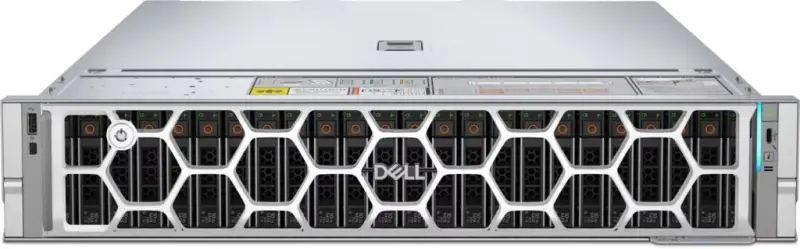
Dell's SC26 announcements were dominated by big hardware: a 72-GPU AMD rack and liquid-cooled storage. Most SMB-focused providers won't be buying those this quarter. The more useful part of the news for channel teams sits lower down the stack, in configurations that start small, tools for feeding business data to AI agents, and software for running the whole thing once it's live.
Dell announced the updates on November 16 at SC26 in Chicago, and they span both its NVIDIA and AMD offerings. My read is that the common thread is pacing. Dell is trying to make it easier for customers to move from a pilot to production without committing to a full rack up front, and that's exactly the gap many providers struggle to fill.
A smaller starting point on AMD
The most practical item for solution providers is the expansion of the Dell AI Platform with AMD. Dell is adding modular configurations built on its PowerEdge XE7745 and R7725 servers with AMD Instinct MI350P PCIe GPUs. The platform bundles Dell servers, networking and storage with its AI Data Platform, plus software and services.
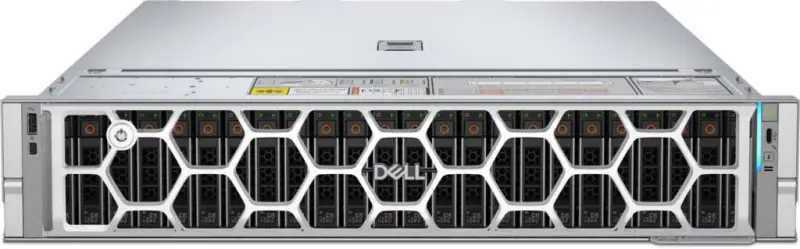
According to Dell, a customer can start with a single compute node, keep that same infrastructure as the workload moves into production, and then add GPUs, nodes, storage or networking as demand grows. Dell is also adding validated support for AMD Enterprise AI Suite, Red Hat OpenShift Container Platform and Red Hat AI Enterprise.
That matters for a customer who wants dedicated AI infrastructure but hasn't settled on the budget. A single-node start doesn't mean the platform suits every SMB spend profile. It does, though, offer a more incremental path than buying a rack before the workload has proven its value. Here's the thing: the hard part of that conversation is usually proving the use case, not buying the box, so the smaller entry point gives providers a way to get to that proof faster.
Dell also announced the air-cooled, AMD EPYC-based PowerEdge M8825 server. Preliminary specifications list support for up to 512 cores and 1,024 threads per node. At the other end sits the AMD Helios Rack-scale Solution from Dell, with 72 AMD Instinct MI455X GPUs. For most SMB-focused providers, the modular configurations are the realistic place to start those customer conversations.
Getting customer data ready for agents
On the NVIDIA side, Dell is extending its AI Data Platform to tackle a problem that rarely gets enough attention: business data is seldom organised around what an AI application actually needs. The new Data Orchestration capabilities include an Agentic Data Gateway, which is meant to give AI agents a common, governed route to enterprise data and context. Dell is also adding hybrid pipeline orchestration that can run wherever the data lives, whether that's on-premises, in non-Dell infrastructure or in public clouds.
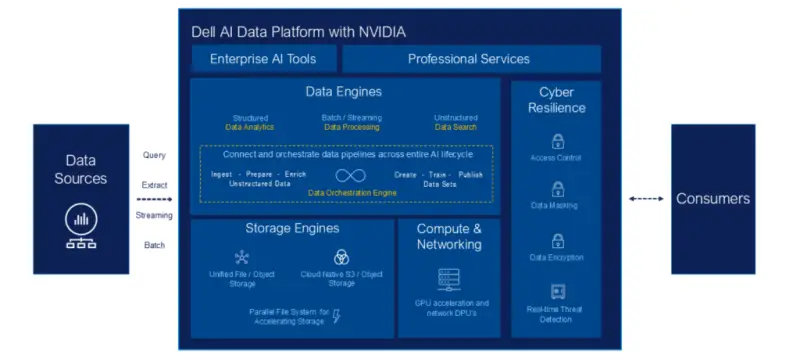
Other additions cover data provenance, quality and usage, and a unified pipeline for preparing documents, images, video and tables. Named integrations include:
- LangChain
- OpenAI Codex
- Unstructured.io
For partners, the work goes well beyond installing a platform. Customers still need help identifying which data sources are worth using, judging whether that data is good enough, and deciding how an AI application should interact with business information. That's where a lot of the billable effort sits, and it's the part that software alone won't handle.
"AI outcomes don't come from models alone. They take data with the right context, infrastructure that scales and solutions validated to work together," said Arthur Lewis, president of Dell's Infrastructure Solutions Group.

Arthur Lewis
Operations tooling for the environment after go-live
Dell is also introducing management tools aimed at the operational load that comes with more complex infrastructure. This is the part that often gets underpriced in early AI projects, so it deserves attention from anyone building a managed service.
OpenManage Rack Scale provides deployment, monitoring and automation across individual servers and complete racks. Dell says it supports up to 100,000 devices and lets teams investigate infrastructure health, alerts, firmware, inventory, power and performance using natural language.
Dell Fabric Manager adds centralised network automation, lifecycle management and observability. Dell lists design, provisioning, upgrades and configuration drift auditing among its capabilities. For providers building a managed AI practice, that's a prompt to define who owns ongoing operations before the first deployment goes live, not after the first incident.
Validated solutions as a starting template
The expanded ecosystem also includes validated solutions for knowledge assistants, coding assistants, AI security, observability and governance. Dell's partner list for these offerings includes OpenAI, DataRobot, Dynatrace, F5 and JFrog. Dell says the solutions are tested against consistent criteria on its AI Factory reference architectures.
Those reference architectures can give solution providers a base for a repeatable offering. Customer-specific integration, workflow design and ongoing support still have to be scoped for each engagement, and that's where margins are either protected or lost.
Dell is also expanding its own delivery capabilities. Its AI Factory Engineers model brings together platform, workload, data, governance and security expertise, and new data center services address power, cooling and space requirements. Partners should work out early how their own services will sit alongside Dell's, so customers don't get two overlapping scopes of work.
Timing and what to plan for
OpenManage Rack Scale and Fabric Manager are available now. Dell says the AI Data Platform advancements begin arriving in December, and additional ecosystem offerings roll out through the first quarter of 2027.
For channel partners, the useful customer conversation starts with the business process an AI application is meant to improve, not with the hardware list. Dell's expanded portfolio offers more infrastructure choices, but the opportunity depends on helping customers turn those choices into a service they can actually use, maintain and justify to their budget holders. That's the test I'd apply before adding any of these pieces to a proposal.