Samsung Portable SSD P9 Reads at 4GB/s Over USB4 and Stays Cool, but Long Writes Lag
- Brian Beeler
- 413 views
Samsung's P9 reads near 4,000MB/s over USB4 and runs cooler than rivals, but its long writes and small random writes trail the LaCie and SanDisk.
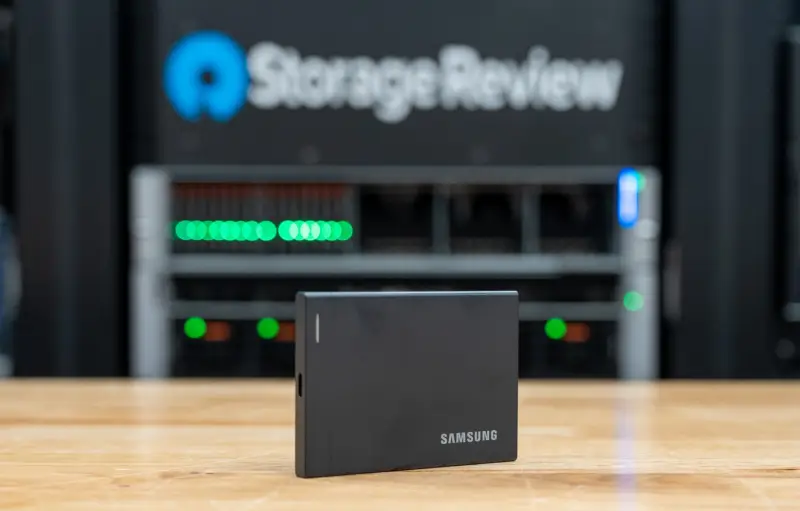
Samsung's Portable SSD P9 is the company's first USB4 portable drive, and on paper it's a big step up. It's rated at 4,000MB/s read and 3,800MB/s write, double the T9 it sits above. It ships in 1TB, 2TB, 4TB and 8TB capacities, and the 8TB model is Samsung's first USB4 portable SSD at that size. The 2TB unit tested here lists at $649.99, matching Samsung's list price.
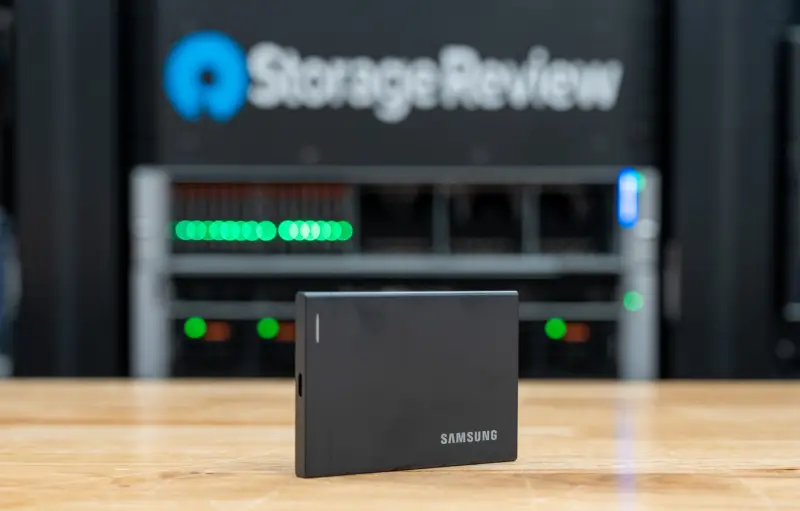
The portable SSD market has split into two camps. The first is 20Gbps USB 3.2 Gen 2×2 drives, which have stalled near 2,000MB/s for about three years. The second is a USB4 class that runs close to internal NVMe speeds, provided the host has a USB4 or Thunderbolt port to match. The P9 is Samsung's entry into that second group, and it's the drive I'd watch if you're pulling camera cards all day.
What We Tested Against
This review is the first outing for a new external storage test. The P9 ran alongside the SanDisk Extreme Pro USB4 2TB, the LaCie Rugged SSD4 4TB, the Samsung T9 4TB and the Lexar ES5 2TB. The short version: the P9 delivers its headline numbers. At low queue depth only the SanDisk reads faster. The P9 also runs cooler under load than every other drive in the group, while long writes are where the LaCie pulls ahead.
Specifications and Design
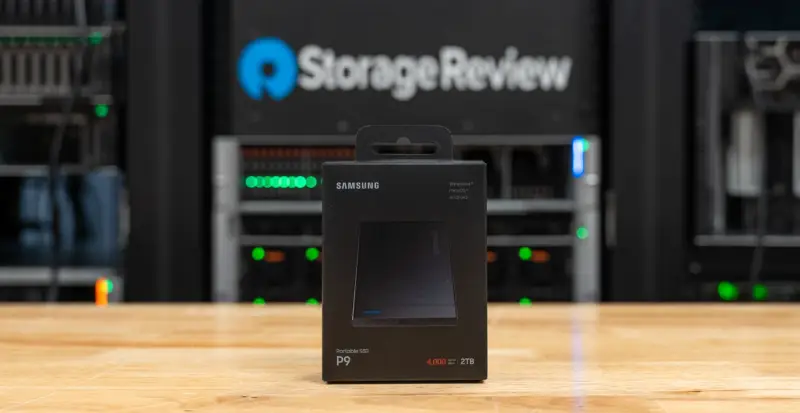
The P9 measures 90 x 65 x 8.3mm and weighs 96g. The T9 it replaces is 88 x 60 x 14mm and 122g, so the new drive is noticeably slimmer and lighter. The bigger change is the shell. The T9 used a thick rubberised cover, while the P9 uses a metal enclosure. That trade gives up some drop protection, with Samsung rating the P9 for a 2-metre drop against 3 metres for the T9. Two metres still clears a desk or a shoulder bag, but it's a step down on paper.
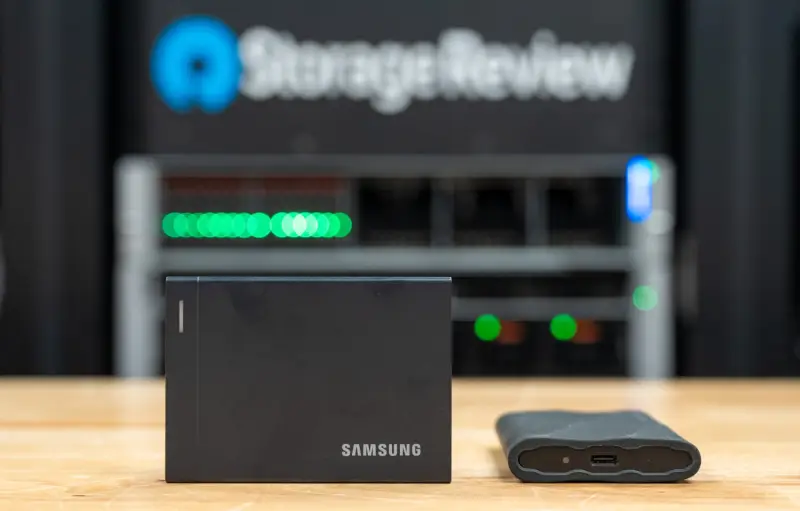
My read is that the shell is a thermal decision. A USB4 drive moving around 4GB/s dissipates more power than a 20Gbps drive, and rubber insulates. The metal case pulls heat away from the NVMe controller and NAND. Our logs back that up. The P9 peaked at 40C across the whole suite and sat between 36 and 38C through a 30-minute sustained write. On the same tests, the SanDisk reached 62C, the LaCie 60C and the Lexar 70C. Scratches show more on metal, but for a drive that will work hard, that's a fair trade.
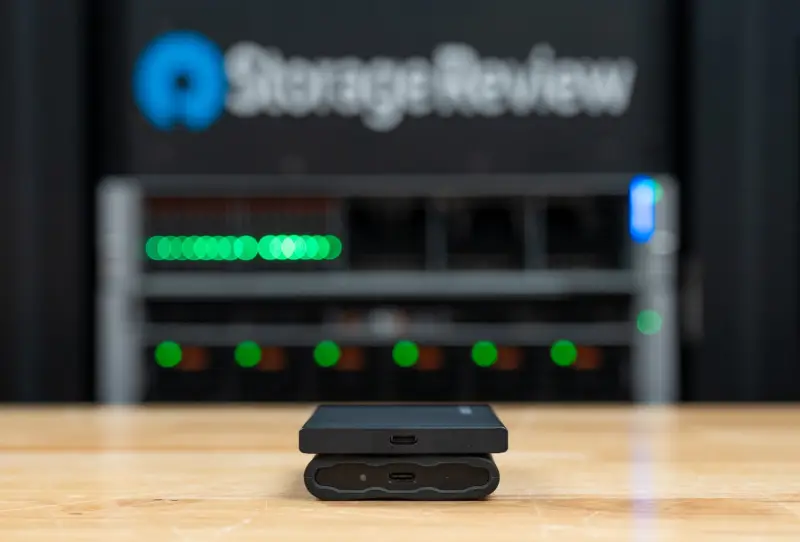
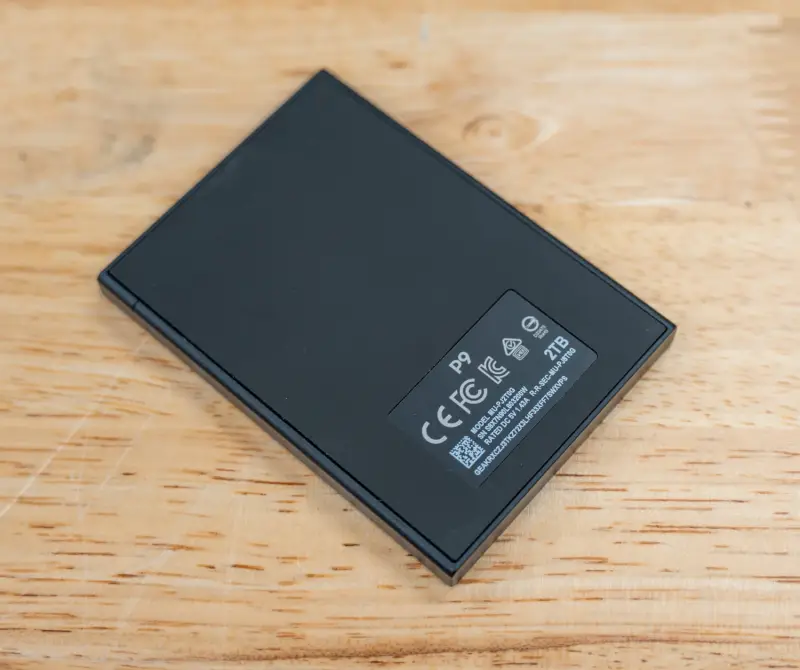
The connector is USB-C. The drive supports hardware AES-256 encryption, managed through Samsung Magician, which runs on Windows 10 and later, macOS 10.15 and later, and Android 7.0 and later. Samsung backs the P9 with a five-year limited warranty. The warranty footnote is specific about use: typical use is defined as four hours a day at 40C or below. The 8TB model shares the 1TB model's dimensions, which packs a lot of capacity into something that fits in a jacket pocket.
How We Tested
The suite is a Windows test built from the same sr-client tooling used for client systems, pointed at a single external drive. It runs nine tests in order, with a five-minute rest between each, or longer if the drive is still warm. It uses direct I/O and incompressible data throughout. Every drive was formatted exFAT and left on Windows' Quick removal policy, which disables the device write cache. That's how most buyers run a portable drive, so it's the fairer baseline.
The tests cover a spec-sheet check that replicates CrystalDiskMark 8's four default rows in fio, followed by standard four-corner runs at 5GiB and 25GiB footprints. Next is a queue-depth sweep of 4K random and 128K sequential I/O from QD1 to QD32, with latency. Real-world file copies with robocopy come after that: a 53.7GB file, a 1,000-file camera card and 50,000 small files, each written and read. The suite then runs a fixed-rate capture ladder, a sustained write, and a fill test.
The P9, SanDisk, LaCie and Lexar ran on a Dell Pro Max 14 Premium with a Core Ultra 9 285H and 64GB of LPDDR5-8400, connected through its Thunderbolt 5 port. The T9 wouldn't stay attached to that machine, so it ran on our consumer SSD bench, a Ryzen 7 9850X3D desktop, through an ASMedia USB 3.2 Gen 2×2 port. Its results are included for generational context, with that caveat. It also reset once during the 25GiB random write test before the suite resumed.
One note on the Lexar ES5. Its exFAT volume came up with a 512-byte cluster size, where the other drives used 512KB to 1MB. The suite flagged this at the start, so its copy and fill results measure the format as much as the drive. We left the Lexar out of the file-copy charts, and its small-block write numbers should be read with that in mind. Its sequential and read results are unaffected.
Spec-Sheet Numbers
The spec-sheet test uses CrystalDiskMark's defaults, a 1GiB file and five 5-second passes, run in fio and reporting the median. The P9 hit 4,048MB/s sequential read at QD8 and 3,769MB/s write. That's 1.01x and 0.99x of Samsung's ratings, and about twice the T9's 2,027MB/s read, which is the comparison Samsung puts on the box. The LaCie matched the P9 on reads at 4,048MB/s and trailed by 61MB/s on writes. The SanDisk came in at 3,811MB/s read and 3,665MB/s write.
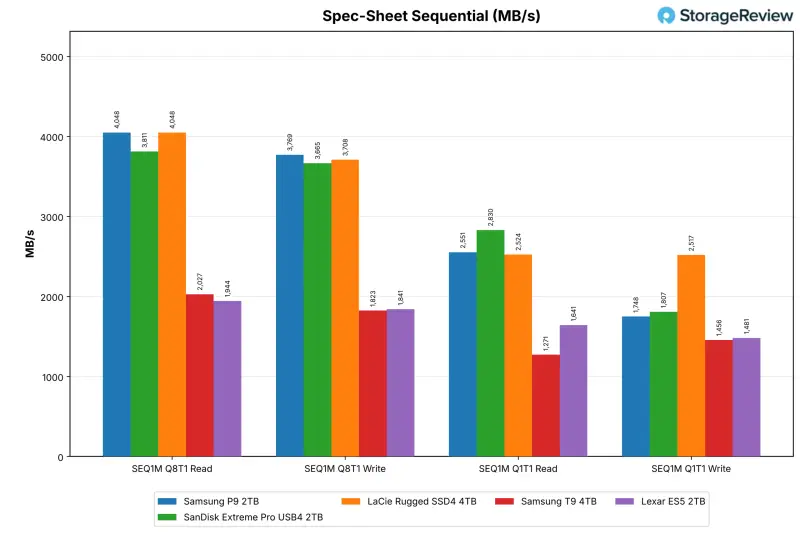
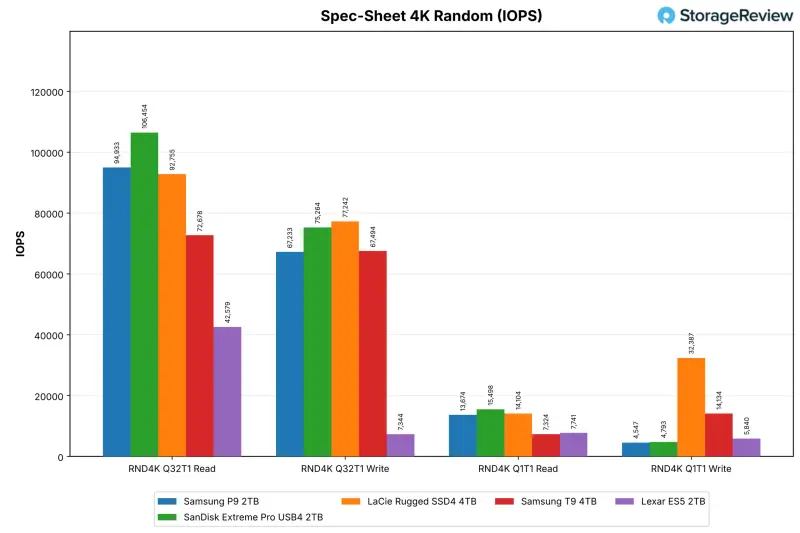
At queue depth 1, where a single file copy lives, the P9 read at 2,551MB/s and wrote at 1,748MB/s. The SanDisk led reads at 2,830MB/s, and the LaCie led writes by a wide margin at 2,517MB/s. That's the first hint that the two USB4 competitors are tuned differently from the P9. The 4K random rows show the same split. The P9 managed 94,933 IOPS at QD32 read and 13,674 at QD1, ahead of the LaCie and behind the SanDisk. Its QD1 random write, though, was 4,547 IOPS at 219µs, about a third of the T9's figure and a seventh of the LaCie's 32,387.
Queue-Depth Behaviour
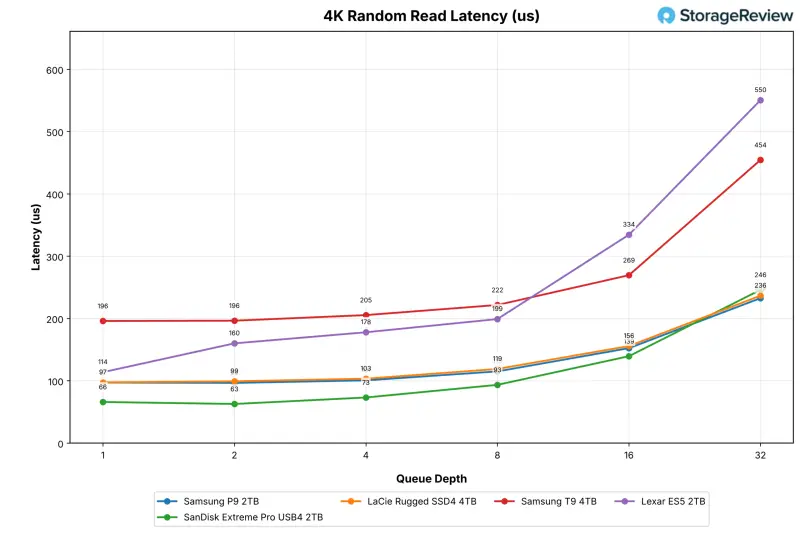
The queue-depth sweep is where a slow controller or bridge chip shows itself, because every request at QD1 pays the full round trip. On 4K random reads, the P9 averaged 97µs at QD1, 101µs at QD4 and 233µs at QD32. It tracked the LaCie within a few microseconds at each step and finished at 94,135 IOPS. The SanDisk was quicker, at 66µs and 107,371 IOPS. The T9 sat at 196µs at QD1 and the Lexar at 114µs. Both topped out below 70,000 IOPS, which is the 20Gbps generation showing its age.
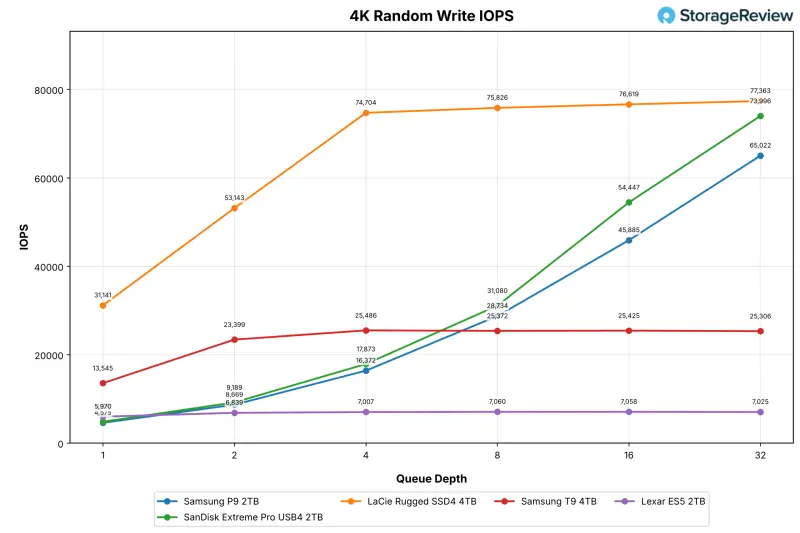
Random writes are the P9's weak spot. At QD1 it managed 4,575 IOPS at 218µs, against 31,141 IOPS at 31µs for the LaCie and 13,545 at 74µs for the T9. The SanDisk was close behind at 4,811 IOPS. The gap narrows with depth. At QD32 the P9 reached 65,022 IOPS at 431µs mean latency, 16 percent behind the LaCie's 77,363. Its 99.99th percentile write latency came in under half the T9's 16.9ms. For a drive that mostly handles large sequential files, this matters less than the table suggests. It is still the first of several write-side areas where the T9 holds its own.
File Copies
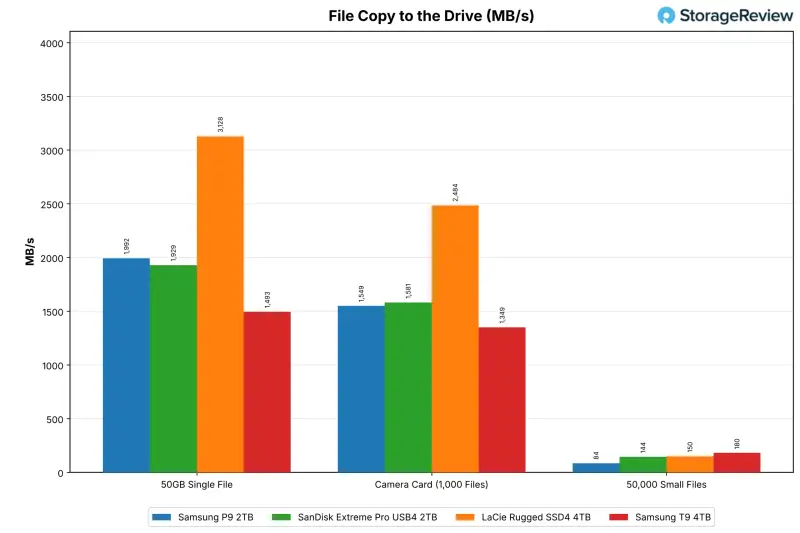
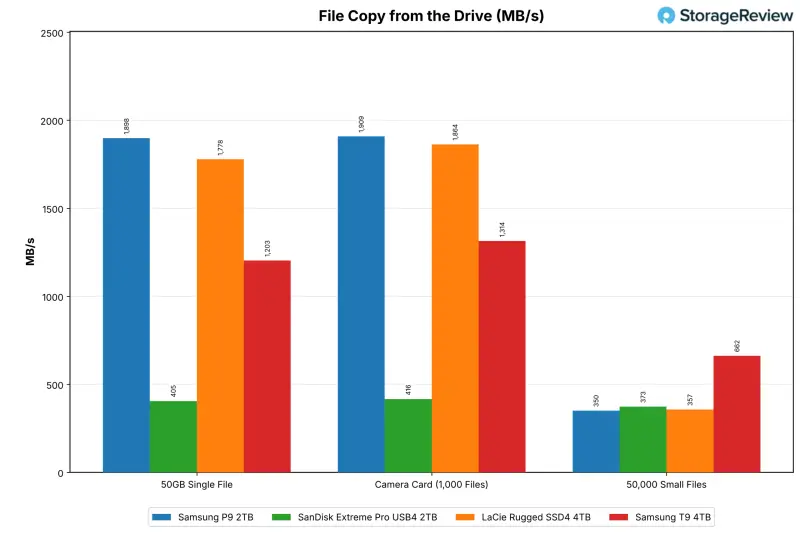
The copy test flushes the Windows file cache first and stops the clock once the data is on the drive. Writing the 53.7GB file to the P9 took 27 seconds at 1,992MB/s. The LaCie managed 3,128MB/s, the SanDisk 1,929MB/s and the T9 1,493MB/s on its 20Gbps host. The 1,000-file camera card hit 1,549MB/s. The 50,000 small files were the problem, landing at 84MB/s. Here the exFAT allocator and the P9's QD1 write latency compound each other. The T9 handled the same set at 180MB/s and the LaCie at 150MB/s.
Reading back is the P9's stronger direction. The large file came off at 1,898MB/s and the camera card at 1,909MB/s, the fastest in the group on both, with the LaCie a few percent behind. The small-file read ran at 350MB/s, matching the LaCie and SanDisk and trailing the T9's 662MB/s on its desktop host. The SanDisk's reads in this run were odd. Its large-file and camera-card reads landed at 405MB/s and 416MB/s, about a fifth of its write speed in the same test. Nothing else in its results is that slow, so I'm reporting it as measured without drawing a conclusion.
Fixed-Rate Capture
Cameras and recorders write at a fixed rate and drop frames when the drive falls behind, so this test holds each rate for 10 minutes. A step passes only if the average reaches 99 percent of the target, no second drops below 90 percent, and no single write takes longer than half a second. Every drive held 500MB/s, which covers ProRes 422 HQ 4K60 at about 220MB/s with room to spare. At 1,000MB/s, which is 600GB in 10 minutes, only the LaCie kept pace, averaging 999.6MB/s.
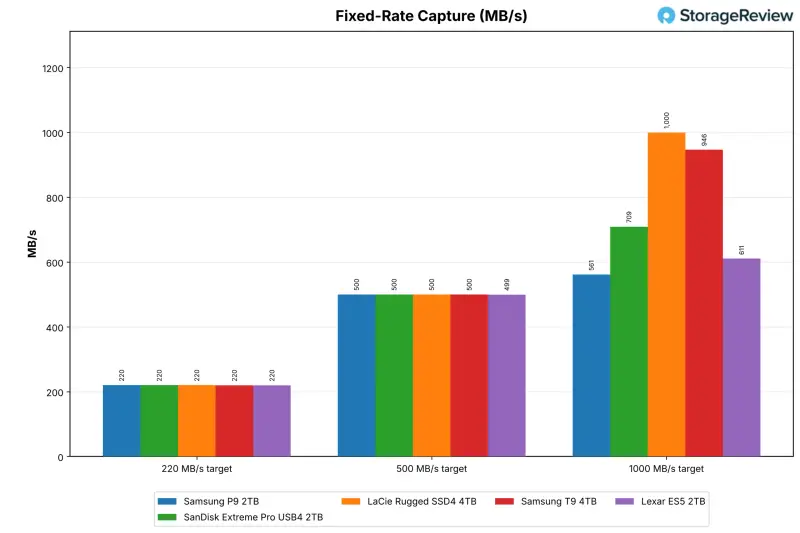
The P9 averaged 561MB/s over the 1,000MB/s step, the lowest in the group. The SanDisk managed 709MB/s, the Lexar 611MB/s and the T9 946MB/s on its desktop host. At 500MB/s the P9 held cleanly, with a slowest second of 231MB/s and a longest single write of 137ms. A camera with a buffer of a second or so would never notice. Samsung lists 12K video recording among the supported workflows. On our numbers, 500MB/s is a safe recording target for the P9, and sustained rates at or above 1,000MB/s belong to the LaCie in this group.
Sustained Writes and Cache Recovery
The sustained test writes half the drive's capacity in one pass and logs throughput every second. The P9 opened at about 1,950MB/s and held that for 149GB. It then dropped to a 540MB/s plateau. From minute 19 it fell into a sawtooth between roughly 240 and 500MB/s, averaging 366MB/s through the end of the 30-minute window. The drive stayed at 36 to 38C the whole time, so this is the controller flushing its cache, not thermal throttling. The SanDisk followed the same shape at a slightly higher level, bursting at 1,830MB/s before settling at 533MB/s, and it ran 24 degrees hotter doing it.
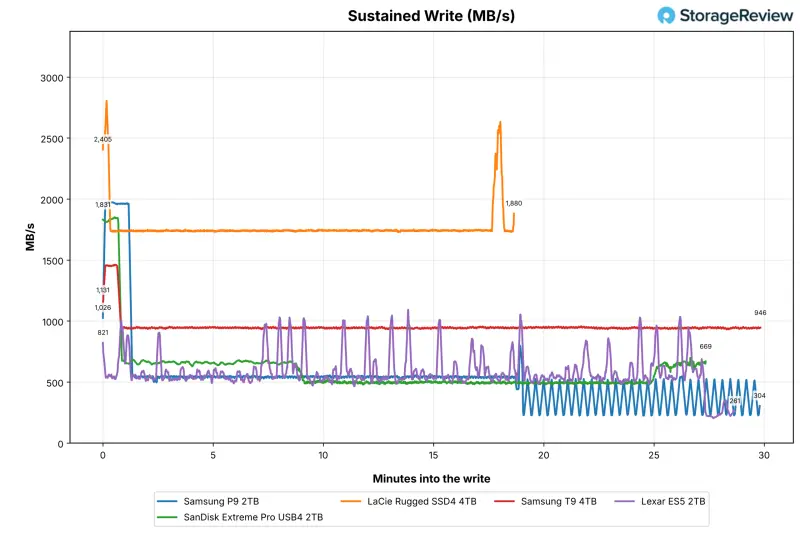
The LaCie went the other way. It wrote its full 2TB test at 1,740 to 1,820MB/s with a 54GB cache and no visible steady-state penalty. The T9 wrote 1.7TB at a flat 945MB/s on its host.
Samsung's figure for the P9 is 2,000MB/s after Intelligent TurboWrite, from internal testing. Our test measures something different: a continuous half-capacity write on an exFAT volume that Windows wouldn't retrim between runs, after the capture ladder had already pushed about 870GB through the drive. The numbers aren't like-for-like. The useful comparison is between drives on the same test, where the P9 and SanDisk share a profile and the LaCie doesn't.
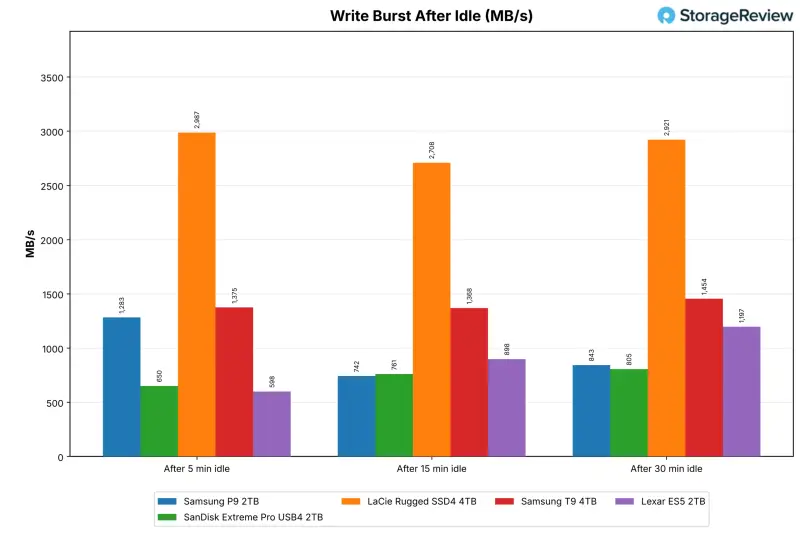
Recovery is where the P9 pulls ahead of the SanDisk. Five minutes after the sustained write ended, the P9 delivered a full 50GB burst at 1,283MB/s to the second camera card. The SanDisk managed under 1GB at burst speed in the same window and 650MB/s overall. After 15 and 30 minutes, the P9's burst settled to 27GB at 742MB/s and 843MB/s, while the LaCie and T9 took the full 50GB at every interval. Each later burst followed another 50GB of writes, so the order matters. I don't have a clear explanation for why longer idle periods performed worse on the P9.
Performance as the Drive Fills
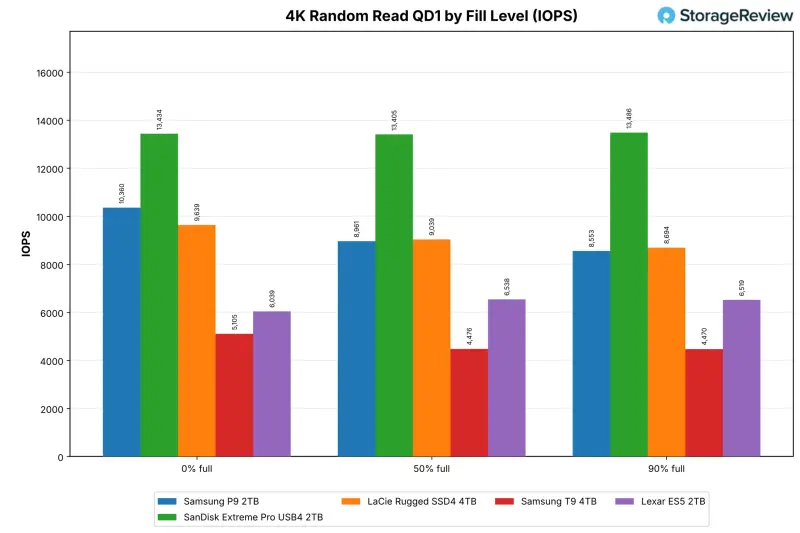
The fill test repeats the corners and a 100GB write at 0, 50 and 90 percent full. Sequential reads barely moved. The P9 read 3,990MB/s empty and 3,903MB/s at 90 percent full, while QD1 random reads dropped from 10,360 to 8,553 IOPS. Sequential writes fell more sharply, from 3,487MB/s empty to 1,528MB/s at half full and 1,281MB/s at 90 percent, as the cache shrinks with less free space. The SanDisk held about 3,600MB/s at every level. The LaCie dropped from 3,687MB/s to about 2,100MB/s, and the T9 roughly halved to 948MB/s.
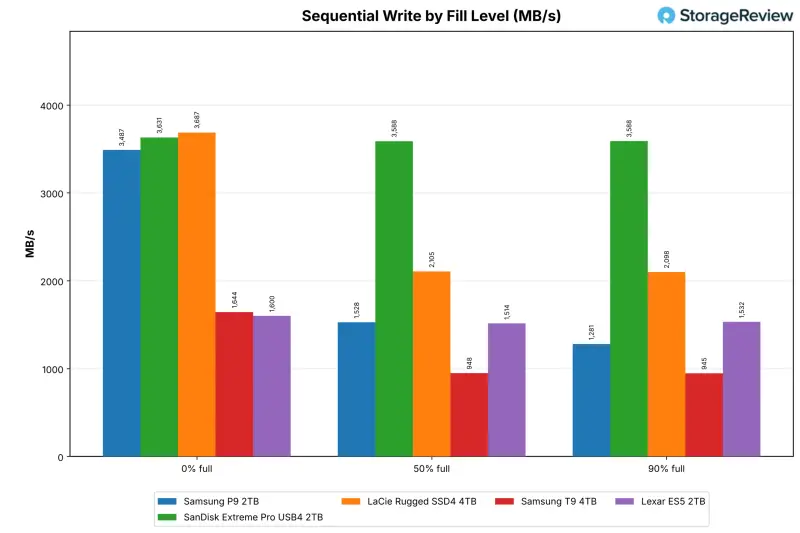
The outlier is the P9's 4K random write at QD32, which held at about 650 IOPS at every fill level, with mean latency near 195ms. In the queue-depth sweep earlier in the same run, it managed 65,022 IOPS. By the time the fill test runs, the drive has already absorbed the capture ladder, the sustained write and the fill writes, and Windows couldn't issue a retrim to the exFAT volume between any of them.
Treat this as a picture of the drive after roughly three terabytes of writes with no idle time and no TRIM. A heavy week of shooting and offloading could get you close to that. Reformatting is the reliable fix. Idle time alone didn't restore performance in our recovery test, and I'd like to see the P9 recover on its own before calling this a non-issue.
The Verdict
The Samsung Portable SSD P9 does what the box says. It reads at 4,000MB/s and writes at about 3,770MB/s over USB4, doubles the T9 on sequential throughput and keeps QD1 read latency under 100µs. It also stays cooler than anything else in this group, which is the payoff of moving from rubber to metal. For a photographer or editor pulling camera cards and working directly off the drive, the read figures and the 500MB/s capture result matter most, and the P9 is as good as anything in its class on both.
The reservations are all about long writes and small random writes. The P9's cache runs out after roughly 150GB, the drive settles near 540MB/s and then dips, and it can't sustain 1,000MB/s. Its QD1 small random writes are the slowest in the group. If sustained write speed is the job, the LaCie Rugged SSD4 is the drive to buy, at the cost of a bulkier, heavier package. The SanDisk Extreme Pro USB4 matches the P9's write profile and leads at low queue depth, but it runs much hotter.
Pricing moves fast, so these are the figures at review time. The P9 2TB lists at $649.99. The SanDisk Extreme Pro USB4 2TB was $279 and the LaCie Rugged SSD4 4TB $479.99, though the SanDisk was out of Amazon's own stock and starting at $519 from other sellers, and the LaCie 4TB was listed at $1,169.99 at B&H while this was written. The T9 2TB was at $436.96. Against that field, the P9 sits at the top of a class that has moved up with it. What you pay for is the thermal design, Samsung's software and warranty, and the fastest file-copy reads we measured.

Leaderboard: The Samsung Portable SSD P9 holds the Coolest-Running USB4 SSD spot on our Best Portable SSDs leaderboard. It's the first drive ranked there on the new external storage test.