Forbes CIO Summit spotlights need for 'human in the flow' with AI
- Joao-Pierre S. Ruth
- 582 views
Select Health CIO Brady talks about evolving with AI for efficiency while maintaining human perspective and context to guide the work that agents perform. NEW YORK — The importance of human respons...
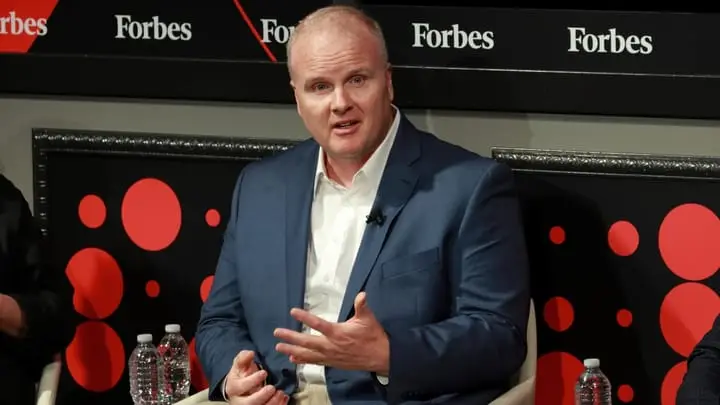
Select Health CIO Brady talks about evolving with AI for efficiency while maintaining human perspective and context to guide the work that agents perform.
NEW YORK — The importance of human responsibility while reaping the benefits of AI was top of mind for Ryan Brady, CIO at Select Health, when he spoke to InformationWeek at the Forbes CIO Summit last week.
Brady shared a story about being in a meeting where he prodded a presenter about a presentation deck, pointing out elements he had questions about. His persistence led to a revelation that AI had been used to develop the deck, and the presenter had not caught the questionable pieces.
"After about five minutes, they said, 'Well, that's Claude's fault,'" Brady said, referring to the AI assistant developed by Anthropic.
Brady was one of the featured speakers at the event, where he championed keeping humans present as AI adoption grows. He also urged his peers and others in the workforce to continue learning the technology rather than push it away.
"If you're not excited about continually progressing, [you’re in the] wrong space if you're in the technology area," he said.
Charles Schwab’s innovation officer says test AI in controlled space
Brady reminded the audience that technology advances have led to reduced reliance on manual skillsets, such as working out math on paper rather than with a smartphone's calculator. He further cautioned that AI alone might not take certain jobs, but people who know how to use AI in that job could.
"There are certain things that I used to do 10 years ago that I would never do now because I don't need to," he said about his work at Select Health, a nonprofit health plan based in Utah.
The way people learn may need to change, Brady said, to reinforce foundational problem-solving and critical thinking skills rather than surrender them entirely to AI.
"Let K-8 education be absolutely no tech whatsoever," he said. It is a spartan notion in a world populated by mobile devices. Brady mused that laptops and AI could be introduced, at least in the classroom, during high school.
In his onstage discussion at the summit, Brady spoke about how Select Health turned to Salesforce to streamline some of its workflows. This included a new platform with AI resources to cut the time needed for provider credentialing — the verification of a healthcare professional's licenses and education — down to six days from six months.
He shared the stage with Mark Wanish, CIO and chief architect at Salesforce Regulated Industries, in a conversation moderated by Forbes Chief Innovation Officer Nina Gould.
To understand how a new credentialing platform could benefit Select Health, Brady conducted an in-person visit to a contact call center. He encouraged IT leaders to set aside the time to do the same to better understand their organization's operations. Call centers are points of contact for the credentialing process at Select Health.
InformationWeek Podcast: Is AI-built software a SaaS killer?
"CIOs, if you haven't sat amongst your people in the call center, do it. Take the time," he said.
Brady said watching those staffers work on dual screens, sometimes with more than a dozen windows open to find information, was a bit of a wake-up call. While the staffers were successfully communicating, the work itself was cumbersome. Brady's desire to streamline their efforts led to partnering with Salesforce and Genesys to introduce a new platform.
Genesys is a software provider for call centers and customer experience teams, with partnerships with Salesforce.
Brady said Select Health's migration from its antiquated software to the new credentialling platform reduced numerous manual steps and made layers of information about doctors, their offices and where they provide services easier to find. He cautioned against letting AI take the wheel for in-house software development instead of turning to outside expertise when sensitive, regulated information and decisions are on the line.
The week of Nov. 9-13: What happened, what matters, what's next
"Vibe coding does not an enterprise platform make.," Brady said. Select Health worked with Salesforce to ensure the new platform was HIPAA-compliant and met other regulatory needs, while also alleviating maintenance tasks from his team.
"I hate the phrase 'human in the loop.' … I love the phrase, 'human in the flow,'" he said, as he described using the technology in tandem with his team. For example, Brady said he used AI to extract action items from pictures taken of whiteboards where the team collaborated on ideas.
Wanish said part of the challenge in deploying AI at Select Health was that the organization's data required context before AI could make heads or tails of it.
He said that at the moment, there is no single all-encompassing platform for how AI is used across business processes, with everything being multimodal, multi-agent and spanning the gamut of operations. That requires humans in the mix to ensure the AI orchestration runs with confidence.
"Agents don't reason. AI doesn't reason off of data. It does off of context," Wanish said. That context helps the model better associate listings under the same doctor's name at three different locations as actually belonging to one doctor. He said agentic operating systems need access to operational knowledge in order to align with business processes.
"That's how you actually start getting the results and not just a lot of very fast intelligence," Wanish said.
Joao-Pierre S. Ruth edits stories for InformationWeek as well as reports on C-suite tech leaders across a multitude of industries and tech disciplines. He also hosts the InformationWeek Podcast, which brings together CIOs, CTOs, and other C-suite leadership to discuss their different approaches to addressing shared challenges. He joined InformationWeek in 2019, initially as a Senior Writer covering cloud computing and DevOps. He became a Senior Editor in 2023.
His work with InformationWeek garnered American Society of Business Publication Editors (ASBE) awards in 2024. This included "Could the DOJ's Antitrust Trial vs Google Drive More Innovation?" as part of the team’s Government Coverage, which collectively won a Bronze National award and a gold Northeast regional award, as well as a bronze regional award for a Web Feature Series on the environmental impact of data-driven organizations published during Earth Month. That award included his story "How Do Supercomputers Fit With Strategies for Sustainability?"
He has been a journalist for more than 25 years, reporting on business and technology first in New Jersey, then covering the New York tech startup community, and later as a freelancer for such outlets as TheStreet, Investopedia, and Street Fight.
Joao-Pierre can be reached via email at [email protected]
Cloud outages, cybersecurity, agentic AI & federal policy
Want more InformationWeek stories in your Google search results?
Copyright © 2026 TechTarget, Inc. d/b/a Informa TechTarget. This website is owned and operated by Informa TechTarget, part of a global network that informs, influences and connects the world’s technology buyers and sellers. All copyright resides with them. Informa PLC’s registered office is 5 Howick Place, London SW1P 1WG. Registered in England and Wales. TechTarget, Inc.’s registered office is 275 Grove St. Newton, MA 02466.